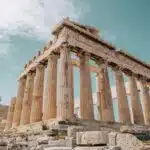
Review of the Acropolis Museum in Athens. The building displays original sculptures, and highlights the political debate over the missing Parthenon marbles.
The controversial modern building
If ever something was on a hiding to nothing, it’s the Acropolis Museum in Athens. It cost €130 million to build, is designed to hold many of Greece’s most important national treasures and was instantly promoted as a tourism flagship.
Naturally, the critics had a field day before it was even opened. Some pointed to the cost, some to the position at the foot of the Acropolis rather than on it, others to the fact that a Swiss architect – Bernard Tschumi – was employed rather than a Greek.
Exterior impressions of the Acropolis Museum
Tschumi, predictably, took most of the flak. His modernistic building hasn’t won universal acclaim. There are none of the Doric columns that grace the Acropolis’ centrepiece, the Parthenon, and a contemporary building by ancient Greece’s key site is always going to be controversial.
It isn’t the Doric columns that the new Acropolis Museum really misses, however – it’s the subtle curves. Tschumi’s museum just looks a little clunky and blocky from the outside – it’s all straight lines, glass and concrete. One suspects that it may date very quickly.

The interior experience
Mercifully, the interior is far more impressive. Tschumi has wisely gone for a minimalist look, allowing the exhibits to do the talking. It’s a light, spacious combo of steel pillars, glass walls and marble.
The sensation of ascending to the Acropolis is recreated by themed collections over different levels. The sloping entrance hall takes visitors through the lower levels of the world’s most famous hill, with artefacts from sanctuaries and temples dedicated to nymphs, heroes and lesser gods.
Why book the Acropolis Museum Tour?
- 🏛 Guided tour through the Acropolis Museum—see thousands of original artifacts discovered on the Acropolis hill
- ⏱ Spend about 1 to 1½ hours inside the museum to explore its rich collections at a comfortable pace
- 📚 Learn from a licensed guide who shares stories behind Parthenon sculptures, Caryatids, and the archaeological digs beneath the museum
- 👥 Small-group format provides a more personal experience and better interaction with the guide
- ⭐ Highly rated by visitors for its educational value, exhibit quality, and immersive storytelling
Acropolis Museum artefacts and displays
The remains – such as a marble table used for funeral sacrifices – are complemented by explanatory panels covering everything from relative popularity of cults to wedding customs. The route through the galleries leads steadily upwards, past dioramas of the Acropolis from different eras.
The museum becomes a highly impressive field of statues, busts and sculptures, all plucked from various temples and sanctuaries that once stood proud. The museum also incorporates great views of the Acropolis, but let’s face it, the Greeks haven’t spent €130 million so that people can look out on something they’ve probably already climbed up.
The Parthenon Gallery
The new Acropolis Museum’s golden crown comes at the top. The Parthenon Gallery, as the name would suggest, is an attempt to simulate what is arguably the greatest work of architecture from the ancient world.
The outer walls are all glass, allowing for 360-degree views of the city, and the whole floor is at a different angle to the rest of the building. It runs precisely parallel to the Parthenon, and the displays are to the exact same dimensions.
5 Athens experiences worth booking
- 🍽️ Taste the flavours of Greece on a food walking tour.
- 🏛️ Learn about the ancient ruins you’re looking at on a Acropolis and Parthenon guided tour.
- ⛵ Island-hop on a luxury sailing cruise.
- 🌊 Pack in the coastal highlights on a Cape Sounion and Temple of Poseidon tour.
- ⛰️ Be stunned by the Meteora monasteries and caves on a guided tour.
Digital recreations and sculptures
In the middle there is a large-screen video presentation explaining the Parthenon’s history and the meaning of the many works of art that adorned it. It uses state-of-the-art graphics to recreate what the building once was before time, fire and trophy hunters had their way.
The real wow factor, however, is generated by the actual sculptures and carvings from the Parthenon themselves. The roof is recreated in the same dimensions, with natural light shining upon it from the same angles. The intricacy of the stonework can be appreciated; friezes depicting scenes from the Battle of Troy, mythical encounters and centaurs fighting lapiths are displayed in order, all cleaned using laser technology.
Missing marbles and international debate
Where the originals are missing – some have been destroyed or are on display in the British Museum in London – plaster replacements are put in their place. Diagrams and explanatory panels tell the stories. The pediments are particularly impressive, with sculptures gradually decreasing in size from the centre to fit the slope of the roof.
They also highlight the museum’s greatest weaknesses and potential achievements. Many major figures are in London, taken by Lord Elgin whilst Athens was under Ottoman rule in the early 19th century. Greece has repeatedly called for the Elgin or Parthenon marbles to be returned.
Why book the Acropolis & Acropolis Museum Morning Walking Tour?
- ⏱ Approximately 3 hours of guided walking including both the Acropolis and the Museum
- 🌄 Small group format ensures personal attention and less crowded experience
- 🏛 Licensed guide provides skip-the-line access and rich historical commentary including mythology, architecture, and archaeology
- 📍 Visit the Temple of Athena Nike, Parthenon, Erechtheion, and then head into the Acropolis Museum to see original artifacts
- 🗺 Meeting point near the Acropolis Museum, with stunning views and convenience for getting there
- ⭐ Highly praised: 4.9/5 from over 100 reviews for guide knowledge, pace, and experience value
Why it matters
The British response has largely been to ignore these requests. But one major reason cited for retention – the lack of a suitable display – is no longer valid. Athens now has the perfect pedestal, and the argument for keeping the marbles looks increasingly feeble. Until reunification is achieved, the Acropolis Museum still ranks among the world’s greatest museums.
Admission costs for the Acropolis Museum
Tickets grant access to all exhibition areas and the archaeological excavation located beneath the museum. It is important to note that the Acropolis Museum ticket is independent from the ticket required to visit the Acropolis archaeological site itself.
| Admission category | Price (EUR) | Notes |
|---|---|---|
| General admission | €20 | Standard price for the summer and winter seasons. |
| Reduced admission | €10 | Available for specific non-EU groups (youth 6–25) and EU senior citizens (over 65). Reduced tickets must be obtained at the ticket desk with proof of eligibility. |
| Free admission | Free | Available for various categories, including EU citizens under 25 and children under 5. Free tickets must be obtained at the ticket desk. |
Opening hours and seasonal variations at the Acropolis Museum
The Acropolis Museum operates on seasonal schedules, with last entry usually 30 minutes before closing. The museum is closed on January 1, Orthodox Easter Sunday, May 1, December 25, and December 26.
- Summer season (April 1 to October 31):
- Monday: 9 am – 5 pm
- Tuesday to Sunday: 9 am – 8 pm
- Friday: 9 am – 10 pm (the second-floor restaurant remains open until midnight)
- Winter season (November 1 to March 31):
- Monday to Thursday: 9 am – 5 pm
- Friday: 9 am – 10 pm
- Saturday and Sunday: 9 am – 8 pm
These Acropolis Museum ticket prices and opening hours were checked and verified in January 2026.
Nearby attractions to the Acropolis Museum
The Acropolis Museum is ideally situated in the historical centre of Athens, making it a convenient starting point for visiting other major ancient sites.
- The Acropolis of Athens: The monument and archaeological site, home to the Parthenon, Erechtheion, and Propylaea, is immediately adjacent to the museum.
- Plaka and Anafiotika: The charming, old historical neighborhoods of Athens, built on the northern slopes of the Acropolis, offering traditional dining and architecture.
- Ancient Agora of Athens: The former political, commercial, and social centre of ancient Athens, which includes the well-preserved Temple of Hephaestus.
- Temple of Olympian Zeus (Olympieion): The monumental ruins of the colossal temple dedicated to the god Zeus.
- Hadrian’s Arch: A Roman triumphal arch located between the Olympieion and the Plaka district.
FAQ: frequently asked questions about the Acropolis Museum
| Question | Answer |
|---|---|
| Is the Acropolis Museum ticket required for the Acropolis site? | No, the tickets for the museum and the Acropolis archaeological site are separate purchases. |
| How long is a visit to the Acropolis Museum recommended to take? | A typical, thorough visit to the museum generally takes between two and three hours. |
| Can visitors access the museum’s second-floor restaurant without a ticket? | While the ground-floor facilities are open access, entry to the second-floor restaurant and shop requires visitors to obtain a free admission ticket at the museum’s ticket desk. |
| Is photography allowed inside the Acropolis Museum? | Photography for personal use is permitted in the permanent exhibitions, but the use of flash and supplementary lighting equipment is strictly prohibited. |
More Athens travel
Other Athens travel stories on Planet Whitley include:
- Athens hotel recommendations.
- A first-time visitor’s guide to the Panathenaic Stadium in Athens.
- How to spend 24 hours in Athens before your cruise.
- A practical guide to the National Garden of Athens.
- Can you visit the Parthenon at night?
You can also choose from a wide range of Athens tours and experiences.