Stargazing tours head behind the scenes at Mount John Observatory in Lake Tekapo, with insights from staff on astronomy research, and what the public doesn’t usually see.
Visiting the Mount John Observatory, summarised
- Lake Tekapo is in New Zealand’s largest dark sky reserve.
- Stargazing tours open up the Mount John Observatory.
- The site was chosen for its stable weather.
- The McLellan Telescope looks at stars billions of light years away.
- The MOA telescope is searching for exo-planets.
To reserve a place on a Lake Tekapo stargazing tour, book here.
For more detail, read on.
The lighting in Lake Tekapo
Down below, the lights from the village of Lake Tekapo shine up towards the heavens. Or, rather more importantly, they don’t. They shine down towards the ground. Special lighting has been installed and covered so that it is focused downwards. In these parts, they want to keep as much human-produced light out of the sky as possible.
The Dark Sky Reserve about Mount John
We’re on Mount John, trying to guide ourselves along the paths and avoid the rabbit holes of the open ground with little red light torches. Normal torches, or mobile phones, would give out a white light that interferes with the instruments of the observatory.
It is not our planet that’s of interest here – it the billions orbiting stars several billion light years away. The skies above Lake Tekapo were recognised as an International Dark Sky Reserve in 2012, and it was the first to be given a gold standard. The name’s something of a misnomer, as it’s the natural brightness of the skies here that make it special. You’d be hard-pushed to find anywhere better on earth from which to stare at the stars.
Why is the observatory at Mount John?
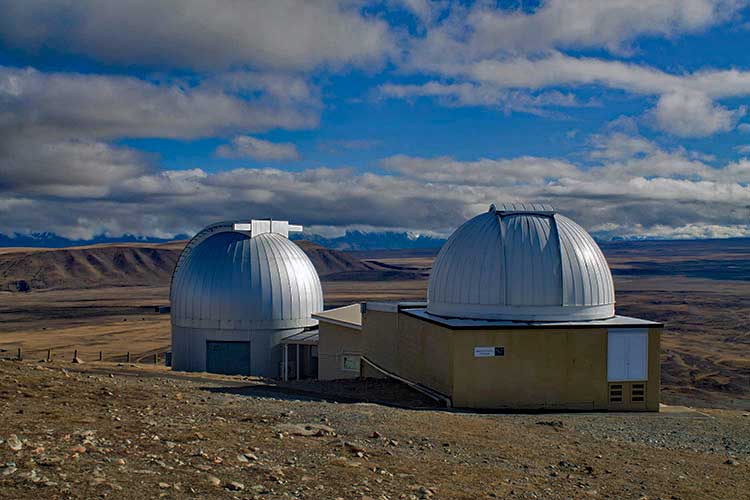
The Mount John Observatory is operated by the University of Canterbury in partnership with the University of Nagoya in Japan. As a sideline to assist with funding, they open the gates at night, allowing tourists to be given a guided tour of the skies above.
The site was partially chosen for its stable weather. The Southern Alps form a handy cloud-catching barrier, and Lake Tekapo to the east benefits from fairly consistently clear skies.
Alas, fairly consistently doesn’t mean permanent. And while a few stars are breaking through the wisps, the stargazing tour has morphed into the back-up option – the behind-the-scenes observatory tour. Which, as it happens, is much more interesting.
The McLellan Telescope
There are some phenomenally large telescopes up on the hill, and the first one we visit looks like some sort of weapon that should be kept under wraps in a Bond villain’s lair. It’s the McLellan telescope and it’s set up to pinpoint something in the sky, then follow it round. A 275kg mirror, made of special ceramics that don’t expand and contract with the temperature, allows for remarkably clear observations of stars billions of light years away. “This is basically time travel,” says one of the guides. “Everything we can see in space is coming from the past.”
Searching for exo-planets
Further up the hill is MOA, an even bigger telescope, and one that has a very specific job to do. It is looking for exo-planets around distant solar systems. It focuses on star-dense sections of the sky, regularly capturing images of them. What they’re looking for is differences in those images. If one of the dots doesn’t follow the usual patterns, it’s a decent indication that there’s a planet there. That information is passed on to researchers elsewhere who can then take a closer look.
It generates a phenomenal amount of data, and the clearest evidence of that is the room next to it where the evidence is analysed. We’ve all had enormous cold weather coats on outside, but everyone’s peeling down to base layers and sweating profusely. There’s a roaring, furnace-like heat in the room, and it’s coming from the cupboard at the side. “That’s not the boiler,” we’re told. “That’s the supercomputer processing all the readings.”
This room, on a remote hill in New Zealand, will probably be the starting point for us discovering life on another planet. It’s probably worth the sweat.
Where is the Mount John Observatory?
The Mount John Observatory is in the Mackenzie region of New Zealand’s South Island. Lake Tekapo is the nearest settlement.
The Observatory is a 235km drive from Christchurch, which takes just over three hours. Alternatively, it’s 110km drive from Mt Cook Village – that drive takes around one hour and 25 minutes.
Lake Tekapo stargazing tours are operated by Dark Sky Project, and need to be booked online in advance.
Other things to do in Lake Tekapo include fishing tours, a lupin flowers tour and a back country 4WD adventure.
Disclosure: There are affiliate links in this article. If you book through them, I earn a small commission.