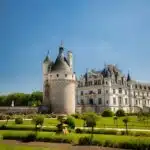
Chambord Castle (the Château de Chambord) is the largest and most majestic château in the Loire Valley, France. Originally constructed as a hunting lodge for King François I, its iconic French Renaissance architecture — heavily inspired by Leonardo da Vinci — is surrounded by Europe’s largest enclosed nature reserve. This guide covers opening hours, ticket prices, transport or parking, accessibility, and practical visitor tips.
To secure entry on your preferred day, book your Chambord Castle tickets online.
This guide was verified and updated in March 2026 to reflect the newly introduced tiered ticket pricing and the low-season Monday closures. Other guides may contain outdated information.
Quick facts about Chambord Castle
| Feature | Details |
| Opening hours | Low season: 9:00 am to 5:00 pm. High season: 9:00 am to 6:00 pm. |
| Ticket prices | Adults (Non-EEA) €31.00, Adults (EEA residents) €21.00. |
| Address | Château de Chambord, 41250 Chambord, France. |
| Nearest public transport | Blois-Chambord train station, connected by seasonal shuttle bus. |
| Typical time needed | 3 to 4 hours. |
Chambord Castle opening hours
Chambord Castle operates on a seasonal schedule. During the high season (late March to late October, plus the Christmas holiday period), the estate is open daily from 9:00 am to 6:00 pm.
During the low season (late October to late March), hours are reduced to 9:00 am to 5:00 pm. The formal gardens close 30 minutes before the château. The site is closed entirely on January 1 and December 25.
Note: As of 2026, the château is experimenting with low-season Monday closures. Outside of French school holidays, the castle is closed on Mondays between mid-November and late March.
Why book tickets for Chambord Castle?
- 🏰 The Largest Loire Valley Château: Marvel at the sheer scale of this French Renaissance masterpiece, featuring 440 rooms, 282 fireplaces, and 77 staircases, originally built as a “hunting lodge” for King Francis I.
- 🌀 Leonardo da Vinci’s Staircase: Experience the genius of the famous double-helix staircase, where two people can ascend and descend at the same time without ever meeting.
- 🏛️ A Roof Like a Skyline: Walk among the forest of chimneys, dormer windows, and towers on the roof terrace, designed to resemble the skyline of a miniature city.
- 🌳 Europe’s Largest Walled Park: Explore the surrounding estate, a nature reserve that is roughly the same size as central Paris and is enclosed by a 32-kilometer-long wall.
- 🎨 The HistoPad Experience: Step back in time with digital 3D reconstructions that show you exactly how the castle’s rooms were furnished and used during the Renaissance era.
Chambord Castle ticket prices
In January 2026, Chambord introduced a new experimental pricing structure based on residency. The standard full-price ticket for international visitors (outside the EEA) is €31.00. Visitors who are nationals or residents of a European Economic Area (EEA) country receive a preferential rate of €21.00 upon presentation of valid ID.
Admission grants access to the château and the French formal gardens. Visitors with disabilities and their accompanying carer are entitled to free admission.
How to get to Chambord Castle
Chambord Castle is located in the Loir-et-Cher department, roughly two hours south of Paris. Drivers can take the A10 motorway and exit at Mer (Exit 16) or Blois (Exit 17), following the signs to the estate.
For visitors using public transport, the closest major train station is Blois-Chambord, which is a 1.5-hour journey from Paris Austerlitz. From the station, a seasonal shuttle bus (Navette Châteaux) operates from spring through autumn, providing direct transport to Chambord and other nearby estates.
Parking at Chambord Castle
The estate offers extensive parking facilities divided into multiple zones. Car Park P0 is located closest to the château (roughly a 600-metre walk) and caters exclusively to standard passenger cars. Car Park P2 is situated slightly further away but accommodates cars, campervans, and motorhomes.
Parking fees are payable at the automated machines located in the car parks before you leave. Parking is free for people with disabilities upon presentation of a valid parking badge at the ticket office.
How long to spend at Chambord Castle
Most visitors spend between three and four hours exploring the estate.
This allows ample time to tour the royal lodgings, climb the famous double-helix staircase, and walk through the restored French formal gardens. Visitors renting bicycles or boats, taking guided nature reserve tours, or attending the Renaissance horse show often extend their visit to a full day.
Accessibility at Chambord Castle
Due to its historic architecture, access to the upper floors of the château is restricted for visitors with severe mobility issues, as there are no elevators to the terraces or upper apartments. However, the ground floor, the audiovisual room, the Café d’Orléans, and the French formal gardens are fully accessible to wheelchair users.
Manual wheelchairs and seat sticks are available to borrow from the reception desk on a first-come, first-served basis. For those who cannot climb the stairs, the HistoPad tablet offers a specialized version with Renaissance reconstructions of the upper floors. Electric carts can also be rented to easily explore the wider parkland, though they are not permitted inside the formal gardens.

Inside / what to see at Chambord Castle
The architectural centerpiece of Chambord is the brilliant double-helix staircase in the central keep, widely attributed to the genius of Leonardo da Vinci. It allows two people to ascend and descend simultaneously without ever crossing paths.
The staircase leads to the royal lodgings, including the apartments of François I and Louis XIV, which are furnished to reflect different eras of the castle’s history. The 18th-century kitchens are also a notable highlight on the lower levels.
At the very top, visitors can access the expansive roof terraces, which offer a close-up view of the château’s spectacular forest of chimneys and lantern towers, alongside panoramic views over the estate.
Outside, the French formal gardens, painstakingly restored in 2017 to their 18th-century glory, occupy six hectares at the foot of the castle. Beyond the manicured lawns lies the 5,440-hectare enclosed forest, where you can rent electric punts to navigate the canal or “rosalies” (pedal cars) to explore the 15-kilometre cycle route.
Practical visitor tips
| Tip category | Practical advice |
| Timing | Arrive before 10:30 am or after 3:30 pm on weekends and holidays to avoid the heaviest crowds. |
| Crowds | Purchase your tickets online in advance to bypass the queues at the main entrance pavilions. |
| Layout | Rent the HistoPad tablet at the entrance; it provides immersive 3D augmented reality views of how the rooms looked during the Renaissance. |
| Entry process | Double-check your ticket for the meeting points if you booked activities (e.g., horse shows meet at the Maréchal de Saxe stables). |
| On-site logistics | Pack a picnic to enjoy on the vast lawns surrounding the castle, or use the shaded tables located near the car parks. |
Frequently asked questions about Chambord Castle
| Query | Answer |
| Is Chambord Castle suitable for children? | Yes, the sheer scale of the castle feels like a fairy tale, and the HistoPad includes a digital treasure hunt specifically designed for children. |
| Do you need to book tickets in advance for Chambord Castle? | While not mandatory, booking online is highly recommended to save time, especially during the peak summer months. |
| Is Chambord Castle open on Sundays? | Yes, the castle is open every Sunday year-round. |
| Are dogs allowed at Chambord Castle? | Dogs are not permitted inside the château or the formal gardens, but they are welcome on a leash in the wider parkland. Service dogs are permitted everywhere. |
Things to do near Chambord Castle
- Château de Cheverny: A beautifully furnished Renaissance château famous for inspiring Captain Haddock’s Marlinspike Hall in The Adventures of Tintin.
- Château de Blois: The royal castle in the centre of nearby Blois, featuring a stunning mix of Gothic, Renaissance, and Classical architecture.
- Maison de la Magie (House of Magic): A unique museum in Blois dedicated to magic and the illusionist Jean Eugène Robert-Houdin.
- Domaine de Chaumont-sur-Loire: A fairy-tale castle renowned for its spectacular annual International Garden Festival.
- Beauval Zoo (ZooParc de Beauval): Located about an hour away, it is widely considered one of the best zoological parks in the world.
More French castles
Other France travel guides on Planet Whitley include:
- French castle guides: Foix Castle near Toulouse and the Chateau de Castelnaud in the Dordogne
- Important visitor information for Chateau de Compiegne and Chateau de Pierrefonds in Hauts-de-France.
- Visitor guides for National Monuments around Paris: The Chateau de Vincennes, the Chateau de Maisons and Villa Savoye..
- Practical guide to visiting the Palais des Papes in Avignon.
- Can you get next-day tickets for Mont-Saint-Michel Abbey in Normandy?