
Château de Gruyères is a historic 13th-century fortress and museum located in the hilltop town of Gruyères, Switzerland. This guide covers opening hours, ticket prices, transport, parking, accessibility, and practical visitor tips. Our comprehensive visitor guide was updated in May 2026 to reflect the latest combined ticket pricing options for the adjacent Maison du Gruyère and HR Giger Museum.
Quick facts
| Feature | Details |
| Opening hours | Summer (April to October): 09:00 to 18:00. Winter (November to March): 10:00 to 17:00. |
| Ticket prices | Adults: CHF 13. Seniors and students: CHF 9. Children (6 to 15): CHF 5. |
| Address | Rue du Château 8, 1663 Gruyères, Switzerland. |
| Nearest public transport or parking | Gruyères railway station. Public car parks P1, P2, and P3. |
| Typical time needed to visit | One hour for the main interior, plus 20 minutes for the seasonal gardens. |
Château de Gruyères opening hours
The castle is open to the public every day of the year, which includes Christmas Day and New Year’s Day. During the summer season from April to October, the main gates open at 09:00 and close at 18:00. The winter season operates from November to March with slightly reduced hours from 10:00 until 17:00.
The final admission time is strictly 45 minutes before the castle closes. Staff recommend arriving at least a full hour before the closing time to ensure you can complete the designated circuit. The historic gardens are only accessible from Easter until October and close at 17:30 daily.
Château de Gruyères ticket prices
Standard adult admission costs CHF 13, while seniors and university students pay a reduced rate of CHF 9. Children between six and fifteen years old cost CHF 5, and any children under six years old enter for free. Families consisting of two adults and up to three children can purchase a flat-rate family ticket for CHF 29.
Opening hours and ticket prices were checked on the official website and last updated in May 2026.
Entry is completely free if you hold a Swiss Travel Pass or a Swiss Museum Pass. These national tourist passes also grant admission to hundreds of other attractions across Switzerland, including Chillon Castle, the Matterhorn Museum, the Swiss National Museum, and the Olympic Museum. If you do not have a pass, you can buy combined tickets on-site that include entry to La Maison du Gruyère for CHF 17, or the HR Giger Museum for CHF 20.
How to get to Château de Gruyères
The most efficient method to reach the site using public transport is taking the train to the Gruyères railway station. Regional trains operate regularly on the line connecting the nearby town of Bulle to Montbovon. Travellers arriving from major Swiss cities like Geneva or Bern will typically need to transfer at the Fribourg or Romont stations.
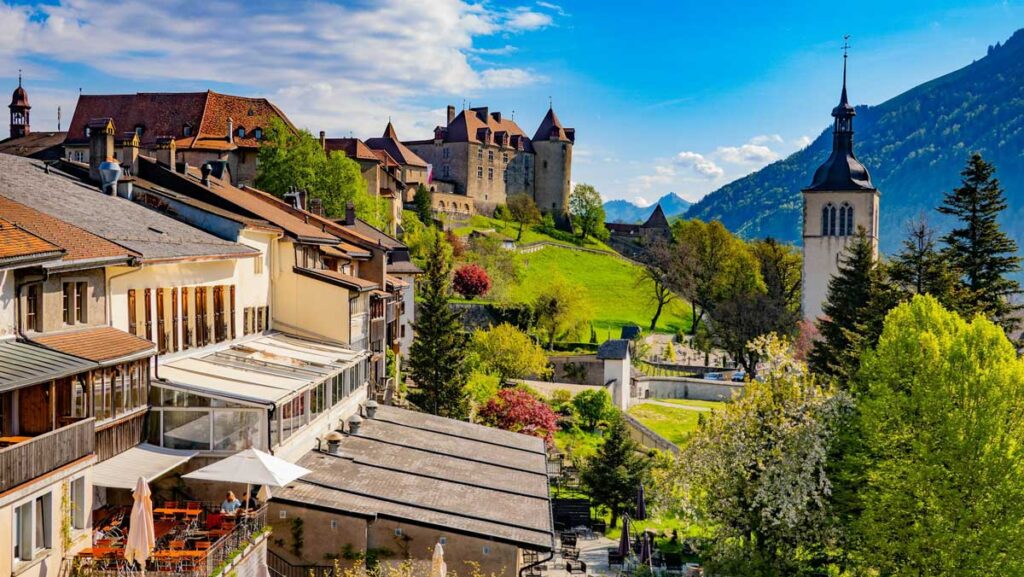
From the local train station, visitors face a 10 to 15-minute uphill walk to the medieval town centre. If you are travelling by car, you must navigate to the town of Gruyères, but you cannot drive directly up to the castle. The medieval town is pedestrianised and strictly closed to all unauthorised vehicle traffic.
Parking at Château de Gruyères
Because the medieval town is car-free, visitors must park their vehicles in one of the three designated public car parks at the bottom of the hill. These parking areas, clearly marked as P1, P2, and P3, are managed by the local municipality. You must pay a parking fee using the on-site machines, which accept coins, cards, and digital parking applications.
After parking your vehicle, allow for a 10 to 20-minute walk up a steep, cobbled path to reach the main castle entrance. There is no public shuttle bus service connecting the lower parking lots directly to the fortress gates.
How long to spend at Château de Gruyères
Visitors typically require one hour to complete the standard self-guided tour of the main castle interior and the temporary exhibitions. The internal exhibition route follows a sequential, one-way path through the various historical rooms and defensive structures.
If you visit between Easter and October, you should allocate an extra 20 minutes to explore the formal French-style gardens. Beyond the fortress walls, most visitors plan three to four hours for the entire trip to accommodate the uphill walk, viewing the medieval village architecture, and dining.
Accessibility at Château de Gruyères
As a protected 13th-century historical monument, Château de Gruyères presents significant architectural barriers for wheelchair users and individuals with limited mobility. The primary approach from the public car parks involves a steep incline paved with rough, uneven cobblestones.
Inside the fortress, visitors must navigate multiple stone staircases to move between the different floors and historical exhibits. There are no elevators or ramps installed within the medieval structure, making step-free access impossible for the interior rooms and the elevated defensive ramparts.
Inside / what to see at Château de Gruyères
The interior of the fortress contains multiple historical rooms that document the eight centuries of the property’s existence. Visitors walk through a designated route that begins in the ground-floor kitchens and moves up into the primary living quarters.
A major historical highlight is the Burgundy Room, which displays three authentic capes belonging to the Order of the Golden Fleece. These garments were captured by the Swiss Confederates during the Battle of Morat in 1476. The room also houses other regional military artifacts from the medieval period.
The Knights’ Hall features large 19th-century wall paintings created by Swiss artists including Jean-Baptiste Camille Corot and Barthélemy Menn. These historical frescoes were commissioned by the Bovy family, who purchased and restored the property in the mid-19th century.
Visitors also walk through the Corot Room, the Count’s Bedroom, and the Guard Room, which retain period-appropriate furniture, intricate woodwork, and historical tapestries. The museum uses these restored salons to demonstrate the transition of the property from a defensive military stronghold to a private residence.
Outside the main structure, the raised defensive ramparts provide unobstructed vantage points over the surrounding Alpine foothills and the Fribourg Prealps. During the summer months, visitors can look down into the enclosed French garden, which features manicured hedges and seasonal flower displays.
Practical visitor tips
| Tip category | Advice |
| Timing | Arrive at the gates right when they open at 09:00 to complete your tour before the large coach groups arrive. |
| Crowds | The summer season and weekends are very busy, so schedule your visit for a weekday in May or September. |
| Layout | Download the official Château de Gruyères + application on your smartphone to access the free audio guide. |
| Entry process | You can purchase your admission tickets directly at the entrance desk, as online advance booking is not required. |
| On-site logistics | Carry a credit card or exact Swiss francs, as the ticket desk will only accept euro banknotes and gives change in local currency. |
Frequently asked questions about Château de Gruyères
| Question | Answer |
| Is Château de Gruyères suitable for children? | Yes, children are permitted and enter for free if they are under six, but pushchairs cannot navigate the internal stairs. |
| Do you need to book tickets in advance for Château de Gruyères? | No, visitors do not need to secure tickets online prior to their trip, as they are sold at the entrance desk daily. |
| Is Château de Gruyères open on Sundays? | Yes, the site operates every day of the year, which includes all Sundays and major public holidays like Christmas Day. |
| Are bags allowed at Château de Gruyères? | Standard day bags and small rucksacks are permitted inside, but large luggage must be left outside the historic museum rooms. |
| Are dogs allowed inside Château de Gruyères? | No, pets are strictly prohibited from entering the interior museum rooms and the formal gardens, except for registered assistance dogs. |
Things to do near Château de Gruyères
- HR Giger Museum: A gallery located opposite the castle displaying the biomechanical artwork of the Swiss artist who designed the creature in the Alien franchise.
- Tibet Museum: A quiet exhibition space housed in a former chapel in Gruyères, featuring a large collection of historical Buddhist sculptures and ritual items.
- La Maison du Gruyère: A working dairy and visitor centre near the train station where you can observe the production of the region’s famous cheese.
- Maison Cailler: A functional chocolate factory located in the neighbouring village of Broc that provides interactive guided tours and a tasting room.
- Les Bains de la Gruyère: A public thermal bath facility situated in Charmey that features heated indoor and outdoor mineral pools.
What to visit tomorrow
- Chillon Castle (Château de Chillon): A large medieval island fortress located on the eastern shore of Lake Geneva just south of Montreux.
- Aigle Castle (Château d’Aigle): A 12th-century fortress situated in the Rhone Valley that contains the regional Museum of Vine and Wine.
- Grandson Castle (Château de Grandson): A substantial lakeside fortress near Neuchâtel that houses extensive collections of historical weapons and armour.
- Thun Castle (Schloss Thun): A 12th-century defensive structure featuring a prominent corner-towered keep, situated above the city of Thun.
- Oberhofen Castle (Schloss Oberhofen): A historic waterside keep featuring a distinct turret extending directly into the waters of Lake Thun.
