The Elephanta Caves are a UNESCO World Heritage Site consisting of rock-cut cave temples carved into basalt on Elephanta Island (Gharapuri). The site is approximately 10 kilometres east of the Gateway of India in Mumbai Harbour, Maharashtra, India. Managed by the Archaeological Survey of India (ASI), the caves are accessible only by ferry and are best known for their monumental Shaivite sculptures, including the iconic three-faced Trimurti. This guide covers opening hours, ticket prices, ferry timings, accessibility, and practical visitor tips.
Last updated: May 2026. The last ferry to Elephanta Island departs the Gateway of India at 2:00 PM. Many guides — and a number of visitors — assume boats run throughout the day. Arriving at the Gateway of India after 2:00 PM means you cannot reach the island that day. Plan accordingly.
Quick facts
| Detail | Information |
|---|---|
| Cave opening hours | 9:30 AM – 5:30 PM, Tuesday to Sunday |
| Closed | Every Monday and national public holidays |
| ASI cave entry — Indians / SAARC / BIMSTEC | ₹40 per person |
| ASI cave entry — all other foreign nationals | ₹600 per person |
| Village entry fee (all visitors) | ₹10 per person |
| Children under 15 | Free entry to caves |
| Ferry from Gateway of India — first departure | 9:00 AM |
| Ferry from Gateway of India — last departure | 2:00 PM |
| Last return ferry from Elephanta Island | 5:30 PM |
| Ferry ticket (return) — Indians approx. | ₹160–₹200 |
| Ferry ticket (return) — foreign nationals approx. | ₹200–₹260 |
| Departure point | Gateway of India, Colaba, Mumbai 400 001 |
| Typical total visit duration | 4–5 hours (including ferry each way) |
Elephanta Caves opening hours
The caves are open Tuesday to Sunday, 9:30 AM to 5:30 PM. They are closed every Monday and on national public holidays. The ferry schedule effectively controls the usable visiting window: as the last ferry to the island departs at 2:00 PM, visitors must be at the Gateway of India jetty with their ferry ticket before that time. Visitors who arrive on the island by 2:00 PM have until the last return ferry at 5:30 PM to explore.
The caves are open year-round on open days, but ferry services are frequently disrupted or suspended during the monsoon season (June to September) due to rough seas. Before visiting between June and September, check ferry operating status at the MTDC (Maharashtra Tourism Development Corporation) counter at Gateway of India on the day of travel.
Elephanta Caves ticket prices
There are three separate charges for a visit to Elephanta Caves: the ferry ticket, the ASI cave entry fee, and a small village entry fee.
ASI cave entry fee (paid at the island entrance):
| Visitor category | Fee |
|---|---|
| Indian nationals and citizens of SAARC / BIMSTEC countries | ₹40 per person |
| All other foreign nationals | ₹600 per person |
| Children under 15 | Free |
| Video camera | ₹25 |
| Still photography / mobile cameras | Free |
Village entry fee: ₹10 per person, payable to the local village authority separately from the ASI fee.
Ferry tickets (purchased at the Gateway of India jetty ticket counter, MTDC):
| Ferry type | Approximate return fare |
|---|---|
| Economy (bench seating) | ₹160 per person |
| Deluxe (plastic chairs) | ₹200 per person |
| Upper deck supplement (inside ferry) | ₹10 per person |
| Child (approximate) | ₹100–₹150 per person |
Ferry tickets should be purchased on arrival at the Gateway of India before boarding. Carry cash — card payment facilities may not be available at all counters on the island or at the jetty.
Ticket prices were checked against multiple confirmed 2025–2026 sources and last updated in May 2026. ASI fees are set by the Government of India and may be revised; verify at asi.nic.in before visiting.
How to get to the Elephanta Caves
The only way to reach Elephanta Island is by ferry. Ferries depart from the Gateway of India jetty in Colaba, South Mumbai. There is no road or rail link to the island.
By ferry: Ferries run from the Gateway of India from 9:00 AM, with departures approximately every 30 minutes. The last ferry to the island leaves at 2:00 PM. The crossing takes approximately one hour each way. The last return ferry from the island departs at 5:30 PM. Buy your return ticket at the Gateway of India counter before boarding — the return portion is valid on any return sailing before 5:30 PM.
Getting to the Gateway of India:
- By train: The nearest stations are Chhatrapati Shivaji Maharaj Terminus (CST) and Churchgate (Western Railway). Both are approximately 2 km from the Gateway of India; take a taxi or auto-rickshaw from either station (note: auto-rickshaws do not operate in South Mumbai — use taxis or app cabs).
- By taxi or app cab: The Gateway of India is well-served by taxis and Ola/Uber from across Mumbai. Allow extra time for traffic, particularly in the morning.
- By bus: BEST bus routes serve Colaba; the Gateway of India stop is on Apollo Bunder road.
From the jetty to the caves: On arriving at Elephanta Island jetty, visitors face a walk of approximately 15 minutes (or 120 steps) to reach the cave complex entrance. A toy train (₹10–₹20 per person) runs from the jetty along the market path and reduces the uphill portion of the walk. Small stalls selling food, water, and souvenirs line the path to the entrance.
Parking at the Elephanta Caves
There is no parking at Elephanta Island — the island is car-free and accessible only by ferry. Visitors driving to the Gateway of India area will find paid public parking in the vicinity of Colaba. Parking near the Gateway is limited, particularly on weekends and public holidays; arriving by taxi or public transport is the more practical option.
How long to spend at the Elephanta Caves
Allow 4 to 5 hours in total, including the one-hour ferry each way. Time on the island itself — exploring all seven caves, the on-site museum, and Cannon Hill — typically takes 1.5 to 2.5 hours depending on the depth of exploration. Visitors with a specific interest in sculpture or iconography may prefer to allow the full 3 hours on the island.
Accessibility at the Elephanta Caves
The Elephanta Caves are not wheelchair accessible. Reaching the cave complex from the jetty involves 120 steps (or the toy train for the first section, followed by additional steps). The cave interiors involve uneven basalt floors, low thresholds, and dim lighting. There are no lifts or ramps within the cave complex. The terrain of the island is hilly and unpaved in sections.
The staircase from the jetty involves approximately 120 steps rising to the cave entrance level. The toy train reduces but does not eliminate the climb. Elderly visitors and those with limited mobility should assess the climb carefully. Only 40 people at a time are permitted inside the painted cave sections (the caves containing surviving wall paintings), which can create short queues.
Flash photography is not permitted inside the cave interiors as a conservation measure.
Inside the Elephanta Caves: what to see
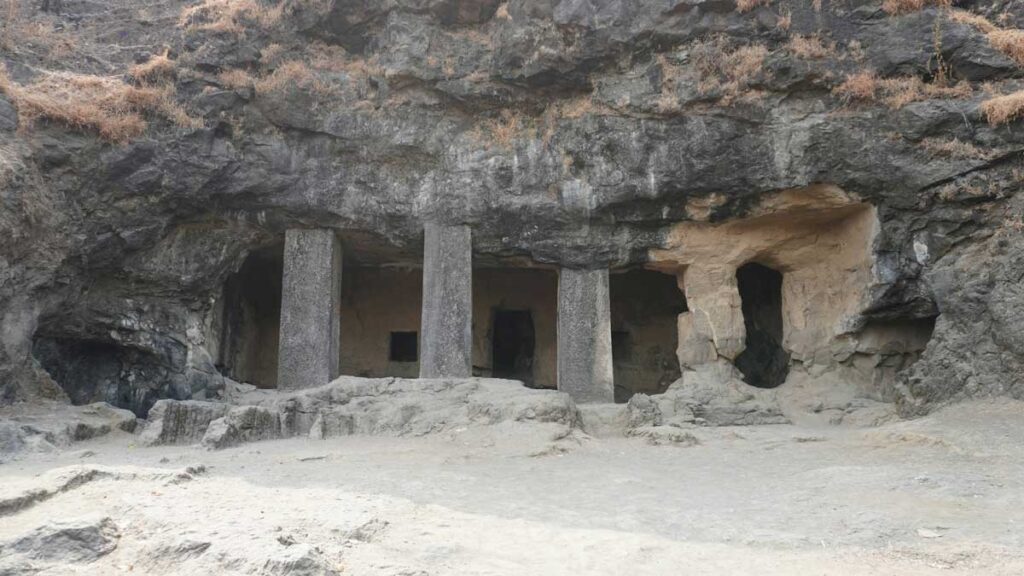
The complex comprises seven caves spread across two hills. The western hill (accessible from the main jetty) contains five Hindu caves; the eastern hill (a separate, longer walk) contains two Buddhist caves with associated water tanks. Most visitors concentrate on the western hill, where Cave 1 is located.
Cave 1 — the Great Cave (Shiva Cave): The largest and best-preserved cave and the centrepiece of the entire complex. A pillared hall approximately 39 metres wide and 39 metres deep, with a central lingam shrine at the rear. The walls bear a series of monumental sculptural panels, each depicting a different form or episode of Shiva. The main panels include:
- Trimurti (Maheshmurti): The defining work of Elephanta. A three-faced bust of Shiva carved approximately 6 metres (20 feet) high from the living rock, depicting Shiva as creator (Brahma), preserver (Vishnu), and destroyer (Mahesh). The central face — serene and monumental — is considered one of the greatest achievements of Indian sculpture.
- Nataraja: Shiva as the Lord of the Cosmic Dance, shown in a dynamic multi-armed pose.
- Ardhanarishvara: Shiva as the half-male, half-female composite form, combining his attributes with those of Parvati on a single figure. Unusually, the lower portions of this panel are largely undamaged.
- Shiva and Parvati on Mount Kailasa (Kalyanasundara): Shiva and Parvati at their divine wedding ceremony.
- Gangadhara: Shiva receiving the descent of the River Ganges through his matted hair.
- Ravana lifting Kailasa: The demon king Ravana attempting to uproot Mount Kailasa, with the assembled gods above trembling.
The north and south entrances of Cave 1 are each flanked by pairs of large dvarapalas (guardian figures).
Caves 2–5 (western hill): Smaller caves in varying states of preservation. Cave 2 has four pillars and two small cells; Cave 3 has a pillared mandapa with inner chambers; Cave 4 is largely ruinous; Cave 5 retains some carved panels but is partially collapsed. These caves were more heavily damaged during the period of Portuguese occupation in the 16th–17th centuries.
Cannon Hill: A short walk above Cave 1, Cannon Hill is a hilltop fortification point with cannon remnants and panoramic views across Mumbai Harbour to the city skyline. The views of the Gateway of India area from this vantage point are among the finest from any publicly accessible site around Mumbai.
Eastern hill (Buddhist caves): A longer walk from the main cave area, the two Buddhist caves are less visited and largely unadorned. They contain evidence of early Hinayana Buddhist occupation (approximately 2nd century BCE) predating the Hindu caves. Water cisterns carved nearby served the early monastic community.
On-site museum: A small ASI museum near the cave entrance displays sculptural fragments, pottery, and contextual exhibits. No separate ticket is required.
Practical visitor tips
| Tip | Detail |
|---|---|
| Arrive at the Gateway of India before 11:00 AM | The last ferry to the island leaves at 2:00 PM. Queues for ferry tickets and boarding grow significantly from 10:30 AM onwards on weekends. An early departure gives more time on the island and avoids the midday heat. |
| Carry cash in small denominations | Card payment is not reliable at the ferry ticket counter, at the island ASI ticket office, or at food stalls. Bring sufficient rupees for the ferry, village fee, cave entry, toy train, and food. |
| Beware of the island’s resident monkeys | Rhesus macaques are present throughout the path from the jetty to the caves and around the cave entrances. Do not eat food near them and keep bags closed. They have been known to snatch food and loose objects. |
| Check ferry status on monsoon days | During June to September, rough sea conditions can result in ferries being cancelled at short notice, sometimes after visitors have already arrived at the Gateway of India. Check the MTDC counter for that morning’s operational status before buying a ticket. |
| Flash photography is prohibited inside the caves | ASI rules prohibit flash photography inside the cave interiors as a conservation measure. Still photography without flash is free; video cameras require a ₹25 permit, also available at the ticket counter. |
Frequently asked questions about the Elephanta Caves
| Question | Answer |
|---|---|
| Are the Elephanta Caves open on Mondays? | No. The caves are closed every Monday and on national public holidays. They are open Tuesday to Sunday, 9:30 AM to 5:30 PM. |
| What time is the last ferry to the Elephanta Island? | The last ferry from the Gateway of India to Elephanta Island departs at 2:00 PM. Visitors must be at the jetty with their ticket before this time. The last return ferry from the island departs at 5:30 PM. |
| Is the America the Beautiful Pass or any city pass valid at the Elephanta Caves? | No. The caves are an ASI site under the Government of India. No international city pass or tourist card covers the entry fee. Admission must be paid separately at the island ticket counter. |
| Are the Elephanta Caves suitable for children? | Yes, with planning. Children under 15 enter the caves free. The ferry ride takes approximately one hour; be prepared for rough sea conditions. The 120-step climb from the jetty can be reduced with the toy train, though steps remain beyond the train terminus. |
| Is an on-site guide recommended? | Yes. The sculptural panels in Cave 1 are complex in their iconography. Licensed guides are available near the cave entrance on the island; agree on the language, duration, and fee before starting. Guided tour packages including the ferry are also bookable through MTDC and private tour operators. |
Things to do near Elephanta Caves
All five attractions below are accessible from the Gateway of India area without returning to Elephanta Island, and are practical stops on the same day.
- Gateway of India (~0 km — ferry departure point): The 1924 basalt triumphal arch built to commemorate the visit of King George V and Queen Mary, and Mumbai’s most recognisable landmark. Freely accessible; the surrounding Apollo Bunder esplanade is a busy viewing area at any time of day.
- Chhatrapati Shivaji Maharaj Vastu Sangrahalaya, Colaba (~1.5 km): Mumbai’s principal museum, housed in a 1923 Indo-Saracenic building, with collections of sculpture, decorative arts, natural history, and miniature paintings. The museum holds important sculptures from across Maharashtra including Elephanta-period material.
- Dr Bhau Daji Lad Museum, Byculla (~9 km from Colaba): Mumbai’s oldest museum, restored in 2008, with collections of city history, decorative arts, and — importantly — the original stone elephant sculpture removed from Elephanta Island by the Portuguese, which now stands in the museum garden.
- Colaba Causeway Market (~1 km): A long street market in Colaba selling textiles, jewellery, antiques, and handicrafts. Primarily a shopping area; useful for souvenirs and browsing after returning from the island.
- Mani Bhavan Gandhi Museum, Gamdevi (~8 km): The house in which Mahatma Gandhi stayed on his visits to Mumbai between 1917 and 1934, now a museum with period rooms, correspondence, and a reference library. A historically significant and relatively quiet counterpoint to the morning’s cave visit.
What to visit tomorrow: other rock-cut cave sites within two hours of Mumbai
- Kanheri Caves, Borivali (~40 km north, ~1 hour by road): A large complex of over 100 Buddhist rock-cut caves within the Sanjay Gandhi National Park, carved between the 1st century BCE and the 10th century CE. The largest Buddhist cave monastery complex in the Mumbai region. An ASI-managed site with a separate entry fee; the park also charges a vehicle entry fee.
- Karla Caves, Lonavala (~100 km southeast, ~2 hours by road): A major Hinayana Buddhist cave complex featuring one of the best-preserved ancient chaitya halls (prayer halls) in India, with a large carved facade and intact wooden ribbing on the ceiling. Combined well with nearby Bhaja Caves.
- Bhaja Caves, Lonavala (~100 km southeast, ~2 hours by road): An early Buddhist cave site (2nd century BCE) with a chaitya hall, viharas (monastic cells), and unusually well-preserved bas-relief sculptures in the verandah of the main cave. Located approximately 3 km from Karla Caves.
- Pandav Leni (Nashik Caves), Nashik (~180 km northeast, ~3–3.5 hours by road): A group of 24 Hinayana Buddhist caves carved between the 1st century BCE and the 6th century CE into a hillside above Nashik. The caves contain carved inscriptions, donated by merchants and local rulers. Note: slightly over two hours from central Mumbai depending on route.
- Kondana Caves, Rajmachi (~80 km southeast, ~2 hours by road): A small and rarely visited group of 16 Buddhist rock-cut caves near the Rajmachi Fort, dating to approximately the 1st century BCE. More challenging to access than Karla or Bhaja but significantly quieter.