Exeter Cathedral is a medieval gothic church and historic site located on Cathedral Green in the centre of Exeter. This guide covers opening hours, ticket prices, transport or parking, accessibility, and practical visitor tips. This guide was updated in May 2026 to reflect current entry policies, noting the updated £12.50 adult admission price which now includes access to the new Treasures Exhibition space.
Quick facts
| Opening hours | Monday to Saturday 9am to 5pm, Sunday 11.30am to 4pm. |
| Ticket prices | Adults £12.50, Seniors and Students £10.50, Children under 18 free. |
| Address | Cathedral Green, Exeter EX1 1HS. |
| Nearest public transport | Exeter Central train station and Exeter bus station. |
| Typical time needed | One to two hours. |
Exeter Cathedral opening hours
Exeter Cathedral opens to sightseers from 9am to 5pm from Monday to Saturday, and from 11.30am to 4pm on Sundays. These year-round times apply to general visiting, though certain areas like the Treasures Exhibition operate shorter hours and close completely on Wednesdays and Sundays.
You should check the official calendar before your trip, because the building occasionally closes to tourists for religious services, graduations, or civic events. While the main floor remains open year-round, special guided roof tours run on a seasonal schedule and are heavily dependent on safe weather conditions.
Exeter Cathedral ticket prices
Standard admission to Exeter Cathedral costs £12.50 for adults, £10.50 for seniors and students, and is free for children under 18 visiting with a family group. Your entry ticket includes access to the ground floor, the Treasures Exhibition, and a complimentary audio guide or introductory floor tour.
Opening hours and ticket prices were checked on the official website and last updated in May 2026.
How to get to Exeter Cathedral
The most efficient way to reach Exeter Cathedral is to walk from the city centre, as the building sits just five minutes away from Exeter Central train station. Visitors arriving by bus or coach can use the main city bus station on Paris Street, which requires a ten-minute walk through the shopping district.
If you are driving into the city, using one of the three park and ride services located at Honiton Road, Sowton, or Matford is highly recommended. These services keep you out of the congested medieval street system and drop you directly in the central pedestrian zones.
Parking at Exeter Cathedral
There is no dedicated visitor parking at Exeter Cathedral, as the surrounding Cathedral Green is a pedestrianised conservation zone. Visitors travelling by car should use nearby public facilities such as the Guildhall Car Park, the Mary Arches Street Car Park, or the Cathedral and Quay Car Park.
Blue Badge holders will find one dedicated disabled parking bay located on Palace Gate at the rear of this English cathedral. Because this single bay operates on a strict first-come, first-served basis, disabled drivers should consider using central city car parks or designated on-street accessible spaces nearby.
How long to spend at Exeter Cathedral
Most tourists spend between one and two hours at Exeter Cathedral to view the main nave, examine the astronomical clock, and walk through the side chapels. This timeframe allows you to comfortably read the plaques and spend around 30 minutes inside the first-floor Treasures Exhibition.
If you book a specialist guided roof tour or a behind-the-scenes library tour, you will need to add at least 90 minutes to your itinerary. Visitors who wish to use the on-site café or attend a choral evensong service should also budget additional time.
Accessibility at Exeter Cathedral
Exeter Cathedral provides level, step-free access throughout the vast majority of the ground floor, making the nave and quire easily navigable for wheelchair users. The on-site accessible toilets are gender-neutral and can be reached without encountering stairs via the Cloister Gallery.
The Treasures Exhibition sits on the first floor, but visitors can request to use a dedicated lift instead of climbing the 30-step staircase. Due to the historic architecture, the special roof tours involve over 150 steep steps and are completely inaccessible to anyone unable to walk unaided.
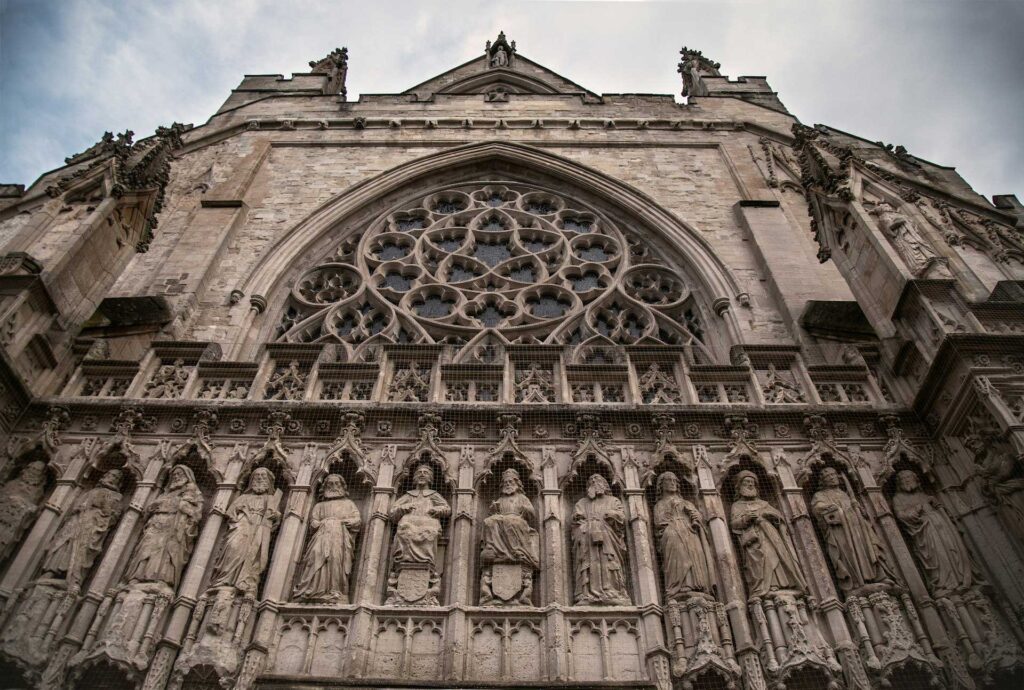
Inside / what to see at Exeter Cathedral
The nave features a continuous medieval vaulted ceiling, constructed entirely from local stone during the 14th century. The roof relies on large, multi-ribbed pillars and features carved ceiling bosses depicting religious scenes, animals, and historical figures.
The 15th-century astronomical clock sits in the north transept and displays the hour of the day, the lunar month, and the phases of the moon. It is believed that this timepiece inspired the nursery rhyme ‘Hickory Dickory Dock’, due to a small hole carved to let the bishop’s cat catch mice.
The quire contains a set of 50 wooden misericords dating from the 13th century, which rank among the oldest surviving sets in the United Kingdom. These carved wooden ledges provided resting support for monks during long periods of standing and feature detailed carvings of mythical beasts and daily life.
The Treasures Exhibition is a dedicated museum space located in the Pearson Building that displays over 1,000 years of regional history. The centrepiece of this collection is the 10th-century Exeter Book, which is officially recognised as the oldest surviving book of English literature in the world.
The Minstrels’ Gallery sits high on the north wall of the nave and features 14 carved angels playing medieval musical instruments. This elevated balcony was originally designed to accommodate live musicians during major services and royal visits.
Practical visitor tips
| Tip category | Advice |
| Timing | Arrive right at 9am on a weekday to explore the nave before guided tour groups and school trips arrive. |
| Crowds | The Treasures Exhibition space is small, so view this section first to avoid bottlenecks later in the day. |
| Layout | Look up constantly while walking down the main aisle, as the ceiling bosses are the most prominent architectural feature. |
| Entry process | Proceed directly to the main welcome desk inside the entrance doors to pay your admission fee and collect a free audio guide. |
| On-site logistics | The on-site café operates between 10am and 4pm, offering light lunches and drinks without requiring a cathedral entry ticket. |
Frequently asked questions about Exeter Cathedral
| Question | Answer |
| Is Exeter Cathedral suitable for children? | Yes, the cathedral provides free children’s activity trails and brass rubbing stations upon request at the welcome desk. |
| Do you need to book tickets in advance for Exeter Cathedral? | No, standard admission tickets can be purchased at the door, but specialist roof tours must be booked online in advance. |
| Is Exeter Cathedral open on Sundays? | Yes, but sightseeing access is limited to 11.30am to 4pm to accommodate morning religious services. |
| Are bags allowed at Exeter Cathedral? | Yes, visitors can bring standard day bags, but large luggage should be avoided as there are no storage lockers on site. |
| Are dogs allowed inside Exeter Cathedral? | No, general pet dogs are not permitted inside the building, but registered assistance dogs are fully welcome. |
Things to do near Exeter Cathedral
- Royal Albert Memorial Museum: A city museum featuring galleries covering global antiquities, local history, and natural sciences.
- Exeter Underground Passages: A network of medieval subterranean tunnels originally built to route fresh water beneath the city centre.
- Exeter Historic Quayside: A riverside area featuring converted historic warehouses, independent shops, and waterside pubs.
- Exeter Guildhall: An active civic building dating back to the 12th century, featuring a stone portico spanning the High Street.
- Rougemont Castle: The ruined remains of an early Norman castle set within public gardens in the city centre.
What to visit tomorrow
- Wells Cathedral: A Gothic cathedral known for its medieval scissor arches, located approximately 90 minutes northeast of Exeter.
- Salisbury Cathedral: An early English Gothic church featuring a 123-metre spire, located two hours east of Exeter.
- Truro Cathedral: A neo-Gothic cathedral built during the late 19th century, located an hour and 45 minutes west in Cornwall.
- Gloucester Cathedral: A medieval building known for its fan-vaulted cloisters, located roughly two hours north of Exeter.
- Bristol Cathedral: A large historic church notable for its hall choir design, situated roughly 90 minutes northeast of Exeter.
More South-West England travel
Other South-West England travel articles on Planet Whitley include:
- Visiting Berry Pomeroy Castle in Devon – England’s most haunted castle.
- Practical guide to visiting Totnes Castle in Devon.
- How to see the Whitelady Waterfall in Lydford Gorge.
- Plan your visit to Kents Cavern in Torquay.
- A first-timer’s guide to visiting Portland Castle in Dorset.