
Framlingham Castle is a 12th-century medieval fortress in the market town of Framlingham, Suffolk, managed by English Heritage. This guide covers 2026 opening hours, ticket prices, transport and parking, accessibility, and practical visitor tips for planning your visit.
This guide was last updated in March 2026 to reflect the 2026/27 admission prices, which came into effect on 28 March 2026. Other guides may still show previous-season pricing. Note also that between 22 February and 16 March 2027, the castle opens Wednesday to Sunday — not Saturday and Sunday only, as at some comparable English Heritage sites during late winter.
Quick facts
| Detail | Information |
|---|---|
| Address | Castle Street, Framlingham, Suffolk IP13 9BP |
| Opening hours | Daily 10am–5pm (summer); reduced days in winter (see below) |
| Adult ticket | £12.32–£15.38 depending on date and day |
| Nearest train station | Wickham Market (6.5 miles); Saxmundham (7 miles) |
| Parking | On-site car park; £3 flat fee for non-members; free for English Heritage members |
| Time needed | 1.5–2.5 hours |
Framlingham Castle opening hours
Framlingham Castle is open daily during the summer season but operates on reduced days during winter. Note that the Christmas period includes a short daily-opening window (27 December to 1 January), and the late-winter schedule (22 February to 16 March) includes Wednesdays — broader than some comparable English Heritage sites. The full schedule for the 2026/27 season (valid 28 March 2026 to 16 March 2027) is:
- 28 March – 24 October: daily, 10am–5pm
- 25 October – 1 November: daily, 10am–4pm
- 2 November – 23 December: Saturday and Sunday only, 10am–4pm
- 24–26 December: closed
- 27 December – 1 January: daily, 10am–4pm
- 2 January – 12 February: Saturday and Sunday only, 10am–4pm
- 13–21 February: daily, 10am–4pm (February half-term)
- 22 February – 16 March: Wednesday to Sunday, 10am–4pm
Last admission is 30 minutes before closing. Opening hours were checked on the official English Heritage website and last updated in March 2026.
Framlingham Castle ticket prices
Admission prices vary by date and day of the week. The three pricing tiers for the 2026/27 season are shown below. English Heritage members enter free of charge. Concession prices apply to visitors aged 65 and over, students with a valid student ID card, and jobseekers showing relevant ID. A free audio guide is included in the ticket price for all paying visitors.
Super Saver — Mon–Fri, 28 Mar–22 May & 1 Sep–1 Nov; daily, 2 Nov–16 Mar
| Visitor | Price |
|---|---|
| Adult | £12.32 |
| Concession | £11.56 |
| Child | £6.12 |
Saver — Sat–Sun & bank holidays, 28 Mar–22 May & 1 Sep–1 Nov; Mon–Fri, 23 May–31 Aug
| Visitor | Price |
|---|---|
| Adult | £13.85 |
| Concession | £13.09 |
| Child | £6.88 |
Standard — Sat–Sun & bank holidays, 23 May–31 Aug
| Visitor | Price |
|---|---|
| Adult | £15.38 |
| Concession | £13.85 |
| Child | £7.65 |
Ticket prices were checked on the official English Heritage website and last updated in March 2026.
Is it worth paying for English Heritage membership?
Entry prices for English Heritage sites, including Dover Castle, Stonehenge and Tintagel Castle, can seem extremely expensive. This is clearly a deliberate ploy to push visitors towards taking out annual English Heritage membership.
Membership gives free access to more than 400 sites across the country, and costs £82. That is, unless you get a special deal – there was a 25%-off Black Friday deal in November 2025, for example.
Whether that £82 is worth it depends on how many sites are near you (there are lots in the south of the country, not so many near me in Yorkshire). And, critically, whether you’re going to visit them with children.
Each member can take up to six children with them free of charge. Given the steep one-time entry fees, an adult member with two children is likely to recoup the cost of their membership by visiting just two or three sites within the year.
For an individual without children, I’d say English Heritage membership is worth it only if you’re planning to blitz a few sites in one year. For an individual with children, membership is a smart investment that will likely pay itself back within one school holiday. To me, it’s a no-brainer.
The real question is whether it’s worth renewing English Heritage membership after a year. That’s debatable, as you’re unlikely to go to many of these sites twice. I eventually renewed after I was offered 20% off the price. I’ll probably recoup the membership price visiting two sites in summer next year, even if I’ve ticked off most of the best ones near me.
If you buy membership through this link, I earn a small commission at no extra cost to you.
How to get to Framlingham Castle
Framlingham Castle is in the centre of the market town of Framlingham, Suffolk, on the B1116. It is approximately 90 miles north-east of London, 18 miles east of Ipswich, and 12 miles from the Suffolk coast. The town has no railway station; the nearest stations are Wickham Market (6.5 miles) and Saxmundham (7 miles), both on the East Suffolk Line.
By train and bus: Trains to Wickham Market and Saxmundham run from Ipswich (journey time approximately 25–40 minutes). From Ipswich, First Bus route 63 and Ipswich Buses route 118 serve Framlingham town centre. Journey planning is best done via the Suffolk on Board website (suffolkonboard.com). A bookable electric taxi and minibus service called Katch runs between Wickham Market station and Framlingham Castle, and is useful for visitors arriving by train; it must be pre-booked at katch.co.uk.
By car: Framlingham is on the B1116. The site postcode for sat nav is IP13 9BP. Note that the lane leading to the castle car park is a single-track road, and may require reversing for approximately 300 metres in some circumstances — coach operators should call ahead to confirm arrangements. Framlingham is well outside the London ULEZ; no emissions charges apply.
By cycle: Cycling routes to Framlingham can be planned via the Sustrans National Cycle Network at sustrans.org.uk. Bike parking is available near the castle entrance.
Parking at Framlingham Castle
An on-site car park is located a short walk from the castle entrance. Parking costs £3 flat fee for non-members and is free for English Heritage members. The car park surface is loose chippings, which can make it difficult for wheelchair users without assistance. There are two Blue Badge parking bays within the car park, located 4–8 metres from the admissions office. An accessible toilet is available in the car park, approximately 300 metres from the castle entrance along a tarmac surface.
If the on-site car park is full, three pay-and-display car parks are available in Framlingham town, all within a short walk of the castle. These include Market Hill Pay and Display (approximately 5 minutes on foot via Church Street) and The Elms on Bridge Street (approximately 8 minutes on foot). Town car park charges are separate from the English Heritage site and apply to all visitors including English Heritage members.
One coach bay is available in the grounds. Coach operators should contact English Heritage’s group visits team in advance to confirm arrangements and the single-track road approach.
How long to spend at Framlingham Castle
Most visitors spend 1.5 to 2.5 hours at Framlingham Castle. The wall walk alone — a full circuit of the 10.5-metre-high curtain wall — takes around 30–45 minutes at a steady pace. The interactive exhibition in the Workhouse adds another 30–45 minutes, and the Lanman Museum a further 15–20 minutes. The outer earthworks, the Mere path, and the castle grounds can extend the visit further. A paid family trail is also available for those with children who want additional structured content.
Accessibility at Framlingham Castle
Accessibility at Framlingham Castle is significantly limited for visitors who cannot use steep spiral stairs, as the main draw of the site — the wall walk — is only accessible by climbing a steep spiral staircase approximately 10.5 metres high. There is no lift to the wall walk.
The exhibition in the Workhouse is accessible via a platform lift to the first floor. The ground floor of the Workhouse, the gift shop, and the admissions office all have level or ramped access. The castle grounds are mostly loose gravel and grass; the outer earthworks involve rough tracks and undulating terrain. The car park surface is loose chippings, which may require assistance for wheelchair users.
Accessible toilets are available both in the castle and in the car park (the car park toilet is approximately 300 metres from the entrance along a tarmac surface). Seating — benches — is available in various locations across the grounds. The audio guide includes a child-friendly version; tactile handling objects are available in the exhibition, including interactive displays on hats and food. Assistance dogs are welcome throughout the site. Dogs on leads are welcome in the castle grounds and the castle itself, except at the café counter.
Visitors with pushchairs should note that pushchairs are not permitted on the first floor or the wall walk; a storage area is available for them while visiting those sections.
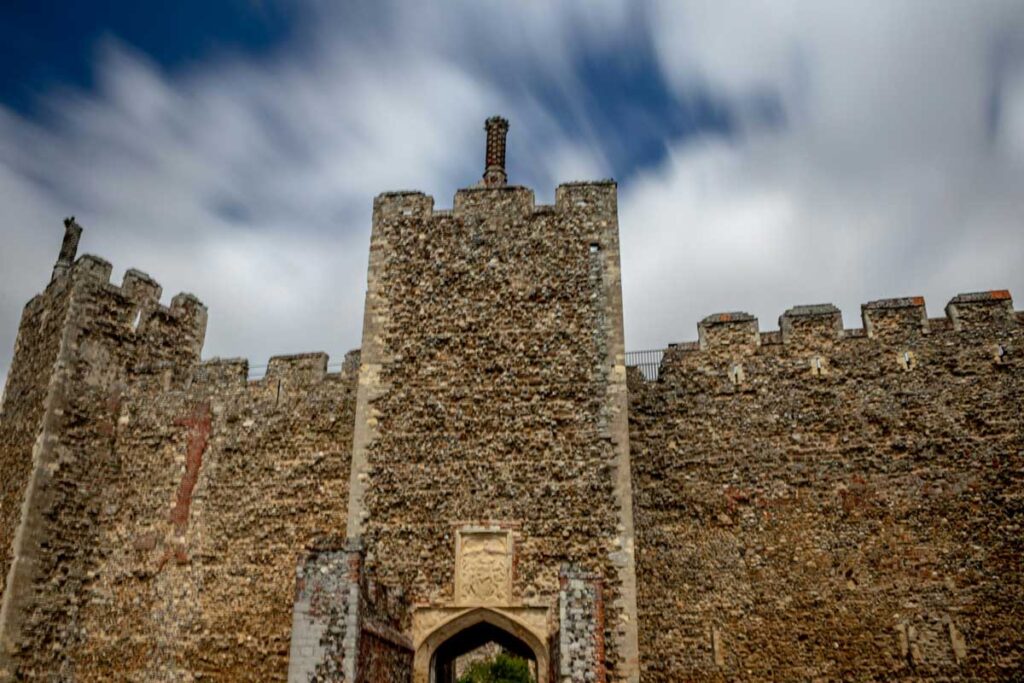
Inside Framlingham Castle: what to see
Framlingham Castle was built in its current form by Roger Bigod, Earl of Norfolk, around 1189–1200. Its most significant moment in history came in 1553, when Mary Tudor raised her banner here and was proclaimed Queen of England, using this English castle as her stronghold as she mustered support against the brief reign of Lady Jane Grey. Later in its history, the castle was used as a workhouse, an almshouse, and during the Second World War as a regional defence post. The only surviving building inside the curtain wall is the former Workhouse, which now houses the main exhibition and the Lanman Museum.
The wall walk is the defining feature of the visit. A full circuit of the 10.5-metre-high curtain walls passes through 13 of the original towers, each topped with a Tudor chimney — among the oldest surviving Tudor chimneys in England, each with a different decorative brick design. Information panels along the walk provide context, and views take in the surrounding Suffolk countryside, the college playing fields, and the Mere, a 33-acre lake that historically supplied the castle with water and today is a nature reserve.
The interactive exhibition in the Workhouse, on the reinstated mezzanine level, traces the castle’s history across its multiple incarnations — baronial fortress, Tudor royal residence, and Georgian poorhouse. Dressing-up activities and hands-on handling objects are available for families. The Lanman Trust Museum of local history, housed within the castle and included in the admission price, displays artefacts from the last 100 years collected by local resident Harold Lanman. A secondhand bookshop is located in the Workhouse.
The Framlingham Castle Café serves seasonal hot and cold meals, light bites, and drinks. Picnic benches are available outside the Workhouse for visitors who bring their own food. A gift shop stocks English Heritage merchandise and medieval-themed souvenirs.
A free audio guide — with a child-friendly version available — is included in the admission price and can be downloaded to a smartphone. A paid family activity trail is also available from the admissions point.
Practical visitor tips
| Tip | Detail |
|---|---|
| Visit on a weekday | Weekday visits outside peak summer months attract the lower Super Saver price. Saturdays and Sundays in peak summer are Standard rate. |
| Use the audio guide | A free audio guide, including a child-friendly version, is included in the ticket price. Download it to your phone in advance to avoid any signal issues on site. |
| Book the Katch service in advance | If arriving by train at Wickham Market, pre-book the Katch electric minibus at katch.co.uk before travelling. It does not run as a turn-up service. |
| Check the single-track road | The lane to the castle car park is narrow. Coaches and larger vehicles should contact English Heritage in advance. |
| Wear appropriate footwear | The castle grounds are mostly loose gravel and grass. The wall walk is fully exposed and can be uneven underfoot. |
| Wall walk is not accessible | The wall walk requires a steep 10.5-metre spiral staircase. Visitors who cannot use this staircase will not be able to access the wall walk; the exhibition and grounds remain accessible. |
| Dogs welcome on leads | Unlike some English Heritage sites, dogs on leads are permitted in the castle grounds and inside the castle, except at the café counter. |
| Parking is not free | Unlike some rural English Heritage sites, the on-site car park charges £3 for non-members. Town car parks are also available nearby but are not free for English Heritage members. |
| Book in advance for cheaper tickets | Booking online via the English Heritage website is recommended; advance online tickets are cheaper than on-the-door prices. |
Frequently asked questions about Framlingham Castle
| Question | Answer |
|---|---|
| Is Framlingham Castle suitable for children? | Yes. A free child-friendly audio guide is included, and a paid family activity trail is available. Dressing-up and handling activities are available in the exhibition. Children must be supervised on the spiral staircase to the wall walk. |
| Do you need to book tickets in advance for Framlingham Castle? | Advance booking is not required but is recommended and gives the best-available price. Tickets can be booked via the English Heritage website. |
| Is Framlingham Castle open on Sundays? | Yes, throughout the year except 24–26 December. |
| Are dogs allowed at Framlingham Castle? | Yes. Dogs on leads are welcome in the castle grounds and inside the castle. They are not permitted at the café counter. Assistance dogs are welcome throughout. |
| Is Framlingham Castle free for English Heritage members? | Yes. Members enter free, and each adult member can bring up to six children free. Parking in the on-site car park is also free for members. |
| Is Framlingham Castle accessible for wheelchair users? | Partially. The exhibition has level access and a platform lift to the first floor. The wall walk — the main feature of the site — is only accessible via a steep 10.5-metre spiral staircase and is not wheelchair accessible. |
| How do I get to Framlingham Castle by public transport? | Take a train to Wickham Market or Saxmundham (both on the East Suffolk Line from Ipswich), then either use the Katch pre-bookable minibus service from Wickham Market, or plan a bus connection via suffolkonboard.com. |
| Is there parking at Framlingham Castle? | Yes. An on-site car park is available. It costs £3 for non-members and is free for English Heritage members. The surface is loose chippings. Two Blue Badge bays are available. |
| Is a guided tour available at Framlingham Castle? | Regular guided tours depart from just inside the gate and are included in the admission price. A free audio guide (including a child version) is also included. |
| How long does a visit to Framlingham Castle take? | Most visitors spend 1.5 to 2.5 hours. Allow longer if visiting the Mere, the outer earthworks, or doing the family activity trail. |
Things to do near Framlingham Castle
Framlingham and the surrounding area of Suffolk contain several paid and free attractions well suited to combining with a castle visit.
Saxtead Green Post Mill (English Heritage), approximately 2.5 miles from Framlingham, is one of the finest surviving examples of a post mill in England. St Michael’s Church, a short walk from the castle in Framlingham town centre, is free to visit and contains the tombs of the Howard family, Dukes of Norfolk, who held the castle for much of the Tudor period. Sutton Hoo (National Trust), approximately 12 miles away near Woodbridge, is the site of the famous Anglo-Saxon royal burial ground. Orford Castle (English Heritage), approximately 10 miles south-east, is a unique 12th-century polygonal keep with views over the Suffolk coast. RSPB Minsmere, one of England’s most visited bird reserves, is approximately 13 miles away on the Suffolk coast. Snape Maltings, approximately 8 miles away, is a converted Victorian maltings complex with concert halls, galleries, craft shops, and riverside walks; entry to the complex itself is free, with charges for individual events and performances.
