
Furness Abbey is a ruined Cistercian monastery in a wooded valley on the north-eastern edge of Barrow-in-Furness in Cumbria, managed by English Heritage. This guide covers opening hours, ticket prices, transport, parking, accessibility, and practical visitor tips for planning your visit.
This guide was last updated in March 2026 to reflect the 2026/27 admission prices, valid from 28 March 2026. Furness Abbey closes entirely from November to March. There is also a sat nav warning: postcode LA13 0PJ may direct you to the Abbey Hotel on Abbey Road, from which there is no access to the abbey — use the turnings onto Abbey Approach or Rating Lane instead.
Quick facts
| Detail | Information |
|---|---|
| Address | Abbey Approach, Barrow-in-Furness, Cumbria LA13 0PJ |
| Sat nav warning | Postcode may direct to Abbey Hotel — use Abbey Approach or Rating Lane, not Abbey Road |
| Opening hours | Daily 10am–5pm (late March to late October only; closed November to March) |
| Adult ticket | £7.65–£9.26 depending on date and day |
| Nearest train | Barrow-in-Furness (~2 miles); Dalton and Roose (~2 miles) |
| Parking | Free car park (20–30 spaces) next to visitor centre entrance |
| Time needed | 1.5–2 hours |
Furness Abbey opening hours
Furness Abbey is closed from early November to late March. There is no winter weekend opening, no half-term opening, and no Christmas-period opening. The 2026/27 schedule is:
- 28 March – 24 October: daily, 10am–5pm
- 25 October – 1 November: daily, 10am–4pm
- 2 November – 27 March 2027: closed
Last admission 30 minutes before closing. Opening hours last updated in March 2026.
Furness Abbey ticket prices
English Heritage members enter free. The Super Saver rate applies on Mondays to Fridays outside peak summer — the same Mon–Fri pattern used at most English Heritage sites. English Heritage members enter free. Concessions apply to visitors aged 65+, students with a valid ID, and jobseekers with relevant ID.
Super Saver — Mon–Fri, 28 Mar–22 May & 1 Sep–1 Nov; daily, 2 Nov–16 Mar
| Visitor | Price |
|---|---|
| Adult | £7.65 |
| Concession | £6.88 |
| Child | £3.82 |
Saver — Sat–Sun & bank holidays, 28 Mar–22 May & 1 Sep–1 Nov; Mon–Fri, 23 May–31 Aug
| Visitor | Price |
|---|---|
| Adult | £8.50 |
| Concession | £7.65 |
| Child | £4.25 |
Standard — Sat–Sun & bank holidays, 23 May–31 Aug
| Visitor | Price |
|---|---|
| Adult | £9.26 |
| Concession | £8.50 |
| Child | £4.59 |
Groups of 15 or more receive a 10% discount. Not included in any city pass scheme. Ticket prices last updated in March 2026.
Is it worth paying for English Heritage membership?
Entry prices for English Heritage sites, including Dover Castle, Stonehenge and Tintagel Castle, can seem extremely expensive. This is clearly a deliberate ploy to push visitors towards taking out annual English Heritage membership.
Membership gives free access to more than 400 sites across the country, and costs £82. That is, unless you get a special deal – there was a 25%-off Black Friday deal in November 2025, for example.
Whether that £82 is worth it depends on how many sites are near you (there are lots in the south of the country, not so many near me in Yorkshire). And, critically, whether you’re going to visit them with children.
Each member can take up to six children with them free of charge. Given the steep one-time entry fees, an adult member with two children is likely to recoup the cost of their membership by visiting just two or three sites within the year.
For an individual without children, I’d say English Heritage membership is worth it only if you’re planning to blitz a few sites in one year. For an individual with children, membership is a smart investment that will likely pay itself back within one school holiday. To me, it’s a no-brainer.
The real question is whether it’s worth renewing English Heritage membership after a year. That’s debatable, as you’re unlikely to go to many of these sites twice. I eventually renewed after I was offered 20% off the price. I’ll probably recoup the membership price visiting two sites in summer next year, even if I’ve ticked off most of the best ones near me.
If you buy membership through this link, I earn a small commission at no extra cost to you.
How to get to Furness Abbey
Furness Abbey is on Abbey Approach, 1.5 miles north of Barrow-in-Furness town centre, off the A590.
By train: Barrow-in-Furness station (Northern/Avanti from Lancaster ~1 hr) is ~2 miles away; taxis are available. Dalton and Roose stations are also ~2 miles away. Stagecoach services 6 and X6 stop within three-quarters of a mile — check traveline.info for timetables.
By car: Postcode LA13 0PJ — but do not follow sat nav to the Abbey Hotel on Abbey Road. Take the turnings onto Abbey Approach or Rating Lane on either side of the hotel. No ULEZ charges apply.
Parking at Furness Abbey
A free car park with space for 20–30 vehicles is next to the visitor centre at the northern end of the site. Free for all visitors including non-members. No specific disabled bays are marked, but all parking is close to the visitor centre. A ramp to the rear of the visitor centre enables step-free access. Additional public parking is at the Abbey Mill Café at the southern end of the site.
How long to spend at Furness Abbey
Most visitors spend 1.5 to 2 hours at Furness Abbey. The museum, visitor centre, and abbey ruins can all be seen within this time. The surrounding grounds are extensive. Allow additional time if visiting Bow Bridge or the Abbey Mill Café.
Accessibility at Furness Abbey
A ramp to the rear of the visitor centre provides step-free access to the site. The museum and exhibition are accessible for visitors with limited mobility. Level paths run around key areas of the ruins. Visitors with electric wheelchairs have encountered difficulties as heavy chairs can sink into soft ground — contact the site before visiting if this is a concern. Manual wheelchair users should bring an assistant. Pushchairs are permitted; an all-terrain pushchair is recommended. Toilets including accessible facilities are on site. Dogs on leads are welcome. Assistance dogs welcome.
Inside Furness Abbey: what to see
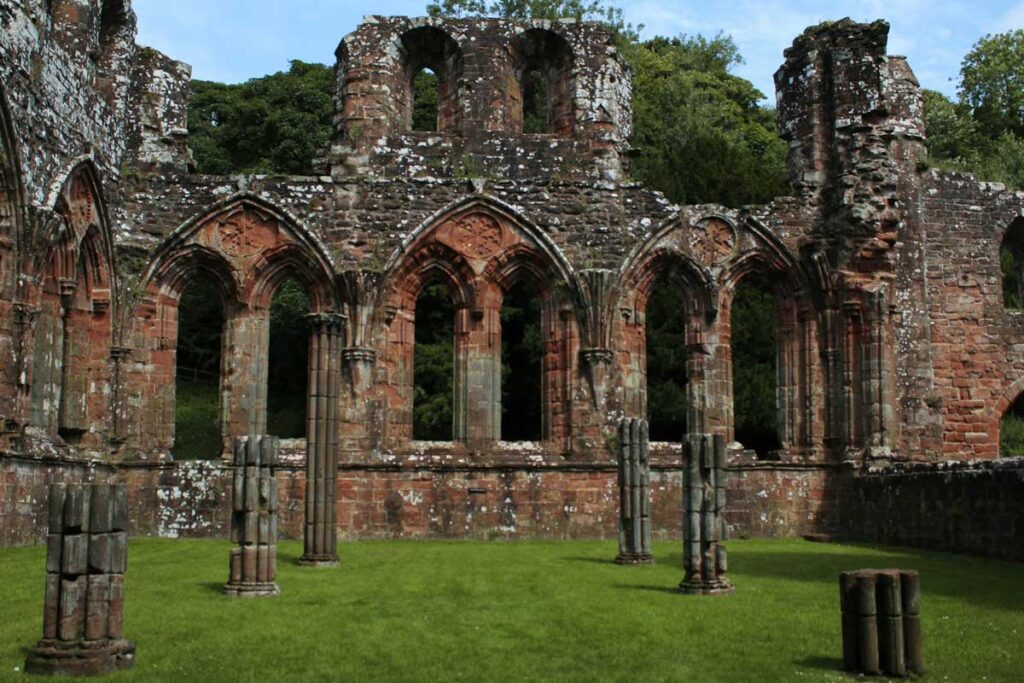
Furness was founded in 1123 and grew to become the largest and wealthiest Cistercian abbey in the north-west of England, controlling vast landholdings across Cumbria, Lancashire, and into Ireland. In 1537, it became the first large abbey dissolved under Henry VIII — a distinction that makes it particularly significant in the story of the English Reformation.
The ruins include the abbey church, chapter house, infirmary, cloister, and gatehouse. The church transepts survive to considerable height, with Transitional Norman–Early Gothic arches. The infirmary chapel is well preserved. A free audio tour — an episode of the English Heritage podcast — provides context throughout.
The museum in the visitor centre holds stone carvings, effigies, and the centrepiece of the collection: the Furness Crozier, a rare 12th-century silver-gilt crozier found in one of the abbey graves and one of the finest surviving examples of Romanesque metalwork in Britain. A gemstone ring from an abbot’s grave and a new ‘monks’ eye view’ display are also on show. A book box and holiday activity resources are in the visitor centre.
Bow Bridge — a late 15th-century stone bridge built by the monks — is accessible via a footpath from the southern car park and is a free English Heritage site.
There is no café managed by English Heritage. A vending machine in the visitor centre offers hot drinks and snacks. The Abbey Mill Café (independent) is at the southern end of the site. Picnic benches are outside the visitor centre.
Practical visitor tips
| Tip | Detail |
|---|---|
| Sat nav warning | Postcode LA13 0PJ may direct to the Abbey Hotel on Abbey Road, from which there is no access. Use the turnings onto Abbey Approach or Rating Lane on either side of the hotel. |
| Closed November to March | No winter opening of any kind. Check dates before travelling. |
| Super Saver is Fri–Sat | The cheapest rate falls Sun–Thu outside peak summer — the reverse of most English Heritage sites. |
| Electric wheelchairs risk sinking | Some ground at the site is soft and has caused difficulties for electric wheelchair users in the past. Contact the site before visiting if this is a concern. |
| No café on site | Hot drink vending machine and snacks in the visitor centre. The Abbey Mill Café is nearby at the southern end of the site. |
| Bow Bridge is free | The 15th-century bridge is a separate English Heritage site accessible by footpath from the Abbey Mill Café car park — worth a short detour. |
Frequently asked questions about Furness Abbey
| Question | Answer |
|---|---|
| Is Furness Abbey open in winter? | No. The abbey closes at the start of November and does not reopen until late March. |
| Is there a café at Furness Abbey? | Not managed by English Heritage. A vending machine provides hot drinks. The Abbey Mill Café (independent) is at the southern end of the site. |
| Is Furness Abbey accessible for wheelchair users? | Mostly, but some soft ground has caused difficulties for electric wheelchairs. A ramp provides access from the visitor centre. Contact the site before visiting. |
| Are dogs allowed at Furness Abbey? | Yes. Dogs on leads are welcome throughout. |
| Is Furness Abbey free for English Heritage members? | Yes. Members enter free and can bring up to six children free. Parking is also free for all visitors. |
| How do I get to Furness Abbey by public transport? | Take a train to Barrow-in-Furness (~2 miles) or Dalton (~2 miles), then a taxi or Stagecoach bus 6/X6 (stops within 0.75 mile). |
Things to do near Furness Abbey
Piel Castle (English Heritage, free), on Piel Island, is a ruined 14th-century castle built by the monks of Furness; accessible by seasonal ferry from Roa Island. Dalton Castle (National Trust, ~3 miles) is a 14th-century pele tower open on selected days. Barrow-in-Furness (~2 miles) has the Dock Museum (free) covering the town’s shipbuilding history. Lake District National Park begins ~10 miles north-east, with Coniston and Grizedale Forest within 30 minutes by car.
More North-West England travel
Other North-West England travel articles on Planet Whitley include:
- Plan your visit to Birdoswald Roman Fort in Cumbria.
- What to expect at Lanercost Priory in Cumbria.
- Is it worth visiting the Puzzling Place in Keswick?
- Discover the mysteries of the Castlerigg Stone Circle in Keswick.
- World of Beatrix Potter visitor guide: What to expect at this Bowness-in-Windermere attraction.
