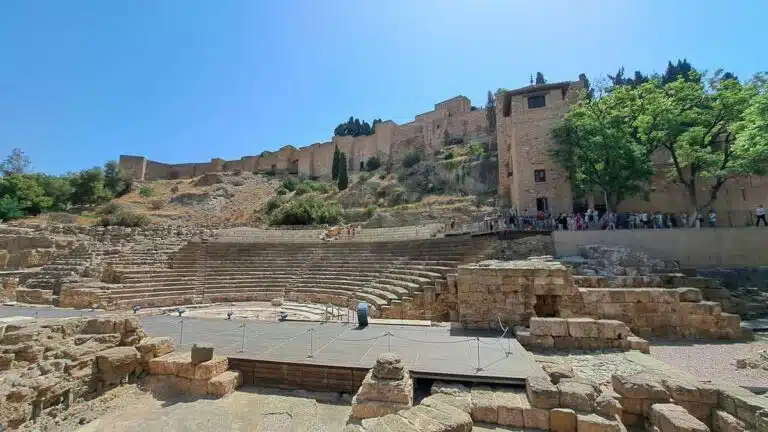
Málaga is one of the most underrated cities on the Mediterranean — a place that spent decades dismissed as a transit point for the Costa del Sol and is now firmly established as a destination in its own right. The old city climbs from a Roman theatre through a Moorish fortress to a hilltop castle with views across the harbour and the mountains behind, while the streets below contain a concentration of serious art museums that would be remarkable in a city twice its size. Picasso was born here, and the museum bearing his name is one of Spain’s finest; the Centre Pompidou outpost in the port district adds contemporary weight to a cultural offer that keeps growing. Beyond the city, the dramatic gorge walk of the Caminito del Rey is within easy reach and ranks among the most spectacular day trips in southern Spain. These guides cover Málaga’s key attractions with practical information on ticket prices, opening hours and what to expect on arrival.
Málaga’s historic monuments and archaeological sites
Málaga’s hilltop and old city contain an exceptional layering of civilisations — Phoenician, Roman, Moorish and Renaissance — compressed into a small area that can be explored largely on foot. The Alcazaba, Gibralfaro and the Roman theatre sit within a few hundred metres of each other and can be combined in a single half-day; the cathedral is a short walk away. The Caminito del Rey requires more planning but rewards the effort handsomely.

- Alcazaba Málaga: tickets, history and best views — visitor guide — an 11th-century Moorish palace-fortress rising directly above the city centre, with ornate courtyards, garden terraces and views over the port that justify the climb alone.
- Gibralfaro Castle Málaga: ticket prices, opening hours and visitor guide — the 14th-century castle on the hill above the Alcazaba, connected by a walled pathway, with the finest panoramic views in the city across the bullring, the port and the mountains beyond.
- Roman theatre Málaga: ticket prices, opening hours and visitor guide — a 1st-century BC theatre discovered beneath a 20th-century building and now excavated and open to visitors, sitting at the foot of the Alcazaba in one of the city’s most dramatic architectural juxtapositions.
- Málaga Cathedral: ticket prices, opening hours and visitor guide — a Renaissance cathedral nicknamed La Manquita (the one-armed lady) for its famously unfinished second tower, with a magnificent interior, rooftop walkway and a history that spans five centuries of construction.
- Caminito del Rey from Málaga: how the tour works, transport, entry rules and route guide — a spectacular 8km walk through the Desfiladero de los Gaitanes gorge along a restored clifftop pathway, once reputedly the most dangerous footpath in the world, now a well-managed day trip from the city.
Five great Malaga experiences to book
- 🏛️ Combine the Cathedral, Alcazaba and Roman Theatre on a city highlights tour.
- 🧖 Indulge in the Arabian Baths experience at Hammam al-Andalus.
- 🛴 Cover the city’s top attractions on a Segway tour.
- ⛰️ Take a guided excursion to the Caminito del Rey.
- 🍳 Learn how to make paella and sangria in a special culinary workshop.
Málaga’s art museums
Málaga has invested heavily in contemporary and modern art over the past two decades and now has a cultural offer that rivals cities far larger. The Museo Picasso is the obvious draw, but the Centre Pompidou’s Málaga outpost is a genuine surprise — not a minor satellite of the Paris original but a substantial collection that merits a visit on its own terms.
- Museo Picasso Málaga: why it’s worth visiting — housed in the 16th-century Palacio de Buenavista in the city where Picasso was born, with over 200 works spanning his career and a building that is itself a reason to visit.
- Centre Pompidou Málaga: is it worth visiting? — an honest assessment of the Pompidou’s Spanish outpost in the port district’s Cubo building, covering what the collection contains, how it compares to the Paris original, and who will get the most from a visit.
- Museo Carmen Thyssen visitor guide.
Planning your visit to Málaga
Málaga’s old city is compact and almost entirely walkable — the Alcazaba, Roman theatre, cathedral and Picasso museum are all within ten minutes of each other on foot. The main logistical consideration for the hilltop sites is the climb: Gibralfaro in particular involves a steep ascent, and the midday heat between June and September makes an early morning start strongly advisable. The Caminito del Rey requires advance booking (it sells out weeks ahead in spring and autumn), a specific departure point outside the city, and a return transport plan — the guide above covers all of this in detail. Málaga airport is well connected to the UK and northern Europe, and the city is easily combined with Granada, Seville or Ronda on a wider Andalucía itinerary.
How many days do you need in Málaga?
Two full days covers Málaga’s main attractions comfortably. A first day works well for the hilltop monuments — the Roman theatre, Alcazaba and Gibralfaro in the morning before the heat builds, then the cathedral and a walk through the historic centre in the afternoon. A second day suits the art museums — the Picasso museum and Centre Pompidou are both in the old city and can be combined without rushing — plus time for the port area and the Muelle Uno waterfront. A third day is ideal if you want to add the Caminito del Rey as a day trip.
What is Málaga best known for?
Málaga is best known internationally as the gateway to the Costa del Sol, but among visitors who spend time in the city itself it is known for the Alcazaba and Gibralfaro, the Museo Picasso (Picasso was born in Málaga in 1881), and an increasingly strong art and food scene that has transformed its reputation over the past decade. The Caminito del Rey gorge walk, though technically outside the city, is one of the most popular day trips in southern Spain and draws visitors specifically to the region.
Is Málaga worth visiting beyond the beaches?
Emphatically yes. Málaga’s old city has more historical and cultural depth than most visitors arriving for a Costa del Sol beach holiday realise, and the combination of Moorish monuments, a world-class Picasso museum and the Caminito del Rey gives it an appeal that has nothing to do with the coast. It works equally well as a standalone city break, a cultural contrast to a beach week, or a base for exploring Andalucía’s interior.