The National Museum of Indonesia (Museum Nasional Indonesia), affectionately known locally as Museum Gajah (Elephant Museum), is the nation’s premier historical, archaeological, and ethnological museum, located in the heart of Central Jakarta. This 2026 visitor guide covers opening hours, ticket prices, transport or parking, accessibility, and practical visitor tips.
This guide was updated in April 2026, noting that the museum has introduced a revised ticketing structure for 2026, which notably ended the long-standing free admission policy for local students and increased standard entry fees for international visitors to support ongoing conservation efforts.
Quick facts
| Detail | Information |
| Opening hours | 8:00 am to 6:00 pm (Tuesday to Thursday), 8:00 am to 8:00 pm (Friday to Sunday). Closed Mondays. |
| Ticket prices | Foreign Adults: Rp 150,000, Local Adults/KITAS: Rp 50,000, Students: Rp 30,000 |
| Address | Jl. Medan Merdeka Barat No. 12, Gambir, Jakarta Pusat 10110, Indonesia |
| Nearest public transport or parking | Monumen Nasional (Monas) TransJakarta Bus Stop |
| Typical time needed to visit | 2 to 3 hours |
National Museum of Indonesia opening hours
The National Museum of Indonesia opening hours operate on a split schedule depending on the day of the week. From Tuesday to Thursday, the museum is open from 8:00 am to 6:00 pm. On weekends (Friday through Sunday), the hours are extended, operating from 8:00 am to 8:00 pm.
The museum is strictly closed every Monday, as well as on major National Public Holidays. It is highly recommended to arrive at least 90 minutes before closing time to ensure you have adequate time to view the primary galleries.
National Museum of Indonesia ticket prices
The National Museum of Indonesia ticket prices operate on a tiered system. General admission for foreign tourists is Rp 150,000. Foreign nationals holding a valid KITAS (residency permit) and Indonesian citizens (WNI) are charged a reduced rate of Rp 50,000. Indonesian students from primary through high school must now pay Rp 30,000, while children under the age of three enter for free.
If you wish to experience the digital ImersifA room, an additional add-on ticket costing Rp 35,000 is required, which must be purchased alongside a standard admission ticket.
Opening hours and ticket prices were checked on the official website and last updated in April 2026. The museum frequently requires digital or online purchases via their official portals or partnered travel apps to expedite the entry process.
How to get to the National Museum of Indonesia
You can reach the National Museum of Indonesia by heading to Jalan Medan Merdeka Barat, situated directly across from the western edge of the Merdeka Square.
The most efficient public transport option is the TransJakarta Busway network. Alight at the Monumen Nasional (Monas) bus stop; from there, the museum entrance is only a brief, flat walk down the pavement. Alternatively, ride-hailing apps such as Gojek or Grab provide direct drop-offs right at the main gates.
Parking at the National Museum of Indonesia
Paid parking at the National Museum of Indonesia is available on-site within the museum compound. While the car park can easily accommodate standard vehicles during weekday mornings, it frequently reaches full capacity during weekends, school holidays, and special cultural exhibitions. Using public transport or ride-hailing services is often more convenient to avoid downtown Jakarta traffic and parking constraints.
How long to spend at the National Museum of Indonesia
Visitors typically spend between two and three hours at the National Museum of Indonesia. This duration provides ample time to explore the vast ethnography collections, view the ancient Hindu-Buddhist sculptures, and attend a 15-minute scheduled session in the ImersifA digital storytelling room.
Accessibility at the National Museum of Indonesia
Accessibility at the National Museum of Indonesia is highly accommodating. The facility is equipped with flat pathways, operational lifts connecting the multiple floors of the newer Building B, and dedicated wheelchair-accessible restrooms. The broad, open gallery layouts make it easy to navigate with both manual wheelchairs and baby strollers.
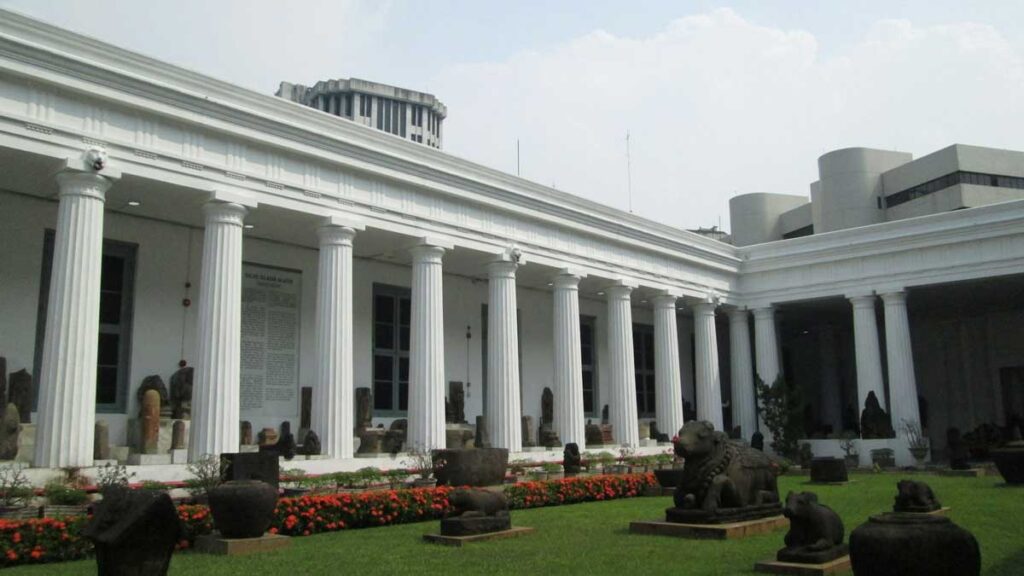
Inside the National Museum of Indonesia
Visitors to the National Museum of Indonesia explore a vast repository of over 190,000 artifacts that chronicle the cultural and geological history of the Indonesian archipelago. The museum is informally called the “Elephant Museum” due to the prominent bronze elephant statue in the forecourt, a gift from King Chulalongkorn of Siam in 1871.
The Prehistoric Era Collection features ancient tools, fossils, and the remains of early hominids discovered across the islands, providing context for the region’s ancient human habitation.
The Hindu-Buddhist Sculpture gallery is located in the central courtyard and features an extensive array of well-preserved stone statues and relics recovered from ancient temples across Java and Sumatra.
The Ethnography Gallery displays a vibrant collection of traditional textiles (including Batik and Ikat), tribal weaponry such as the keris, musical instruments, and detailed miniature models of traditional indigenous houses from all over the country.
The Gold and Treasure Rooms house the dazzling royal regalia of former Indonesian kingdoms, featuring intricate jewelry and ceremonial artifacts crafted from gold and precious stones.
The ImersifA Room is a modern addition, offering a 360-degree projection mapping and audiovisual experience that brings Indonesian folklore, history, and landscapes to life in an interactive, 15-minute show.
Practical visitor tips
| Focus | Tip |
| Timing | Arriving right at 8:00 am allows you to beat the intense Jakarta midday heat and the noise of large local school excursion groups. |
| Crowds | Weekdays (Tuesday to Thursday) are generally much quieter than the extended Friday to Sunday periods. |
| Layout | The complex is split into the older Building A (heritage architecture) and the modern Building B (air-conditioned galleries); move to Building B when you need to cool down. |
| Entry process | Have your digital e-ticket QR code ready on your smartphone with the screen brightness turned all the way up for the entrance scanners. |
| On-site logistics | You must remove your shoes to enter the ImersifA room. Flash photography is strictly prohibited in the Gold and Treasure Rooms. |
Frequently asked questions about the National Museum of Indonesia
| Question | Answer |
| Is the National Museum of Indonesia suitable for children? | Yes, the museum is highly educational, stroller-friendly, and features engaging visual displays like the ImersifA room. |
| Do you need to book tickets in advance for the National Museum of Indonesia? | Advance booking is highly recommended via the official site or local travel apps to secure specific time slots for the ImersifA room. |
| Is the National Museum of Indonesia open on Sundays? | Yes, the museum is open with extended hours from 8:00 am to 8:00 pm every Sunday. |
| Are bags allowed at the National Museum of Indonesia? | Small day bags are permitted, but large backpacks and outside food/drinks must be left in the complimentary lockers at the entrance. |
Things to do near the National Museum of Indonesia
- National Monument (Monas)
- Istiqlal Mosque
- Jakarta Cathedral
- Sarinah Shopping Mall
- Taman Fatahillah (Jakarta Old Town/Kota Tua)
More South-East Asia travel
Other South-East Asia travel guides on Planet Whitley include:
- Guide to Lumphini Park – Bangkok’s prime green space.
- Guides to the Mandai Wildlife Reserve’s attractions: Bird Paradise, Curiosity Cove, Exploria, the Mandai Boardwalk, the Night Safari, Rainforest Wild Asia and River Wonders.
- Discovering Islamic architecture at the Islamic Arts Museum Malaysia.
- A Lao barbecue dining experience in Luang Prabang.
- What to expect at the Royal Regalia Museum in Bandar Seri Begawan.