
Tarragona Cathedral (Catedral Basílica Metropolitana y Primada de Santa Tecla) is a Roman Catholic church and historical monument located at Pla de la Seu in the Part Alta of Tarragona, Spain. This guide covers opening hours, ticket prices, transport or parking, accessibility, and practical visitor tips.
To skip the details, and just book tickets, head here.
This guide was last updated in March 2026 to reflect the introduction of the new smartphone audio guide system, which recently replaced physical devices for all self-guided tours.
Quick facts about Tarragona Cathedral
| Feature | Details |
| Opening hours | Varies seasonally; opens 9:30 AM (Mon 10:30 AM, Sun 2:00 PM) and closes between 5:00 PM and 8:00 PM |
| Ticket prices | Adults €12.50, Reduced €8.50, Juniors (7–12) €5.50 |
| Address | Pla de la Seu 1, 43003 Tarragona, Spain |
| Nearest public transport or parking | Portal del Roser bus stop; Saavedra underground car park |
| Typical time needed | 1 to 1.5 hours |
Tarragona Cathedral opening hours
The Tarragona Cathedral operates on a seasonal schedule with varying closing times throughout the year. Final entry is always permitted thirty minutes before the scheduled closing time.
- Winter (November to early March): Monday 10:30 AM – 5:00 PM; Tuesday to Friday 9:30 AM – 5:00 PM; Saturday 9:30 AM – 6:00 PM; Sunday 2:00 PM – 6:00 PM.
- Spring & Autumn (March to June; September to October): Monday 10:30 AM – 7:00 PM; Tuesday to Saturday 9:30 AM – 7:00 PM; Sunday 2:00 PM – 7:00 PM.
- Summer (Late June to August): Monday 10:30 AM – 8:00 PM; Tuesday to Saturday 9:30 AM – 8:00 PM; Sunday 2:00 PM – 8:00 PM.
Opening hours and ticket prices were checked on the official website and last updated in March 2026.
Tarragona Cathedral ticket prices
General admission tickets cost €12.50 for adults, while a reduced rate of €8.50 applies to seniors over 65, students, and youths under 18. A junior ticket for children aged seven to twelve costs €5.50, and children under seven enter for free.
Opening hours and ticket prices were checked on the official website and last updated in March 2026.
How to get to Tarragona Cathedral
The cathedral is located at the highest point of the Part Alta, the historic upper town of Tarragona. Visitors using the local EMT bus network can take routes 8, 11, 12, or 22 and alight at the Portal del Roser stop, which sits just outside the ancient Roman walls.
From the bus stop, visitors must walk uphill through the pedestrianised medieval streets for approximately ten minutes to reach the main square and the cathedral entrance.
Parking at Tarragona Cathedral
The cathedral does not have a dedicated visitor car park, and vehicular access to the surrounding medieval streets is strictly limited to residents.
Drivers should use the paid underground parking garages situated just outside the old city walls. The closest option is the Saavedra car park on Avinguda Catalunya, or the Catalunya car park, both of which leave a short uphill walk to the site.
How long to spend at Tarragona Cathedral
Most visitors spend between one and one and a half hours exploring this European cathedral complex.
This provides enough time to walk the central nave, view the Diocesan Museum, explore the exterior cloisters, and listen to the core chapters of the digital audio guide.
Accessibility at Tarragona Cathedral
The main cathedral floor, the nave, and the central cloister are wheelchair accessible via flat stone surfaces and ramps.
The site is designated as partially accessible because the underground Archaeological Route, the bell tower, and certain raised side chapels are only reachable via steep stone staircases.
Inside / what to see at Tarragona Cathedral
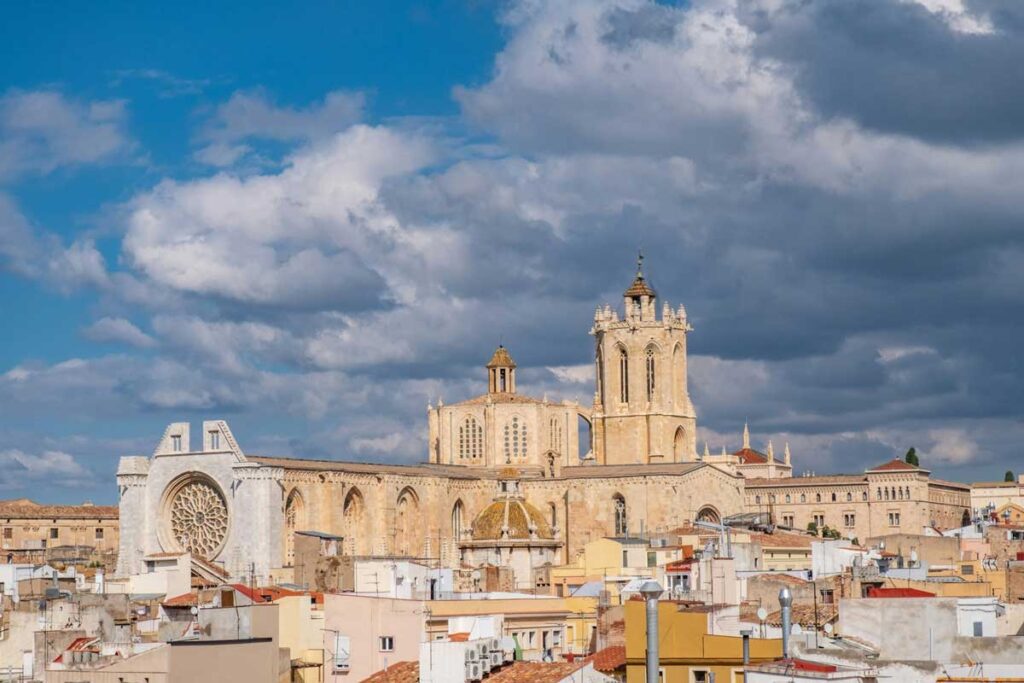
The cathedral is built upon the ancient remains of the Roman Temple of Augustus, blending transitionary Romanesque and Gothic architectural styles. Visitors enter through the western façade, which features a large Gothic rose window and intricate stone portals.
The interior consists of a luminous central nave flanked by numerous side chapels. A primary highlight is the main altar, which displays an elaborately carved 15th-century Gothic altarpiece dedicated to Saint Thecla, the patron saint of the city.
Visitors also have access to the large Romanesque cloister, a quiet central courtyard surrounded by vaulted galleries and carved stone capitals depicting biblical scenes.
The complex includes the Diocesan Museum, which houses a collection of religious art, tapestries, and medieval goldsmithing, alongside the newly opened Gardens of Santa Tecla la Vella, situated directly behind the main apse.
Practical visitor tips
| Tip Category | Advice |
| Timing | Visit on a Tuesday or Wednesday morning at 9:30 AM to explore the cloisters before the peak midday crowds arrive from Catalonia‘s seaside resorts. |
| Crowds | The expansive interior of the cathedral rarely feels congested, even when large tour groups are present. |
| Layout | Begin your visit in the main nave to view the altarpiece, before moving into the museum and finishing in the outdoor cloisters. |
| Entry process | Purchase your tickets at the main desk inside the entrance; the cost includes free access to the digital self-guided tour. Alternatively, book online to skip queues. |
| On-site logistics | Bring your smartphone fully charged and a pair of headphones to connect to the cathedral’s mobile audio guide system. |
Frequently asked questions about Tarragona Cathedral
| Question | Answer |
| Is Tarragona Cathedral suitable for children? | Yes, children are welcome and discounted junior tickets are available for them. |
| Do you need to book tickets in advance for Tarragona Cathedral? | Advance booking is not strictly required; walk-up tickets can be easily purchased upon arrival. |
| Is Tarragona Cathedral open on Sundays? | Yes, but tourist visiting hours are restricted to the afternoon, opening at 2:00 PM. |
| Are bags allowed at Tarragona Cathedral? | Standard day bags are permitted, but visitors must dress respectfully and remove hats inside the active church. |
Things to do near Tarragona Cathedral
The cathedral’s location in the historic Part Alta makes it an ideal starting point for exploring other paid historical attractions in the city:
- Tarragona Amphitheatre: A paid Roman amphitheatre overlooking the Mediterranean Sea, located a fifteen-minute walk down the hill.
- National Archaeological Museum of Tarragona (MNAT): A paid museum housing extensive collections of Roman mosaics, sculptures, and artifacts from ancient Tarraco.
- Roman Circus and Praetorium: A paid archaeological site featuring the underground vaults of the 1st-century chariot racing track and a defensive tower offering panoramic city views.
- Poblet Monastery: 45km north-west of the city, this World Heritage site is a popular half day trip option.

