Western Australia sits on some of the most ancient and geologically active limestone country on earth. The result is a cave network of extraordinary variety — from the show caves of the Leeuwin-Naturaliste Ridge south of Perth, where formations of crystallised calcite have been growing for hundreds of thousands of years, to the wild, unlit tunnel of Tunnel Creek in the Kimberley, where freshwater crocodiles share the darkness with roosting bats and the rock art of the Bunuba people.
The caves of the Margaret River region form the most accessible and most visited cave destination in Western Australia, but they are not interchangeable. Each has a distinct character, formation type and visiting experience. Further north, Tunnel Creek offers something altogether different — a genuinely wild cave experience requiring a torch, some nerve and a willingness to wade.
The Leeuwin-Naturaliste Ridge, Margaret River region
The Leeuwin-Naturaliste Ridge, a narrow band of ancient limestone running for 100 kilometres along the southwestern tip of Western Australia, contains around 150 known caves. Of these, six are open to the public. They lie along Caves Road — one of the more aptly named roads in Australia — between Yallingup in the north and Augusta in the south, within the Leeuwin-Naturaliste National Park.
The caves formed over millions of years as slightly acidic groundwater dissolved passages and chambers through the limestone. The formations inside — stalactites, stalagmites, helictites, shawls and calcite crystals — are still actively growing wherever the conditions are right. The four main show caves each have a distinct speciality, and visitors based in the region for several days are well rewarded by visiting more than one.
Jewel Cave, Augusta
Jewel Cave is the largest and most spectacular show cave in Western Australia. Discovered in 1959 at the southern end of the ridge near Augusta, it contains chambers of a scale that the other caves in the region do not match. The main chamber alone is large enough to hold a small concert, and the formation density throughout is extraordinary — stalactites, stalagmites, helictites and shawls covering almost every surface.
The cave’s signature feature is a straw stalactite measuring 5.4 metres in length — the longest in Australia. Straw stalactites form when water drips through a hollow tube of calcite so slowly that the tube remains open; they are fragile, translucent and extraordinarily difficult to preserve once a cave is opened to visitors. The Jewel Cave specimen is a remarkable survival. The cave was also found to contain the fossilised skull of a Tasmanian tiger, extending the known range of the species considerably.
A fully guided tour of Jewel Cave runs daily and takes approximately 45 minutes underground. The guide covers the cave’s geology, formation types and discovery story in detail. The cave is cool year-round at around 17°C — a jacket is advisable regardless of the surface temperature. After the tour, a self-guided walk through the forest above the cave is included.
Lake Cave, Margaret River
Lake Cave, 20 minutes south of Margaret River town, is widely regarded as the most beautiful cave in the region. The approach prepares you for something unusual: the entrance is a collapsed sinkhole ringed by the skeletal trunks of a sunken karri forest — trees killed when the roof fell in and now standing silvered and dead above the opening. Descending the stairs through the forest into the cave below is one of the more atmospheric entrances in Australian caving.
Inside, the cave centres on an underground lake fed by the water table — its level rising and falling with seasonal rainfall on the surface. Above the lake hangs the cave’s signature formation: the suspended table, a delicate calcite mass that grew downward from the ceiling over thousands of years, its base hovering just above the water. The stillness of the lake, the reflection of the formations in the water and the low lighting combine to make Lake Cave one of the most genuinely serene underground experiences in Australia.
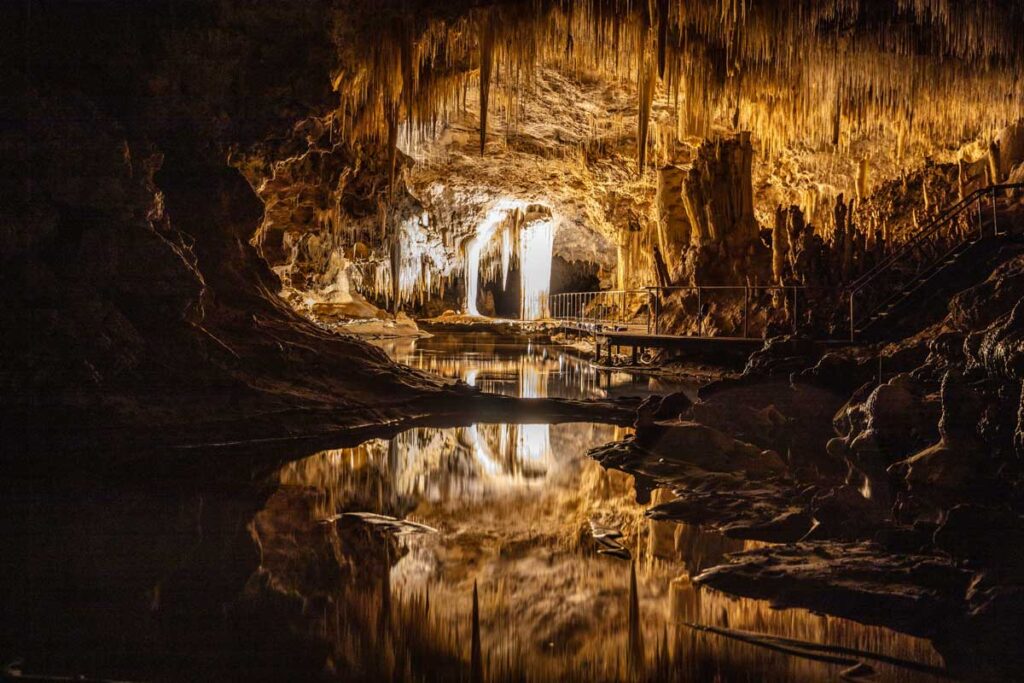
A fully guided tour of Lake Cave descends through the sinkhole and the sunken forest before entering the cave chamber. Guides explain the geology of the suspended table and the cave’s relationship with the water table above. A treetop viewing platform above the sinkhole gives a perspective on the collapsed roof that changes how you understand the cave’s formation. Reviewers consistently describe the experience as the highlight of their Margaret River trip.
5 great Margaret River region experiences worth booking
- 🍷 Hop between world class wineries on a classic Margaret River wine tour.
- 🍺 Go beyond the wine-tasting with a wineries, breweries and distilleries tour.
- 🚙 Take a 4WD tour to the region’s natural highlights, uncovering the local secrets.
- 🏄 Learn how to catch a wave with a beginner’s surfing lesson.
- 🛶 Enjoy a canoe tour through the forest along the Margaret River.
Ngilgi Cave, Yallingup
Ngilgi Cave, at the northern end of the ridge near Yallingup, is the closest of the main caves to Perth — approximately two and a half hours by road — and the most culturally layered. The cave takes its name from Ngilgi, a good spirit of the Wardandi Noongar people who, according to tradition, defeated the evil spirit Wolgine in the cave and drove him into the sea. The cave was known to Aboriginal people for generations before European settlers were guided to it in 1899.
The formations here include an unusual concentration of helictites — spiral, contorted calcite growths that defy gravity by following crystal structure rather than the pull of water — alongside shawls, stalactites and shimmering deposits of calcite crystal. The Amphitheatre, a large domed chamber with a natural acoustic that visitors are invited to test, is a regular highlight. The junior explorer’s tunnel, a squeeze passage through a lower section, entertains younger visitors considerably.
A semi-guided tour of Ngilgi Cave begins with a guide covering the cave’s Noongar cultural history and pointing out the key formations, after which visitors explore independently. The Ancient Lands Experience walk through native bushland above the cave provides context on the landscape and its Aboriginal connections before the underground section begins. The semi-guided format suits visitors who prefer to linger rather than keep pace with a group.
Visitors based in Perth who want to combine Ngilgi Cave with the wider Margaret River region can join a luxury small-group day trip from Perth covering Ngilgi Cave, Geographe Bay and the Margaret River wine region. Groups are capped at six, the vehicle is a Mercedes, and wine tasting at a Margaret River winery is included. The itinerary is flexible and adapts to the group’s interests.
Mammoth Cave, Margaret River
Mammoth Cave is the only cave on the ridge offering a fully self-guided audio tour, which gives it a different pace to the others. Visitors move through the cave with an audio guide narrating the formations and the cave’s most significant feature: a substantial collection of megafauna fossils still lying where they fell, embedded in the cave floor and walls.
The fossils date from the Pleistocene and include the remains of a Zygomaturus — a large, wombat-like creature — a Thylacoleo or marsupial lion, giant kangaroos and other species that became extinct roughly 40,000 years ago. Several are visible in situ, which gives Mammoth Cave a scientific significance the other show caves lack. The audio commentary explains how the animals came to be preserved here and what the fossil record tells us about the prehistoric ecosystem of southwest Australia.
A self-guided audio tour ticket for Mammoth Cave is available in advance and includes the audio device. The self-guided format means there is no fixed tour time — visitors can move at their own pace, pause as long as they like at individual formations or fossil beds and revisit sections. Combination tickets covering multiple caves offer good value for visitors planning to see more than one.
Moondyne Cave: adventure caving
For visitors who want to leave the boardwalks behind, Moondyne Cave offers the region’s main adventure caving experience. Named after the colonial-era bushranger Joseph Johns — better known as Moondyne Joe — it is not a show cave and has no pathway lighting. Visitors are equipped with overalls, helmets and headlamps and led by a guide through passages that require crawling, squeezing and scrambling rather than strolling.
The cave contains excellent formations including pristine helictites and shawls in areas not accessible on the standard show cave tours. The absence of lighting means the formations are seen by torchlight, which gives them a different and arguably more striking quality than the theatrical illumination of the show caves. Moondyne tours run daily and are bookable directly through the CaveWorks visitor centre on Caves Road, which also handles bookings for Lake Cave and Mammoth Cave.
The adventure option at nearby Giants Cave takes the experience further still, into a larger cave system with more extensive crawl passages and abseiling. Both are suitable for reasonably fit adults and older children; neither requires previous caving experience.
Tunnel Creek, the Kimberley
Tunnel Creek is Western Australia’s oldest cave system and one of its most extraordinary natural experiences. The cave cuts through the Napier Range — an ancient Devonian reef, 350 million years old — for approximately 750 metres, emerging on the far side of the range in the dry season or becoming a wading experience through knee-deep water after rain. There is no lighting. You bring your own torch and follow the creek bed through the dark.
The cave became famous in the 1890s as the hideout of Jandamarra, a Bunuba warrior who led an armed resistance against colonial settlement in the Kimberley for three years before being killed in 1897. He used Tunnel Creek’s passages and chambers to evade pursuit — knowledge of the cave’s geography giving him an advantage that colonial trackers struggled to match. Aboriginal rock art covers sections of the cave wall, and the site remains of deep cultural significance to the Bunuba people.
The cave also contains a colony of ghost bats and several species of microbat, which roost in the higher chambers and are visible with a torch. Most significantly, freshwater crocodiles inhabit the permanent pool at the cave’s centre — a detail that tends to concentrate the mind considerably. They are not aggressive toward humans but warrant respectful attention. A collapsed section partway through allows daylight into the cave, creating a dramatic contrast between the sunlit rockfall and the darkness on either side.
A full-day 4WD tour from Broome combining Windjana Gorge and Tunnel Creek travels by deluxe 4WD through the Kimberley, stopping at the historic Boab Prison Tree in Derby, the ancient reef at Windjana Gorge — where freshwater crocodiles line the riverbanks — and then Tunnel Creek for the cave passage. A picnic lunch is included, and the option to swim in the cave’s watering hole is offered on the day. This tour covers the two most significant sites in the King Leopold Ranges in a single, well-paced day.
The Nullarbor: caves at the edge of the world
Beneath the Nullarbor Plain, the vast flat expanse of limestone stretching across the south of Western Australia into South Australia, lies one of the largest cave networks on earth. Most of it is inaccessible. What is visible from the surface are the dramatic blowholes and sinkholes along the cliff edge near Eucla, where compressed air pulses from the cave system below with each wave strike on the coast. The blowholes operate like a geological bellows — audible, and faintly unsettling, from several metres away.
Koonalda Cave, accessible by arrangement in South Australia, contains evidence of human presence dating back 20,000 years — finger flutings in the soft limestone walls made by Pleistocene-era people who ventured deep into the darkness with no artificial light. The Nullarbor caves are not a casual visitor destination, but for anyone crossing the plain on the Eyre Highway, the coastal blowholes near the WA-SA border are worth the short detour from the road.
Practical tips for visiting caves in Western Australia
Booking ahead
The Margaret River show caves — Jewel, Lake, Ngilgi and Mammoth — all operate ticketed entry and can sell out during Western Australian school holidays and the peak summer period from December to February. Booking in advance, particularly for Lake Cave’s guided tour which runs at fixed times with limited places, is strongly advisable. Combination tickets covering multiple caves are available and offer meaningful savings over individual admissions.
What to wear
The show caves sit at a constant temperature of around 17°C regardless of the outside weather. In summer, when surface temperatures in the Margaret River region can reach 35°C or above, the temperature contrast on entering a cave can be striking. A light jacket or layer is worth carrying even on hot days. For Moondyne and Giants Cave adventure tours, overalls are provided. For Tunnel Creek, wear clothes and shoes you are happy to get wet.
Torch etiquette
At Tunnel Creek, a powerful torch is essential — the cave is long, the floor is uneven and parts of it are deeply dark even on a bright day. Two torches per person are recommended in case of failure. At the show caves, personal torches or phone lights are unnecessary and should be kept away — the professional lighting in these caves is calibrated to show formations to their best advantage, and additional light sources disrupt the effect for other visitors.
The best order to visit the Margaret River caves
If visiting multiple caves in a single trip, a logical sequence from north to south along Caves Road is: Ngilgi Cave (Yallingup) first, then Mammoth Cave and Lake Cave together near Margaret River town, and finally Jewel Cave near Augusta. This follows the road naturally and ends at the most spectacular cave, which is a sound editorial principle for any itinerary. Moondyne Cave sits between Mammoth and Lake and can be slotted in if the adventure option appeals.