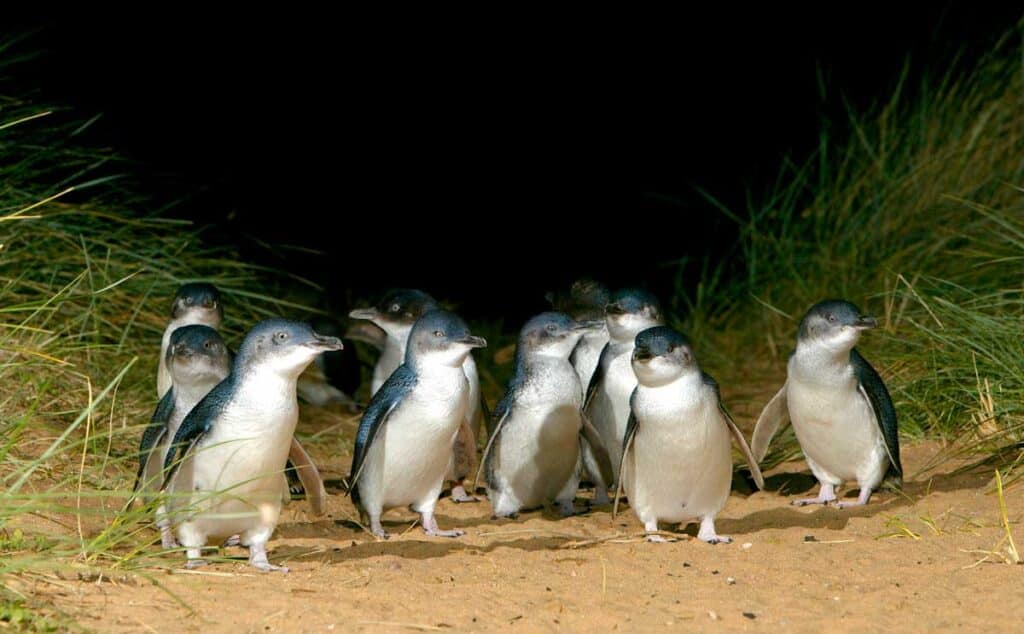
The little penguin — the world’s smallest penguin species, standing roughly 33 centimetres tall and weighing not much more than a kilogram — has an improbable relationship with the state of Victoria. It breeds along much of the Victorian coastline, tolerates human visitors with an equanimity that borders on indifference, and has, in the case of Phillip Island, attracted a tourism industry of considerable scale. Some 500,000 people a year make the trip to watch the animals waddle ashore at dusk. This is not a niche pursuit.
Also known in Australia as the fairy penguin, the little penguin is a year-round resident at several Victorian sites. Unlike its Antarctic cousins, it does not migrate. It simply gets on with its life — fishing by day, returning to its burrow at sunset, raising its chicks in spring — while the rest of the world watches, often with expressions of helpless delight.
Victoria has four reliably productive locations for penguin watching, each with a distinct character. This wildlife-spotting guide outlines what to expect at each one.
Phillip Island: the penguin parade
Phillip Island, a two-hour drive south-east of Melbourne, is the dominant name in Victorian penguin tourism by some margin. The island is home to a colony of approximately 32,000 little penguins, the largest in Victoria, concentrated around the beaches and sand dunes of the island’s southern coast. The main event — marketed, with appropriate directness, as the Penguin Parade — takes place at Summerland Beach every evening at dusk, when the penguins emerge from the surf and make their way inland to their burrows in the dunes.
The spectacle is managed by Phillip Island Nature Parks, which operates a tiered system of viewing options ranging from general grandstand seating to elevated platforms and small-group underground viewing areas. The penguins are entirely indifferent to all of it. They emerge when they emerge, crossing the beach at their own pace, occasionally pausing, occasionally toppling over each other. Numbers vary considerably by night and by season, and there are no guarantees, but 100 or more birds is not unusual during the summer breeding season.
Photography of the penguins during the parade is not permitted — flash photography in particular is disorienting for the birds — so the experience is, whether you like it or not, a largely unmediated one. The absence of phones in front of faces turns out to be rather pleasant.
A small-group eco tour from Melbourne covers the key sites of the island before the parade, including a stop at the Moonlit Sanctuary Wildlife Conservation Park, the Brighton Beach bathing boxes and the rugged headland at the Nobbies, which overlooks a large Australian fur seal colony on Seal Rocks. All entrance fees are included, and the tour returns to Melbourne after the parade, making it a long but self-contained day out.
For those who prefer a more unhurried pace, a small-group day tour combining the Penguin Parade with wine tasting and lunch visits a boutique local winery for a tasting and grazing platter, watches the sunset from the Nobbies with a glass of sparkling wine, and ends at the parade. Groups are capped at 15, and the pace is considerably more relaxed than the standard coach tour format.
If you’re driving yourself, it’s highly advisable to book Penguin Parade tickets online in advance.
St Kilda, Melbourne: penguins in the city
Not everyone visiting Victoria has the time or inclination for a full day trip to Phillip Island. The good news is that a small but established penguin colony lives right on the edge of Melbourne itself, in the granite boulders of the St Kilda breakwater.
Around 1,200 little penguins nest in the rocks at the end of the St Kilda Pier, making this one of the only city-adjacent penguin colonies in the world. They return each evening at dusk, and are consistently visible during spring and summer (September to February in particular). Entry to the breakwater is free, and the pier is easily reached by tram from the city centre.
Viewing is managed by a small team of volunteer rangers who patrol the breakwater after dark and can direct visitors to where the penguins are active on any given night. The numbers here are nothing like Phillip Island, but the proximity is extraordinary — birds pass within a metre or two of visitors, again with complete apparent indifference. On a calm evening, with the city lights reflecting off Port Phillip Bay, it is a genuinely memorable experience.
The main rules are simple: no flash photography, no torches, no approaching the birds, and no touching them if they come to you. The rangers are politely but firmly insistent on all of these points.
Five great things to do while you’re in Melbourne
- 🏙️ Get to know the city’s history and culture on a laneways walking tour.
- 🍷 Take a Yarra Valley day tour with indulgent wine-tasting.
- 🚴 Cover far more of Melbourne’s highlights on an electric bike tour.
- 🛶 Kayak along the Yarra River at sunset.
- 🍽️ Discover Melbourne’s multicultural dining scene on a top-rated food tour.
Queenscliff and Point Lonsdale
On the western side of Port Phillip Bay, the towns of Queenscliff and Point Lonsdale at the tip of the Bellarine Peninsula are considerably quieter penguin-watching destinations than either Phillip Island or St Kilda. A small colony nests along the rocky foreshore around Point Lonsdale Lighthouse, and the birds return there each evening in modest but reliably visible numbers.
The appeal here is the atmosphere rather than the numbers. Queenscliff is a handsome Victorian-era seaside town with a working fishing harbour, and a summer evening spent watching penguins emerge from the water near the lighthouse — with the lights of the Rip and the ferries passing in the background — has a quality that the larger, more managed sites can lack. There are no grandstands, no tiers of seating, no merchandise shops. Just the birds and the foreshore.
Warrnambool and the Maremma dogs of Middle Island
Further west along the Great Ocean Road, the city of Warrnambool is home to one of the more unusual stories in Australian wildlife conservation. A small colony of little penguins nests at nearby Middle Island, a tidal island accessible on foot at low tide via Mahers Landing. By the early 2000s, repeated fox attacks had reduced the colony from around 600 birds to fewer than 10. The local council, after some deliberation, decided to try something unconventional: deploying Maremma sheepdogs to guard the colony.
The scheme worked. The dogs, specifically bred to protect livestock from predators, bonded with the penguins instead and proved effective deterrents against fox incursion. The colony has since recovered to around 200 birds. The story attracted enough international attention to be made into a film — Oddball, released in 2015 — and the Maremma project remains active. Dogs named after the film’s characters continue to be deployed during the penguin breeding season.
Penguin viewing at Middle Island is managed through guided tours operating from Warrnambool during the breeding season (roughly October to February), and the site is accessible only with a registered guide. The Flagstaff Hill Maritime Village in Warrnambool also provides good contextual information about the local colony and the conservation project.
Warrnambool sits approximately three and a half hours west of Melbourne along the Great Ocean Road, making it a natural stop on any road trip along the coast rather than a straightforward day trip from the city.
Practical tips for seeing penguins in Victoria
When to go
Little penguins are present at all Victorian sites year-round, but numbers at the penguin parade and other locations are highest during the breeding season, from October to February. The birds are particularly active during this period, with more individuals coming ashore each evening and more visible activity around burrows. Outside the breeding season, sightings are still reliable but numbers are lower and timing is less predictable.
What time to arrive
The penguins return to shore at dusk, and the precise time shifts throughout the year. Phillip Island Nature Parks publishes daily parade times on its website, and most tour operators time their day trips to arrive with comfortable margin. At St Kilda, the penguins typically begin arriving 30 to 45 minutes after sunset. At other sites, it is worth arriving at the viewing area well before dark and simply waiting.
What to bring
Victorian coastal evenings can be considerably cooler than the afternoon suggests, particularly at Phillip Island where the Bass Strait wind has an unimpeded run at the beach. Bring more layers than you think you need. Torches and flash photography are prohibited at virtually all penguin viewing sites — the light disorients the birds and disrupts their navigation. Red-filtered torches are the exception at some sites, but check individual site rules before visiting.
Booking in advance
Phillip Island’s Penguin Parade sells out regularly during peak summer months and school holidays. Booking several weeks in advance is advisable, particularly for the premium viewing options. Day tour operators from Melbourne also fill up quickly during high season, and last-minute availability is not guaranteed.
More Victoria travel
Other Victoria travel articles on Planet Whitley include:
- Planning a visit to the Healesville Sanctuary.
- What to expect at Deep Blue Hot Springs in Warrnambool.
- How tours of the J Ward Lunatic Asylum in Ararat work.
- Exploring Murray Sunset and Hattah-Kulkyne national parks in north-eastern Victoria.
- A series of wildlife encounters on the Great Ocean Road.