Scotland has two resident seal species: the grey seal and the smaller harbour seal (also called the common seal). Combined, they account for roughly 40 per cent of the world’s grey seal population and around 30 per cent of Europe’s harbour seals. In short, Scotland is one of the finest places on earth to see wild seals — and virtually no effort is required to find them.
Both species are present year-round, though grey seals are most conspicuous during pupping season from October to December, when large numbers haul out on beaches and rocky shores. Harbour seals pup in summer, from June to August. The locations below span the country from the Hebrides to the northern isles, each with a distinct character.
Fort William and Loch Linnhe
Fort William, at the foot of Ben Nevis on the western Highland coast, sits on Loch Linnhe — a sea loch that extends southwards toward the Firth of Lorn and holds a healthy population of both grey and harbour seals. The seals congregate on a small islet in the loch known, with admirable simplicity, as Seal Island.
A seal island cruise from Fort William’s town pier navigates the loch past castle ruins, Highland shoreline and the views toward the Ardnamurchan peninsula before arriving at the seal haul-out. Reviewers consistently report 20 or more seals at close range. The skipper provides wildlife and historical commentary throughout. Hot drinks and snacks are available on board, and the cruise is comfortable for all ages. One reviewer describes it as “the icing on the cake” of a Fort William trip.
This is an excellent option for visitors already based in Fort William for Ben Nevis, Glen Coe or the Jacobite steam train. It adds a two-hour wildlife dimension to a day otherwise spent in the mountains.
The Isle of Mull and the Treshnish Isles
The waters around Mull, in the Inner Hebrides, are among the most wildlife-rich in Britain. Grey seals haul out on the rocky skerries around the island’s coastline, and the uninhabited Treshnish Isles to the west hold large breeding colonies on low, flat rocks between the cliffs and the sea. White-tailed sea eagles, otters, minke whales and dolphins move through the same waters — any boat trip here tends to accumulate sightings.
A wildlife and Staffa tour from Mull or Iona combines a visit to the extraordinary basalt columns of Fingal’s Cave on Staffa with open-water wildlife searching around the Treshnish Isles, with seals, dolphins, gannets, puffins and occasional minke whales among the species reported. Reviewers describe the guide’s knowledge as exceptional, and multiple trips report white-tailed sea eagles as a bonus sighting on the crossing. Departures are available from Fionnphort, Iona and Tobermory depending on the route chosen.
Mull itself rewards several days of exploration. Tobermory, the island’s brightly painted main town, has a working harbour where seals are regularly seen from the pier. The single-track roads circling the island pass coastal viewpoints where seals can be spotted from the car.
The Isle of Skye and Glenelg
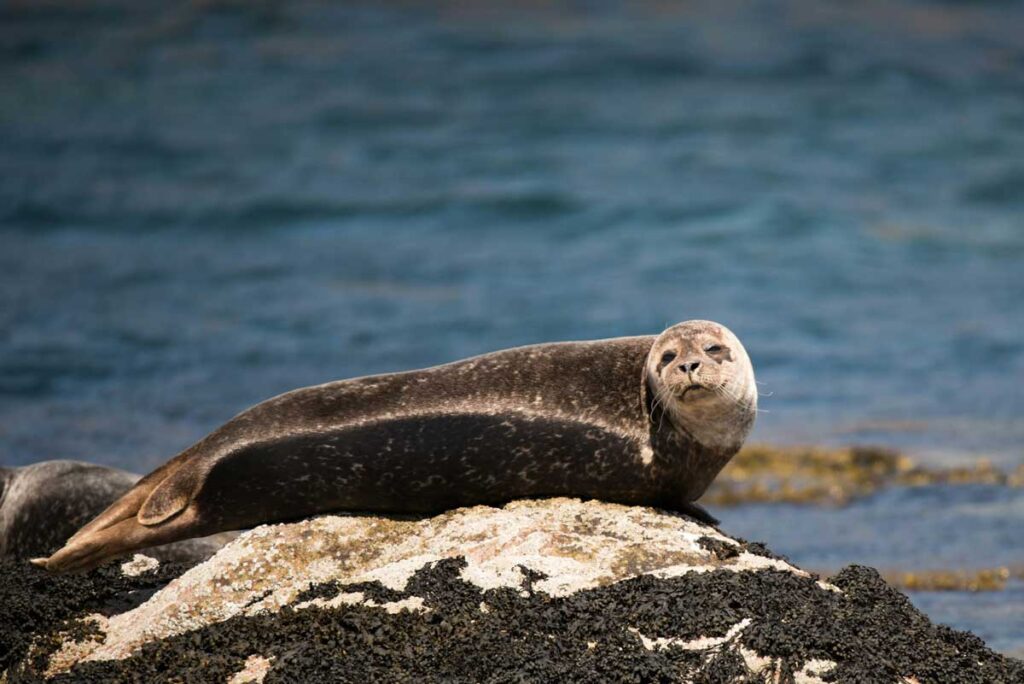
Skye’s coastline is extensive and varied — sea cliffs, sheltered sea lochs, sandy bays and the tidal races of the sounds between islands. Grey and harbour seals are present throughout, with particular concentrations in the quieter sea lochs on the island’s western side. The waters around Loch Dunvegan in the northwest are reliably productive, with seals visible from the castle grounds and the shoreline paths.
On the mainland just across from Skye, the Glenelg ferry crossing — the shortest crossing to Skye, running in summer only — passes through tidal narrows where seals are almost always visible in the water or on the rocks. The village of Kylerhea on the Skye side has a small hide overlooking the narrows, managed by the Forestry Commission, where otters are also regularly spotted.
A wildlife photography experience on Skye with an expert guide covers the island’s best wildlife habitats on foot and by vehicle, targeting golden eagles, white-tailed sea eagles, red deer, otters and seals across a full day. The guide is a professional wildlife photographer with deep local knowledge and carries specialist equipment. Groups are kept very small. This is the best option for visitors who want to photograph seals and other Skye wildlife properly rather than view them from a boat or at distance.
Orkney
The Orkney Islands, a 20-island archipelago separated from the Scottish mainland by the Pentland Firth, hold some of the largest grey seal colonies in Britain. The coastline here — red sandstone cliffs, tidal races, sweeping sandy bays — is ideal seal habitat, and the animals are present in large numbers along virtually every stretch of exposed shoreline.
Orkney combines exceptional seal watching with some of the most extraordinary prehistoric archaeology in Europe: Skara Brae, the Ring of Brodgar, Maeshowe and a dozen other Neolithic and Viking sites within a short drive of each other. Few destinations anywhere reward time as consistently as Orkney does.
A day trip to Orkney from Inverness travels by coach to John O’Groats, crosses the Pentland Firth by ferry — a crossing where seals, seabirds and occasional whales and porpoises are spotted — and tours the island’s main Neolithic and Viking sites with a local guide. The Churchill Barriers causeway passes seal haul-outs directly alongside the road. A full day on the islands is included before the return crossing.
For those already on Orkney, an Orkney trike tour with a local guide explores the dramatic sandstone coastline and seal colonies at a leisurely pace, with itineraries tailored to your interests. The guide — a lifelong Orkney resident — can route the tour specifically around the best seal haul-outs alongside the archaeological sites. Themed options include Neolithic Orkney, Orkney at War and a coastal wildlife circuit.
Shetland
The Shetland Islands, 170 miles north of the Scottish mainland and closer to Bergen than to Edinburgh, hold the most concentrated grey seal populations in Scotland. The islands’ 900 miles of coastline — sea stacks, geo cliffs, voes and white sand beaches — provide haul-out sites at almost every headland. The seals here are notably unhurried in the presence of humans and often allow close approach on foot.
Lerwick, Shetland’s main town, has grey seals visible in the harbour from the waterfront. The Out Skerries, Noss and Mousa island all hold large colonies. Mousa, site of the best-preserved Iron Age broch in the world, has seals on the beach immediately below the tower — one of the stranger wildlife-watching contexts you are likely to encounter.
Getting to Shetland requires a flight from Aberdeen, Edinburgh, Inverness or Glasgow, or an overnight ferry from Aberdeen. Once there, the island rewards several days of exploration. Orcas visit the waters around Shetland occasionally in summer, often in pursuit of grey seals — the encounter can be dramatic and is well documented by local wildlife watchers.
Practical tips for seeing seals in Scotland
Grey seal versus harbour seal
Grey seals are larger, with a distinctive long, horse-like head. Harbour seals are smaller and rounder-faced, with a more dog-like profile. In Scotland, grey seals are more abundant in the north and west; harbour seals favour sheltered sea lochs and the eastern coast. Both species are often seen together at productive haul-out sites.
Pupping season
Grey seals pup from October to December on exposed beaches and rocky shores. This is when the largest aggregations form and when white pups are visible at close range. Pupping beaches should be approached quietly and from downwind — disturbed females may abandon their pups. Harbour seals pup in June and July, with pups able to swim almost immediately after birth.
What to bring
Scotland’s coastal weather is changeable in any month. Waterproof layers, warm underlayers and sturdy footwear are essential at any coastal site. On boat trips, wind chill on the water is considerably more intense than the air temperature onshore. Binoculars improve both boat and land-based viewing significantly — a 10×42 pair is a sensible choice for Scottish coastal wildlife watching.
More Scotland travel
Other Scotland travel articles on Planet Whitley include:
- Live out your Outlander fantasies at Beauly Priory and the Clava Cairns.
- Explore Scottish history at Fort George and Culloden Battlefield.
- Making a visit to the Fairy Pools and Dunvegan Castle on the Isle of Skye.
- Is it worth visiting the University of Dundee Botanic Garden?
- What to expect when visiting St Machar’s Cathedral in Aberdeen.