The jungle-covered ancient Mayan city of Tikal has appeared in a Bond film and Star Wars. Climbing the temples is an awe-inspiring experience.
The howler monkeys of the Guatemalan jungle
The roars cry out over the thick Central American jungle. It’s all very Jurassic Park. As we plod through the puddles and over the slippery limestone it gets louder, nearer, more fearsome. That can only be a T-Rex.
Our guide, Antonio, has different ideas. “Howler monkey,” he says. “And not a very happy one.”
The angry ape isn’t alone. All manner of creatures prowl around under the dense canopy. Jaguars, snakes, the odd cougar… it’s hardly the place you’d expect to find one of the world’s greatest ancient cities.
Why book a Tikal day trip by air from Guatemala City?
- ✈️ Fast and scenic flight from Guatemala City gives you more time exploring at Tikal
- 🏛️ Discover the ancient Mayan ruins with a knowledgeable guide sharing historical insights
- 🐒 Spot wildlife like monkeys, toucans, and howler monkeys in the surrounding rainforest
- 🍽️ Includes a traditional Guatemalan lunch to complete your immersive day
- 🚌 All transfers and logistics handled so you can relax and enjoy the experience
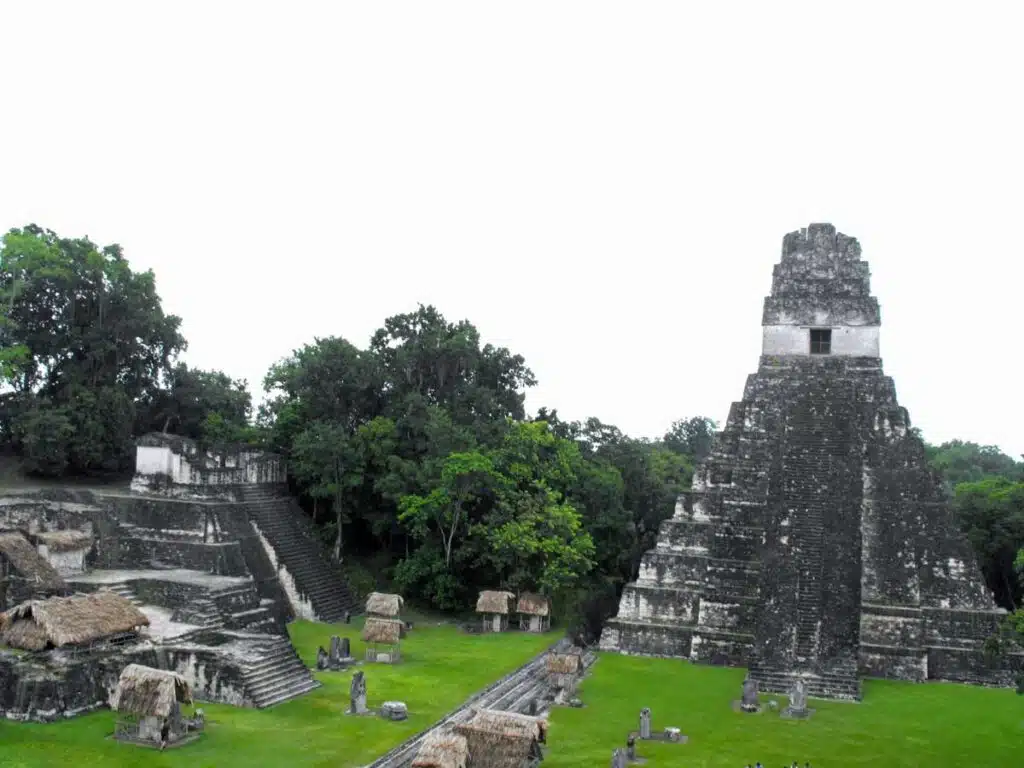
A first sighting of Gran Plaza at Tikal
But through the vines and strangler figs, the abandoned Mayan city of Tikal suddenly appears, and it is well worth braving the nasties for. In fact, the jungle location adds to the wow factor.
But frankly you could put Gran Plaza in the middle of a grim industrial estate and it would still impress. In a way, it’s a northern version of Machu Picchu.
Tikal was one of the most powerful and important Maya cities. It would be wonderful if this was down to trade and enlightened social policies, but it was more down to adopting advanced military procedures and relentless bullying of neighbours.
Tikal on film
The Gran Plaza is the centrepiece of this great lost city, but it would be possible to spend days wandering the trails around the site and continually come across buildings more than 1200 years old.
Some are rather famous – the site featured in the original Star Wars film and was the villain’s lair in the Bond movie Moonraker – but the little things are equally fascinating.
For example, two holes in the ground were kitchen stores, while another structure that looks like a scale model bridge is a kiln.
How old is Tikal?
According to Antonio, fragments of the site date back to 800BC. They have been built upon and built upon, of course, but even the newer bits are fearsomely advanced for their time.
The oldest bits are in the Lost World, so named because prudish archaeologists saw Karma Sutra-like engravings on the walls and thought it was a place of lost morals.
Moreover, the vast majority of the site is still uncovered. Renovation and excavation work is underway, but it’s a slow process – Guatemala is a poor country and can only divert so much funding towards archaeological digs.
And considering that, at its peak, Tikal was thought to have a population of around 190,000, the scale of the task is enormous.
Templo I at Tikal
In the mean time, however, the big set pieces are incredible. The emblem of Gran Plaza is Templo I (or, to use its far cooler name, the Temple of the Grand Jaguar). It’s a steep pyramid structure, topped with ceremonial rooms and an arch, and it manages to breach the canopy and reach for the sun. It was built as a rather over-the-top burial site for King Moon Double Comb, but only got completed under his son and successor.
In the past, it has been possible to climb it, but a few falls and a few deaths tend to put a dampener on that sort of activity.
Climbing Templo II at Tikal
Still, it is possible to climb the slightly shorter (but still hugely commanding) Templo II opposite. Wisely, some wooden steps have been built by the side – the steep, uneven limestone steps are incredibly slippery when it has been raining.
Sat on top of Templo II, we’re treated to a small taste of Mayan culture. A group of indigenous Maya arrive to conduct a ceremony in a central circle. It involves fire, lots of chanting, large candles and slightly incongruous Catholic-style crossing of the chest. Antonio tells us that they have come as a pilgrimage and are giving thanks for a good harvest.
The Tikal Necropolis
Between the two temples is a necropolis complex. Over the years, a treasure trove of 24,000-plus Mayan artefacts have been found in there, pilfered by foreign archaeologists and taken to museums across the world.
Some bits still remain, however. Under a shelter, for example, a huge stone face can be seen. It is thought that this is a depiction of the rain god. Nearby is a less well-preserved image of the sun god.
Mayan maths and science
Excavations at Tikal and elsewhere in the region tell us a lot about Maya culture and beliefs. Visitors all want to hear about the human sacrifices, of course, but arguably more astonishing are the achievements in maths and astronomy. The temples and pyramids at Tikal were built with such precision that during equinoxes and solstices, their shadows line up in pre-designed ways and the sun shines through small holes and archways. The Mayan calendar, too, was accurate to within three minutes over a period of 35 centuries.
Why was Tikal abandoned?
Tikal was abandoned in the 9th century AD, but the reason why is one of its many mysteries. A current school of thought has it that the Mayans cut down so much of the jungle to create the city that the eco-system was ruined. Food and water sources dried up, there was a major drought, and competition for resources led to destructive warfare. The theory applies to the Maya civilisation as a whole.
Nature reclaims Tikal
But this is especially poignant at Tikal. From the top of the 64m Templo IV – the second highest building on the American continent before the Spanish conquest in the 16th century – it is clear how the jungle has reclaimed the site.
Only the tops of the other temples can be seen on the pure green horizon, and it can be seen as a modern day parable: where man destroys too much of its environment, nature will claim its revenge.
How to get to Tikal
Tikal is, frankly, in the middle of nowhere in the Northern Guatemalan jungle. It’s a 10 hour drive from Guatemala City. The nearest town of any size is Flores, which is 66km away but has an airport.
Several companies operate not-entirely-reliable shuttle buses from Flores to Tikal. Adrenalina Tours is amongst those offering $20 return trips, as long as they get 48 hours notice.
Given that you can get a basic guided tour to Tikal including transportation for $25, you might as well go for the tour.
There are also more in-depth sunrise tours that focus on the archaeology and wildlife.
If you’re in Guatemala City or Antigua, and want to dodge a gruelling bus journey, you’re better off going by air. Day tours including flights, guided tours of the ruins and lunch are available from Guatemala City.
Things to do near Tikal
- Visit Yaxhá Archaeological Park. Around 35 miles from Tikal, this large Maya site sits beside a lagoon and includes pyramids, plazas and causeways.
- Explore Uaxactún. Approximately 15 miles north of Tikal, this lesser-known Maya city offers temples, stelae and an insight into ancient astronomical alignments.
- Discover the ruins of El Zotz. About 20 miles from Tikal, El Zotz is a remote archaeological site known for Temple of the Night Sun and wide views over the jungle canopy. Access normally requires a guided tour.
- Take a boat trip on Lake Petén Itzá. Around 40 miles south in Flores, boat excursions run on the lake with stops at lakeside villages and viewpoints.
- Visit the island town of Flores. Built on Lake Petén Itzá, Flores is the main base for visiting Tikal, with museums, restaurants and colonial-era streets to explore.
Tikal FAQs
| Question | Answer |
|---|---|
| What is Tikal? | Tikal is one of the largest and most important ancient Maya cities, located in northern Guatemala and surrounded by dense rainforest within Tikal National Park. |
| Do I need to book Tikal tickets in advance? | Advance booking is recommended, especially during peak travel months, although tickets can also be purchased locally. |
| How long should I allow for visiting Tikal? | Most visitors spend between 4 and 6 hours exploring Tikal, depending on how many temples and plazas they choose to visit. |
| Can you climb the temples at Tikal? | Some temple structures allow climbing to viewpoints, although access can change for conservation reasons. |
| Where is Tikal located? | Tikal is located in Guatemala’s Petén region, about 40 miles north of Flores, within the protected rainforest of Tikal National Park. |
More Guatemala travel
Other Guatemala travel stories on Planet Whitley include:
- Meeting Maximon – Guatemala’s rogue saint.
- Conquering the Cueva del Tigre.
- Climbing volcanoes in Guatemala – Pacaya and Chicabal.