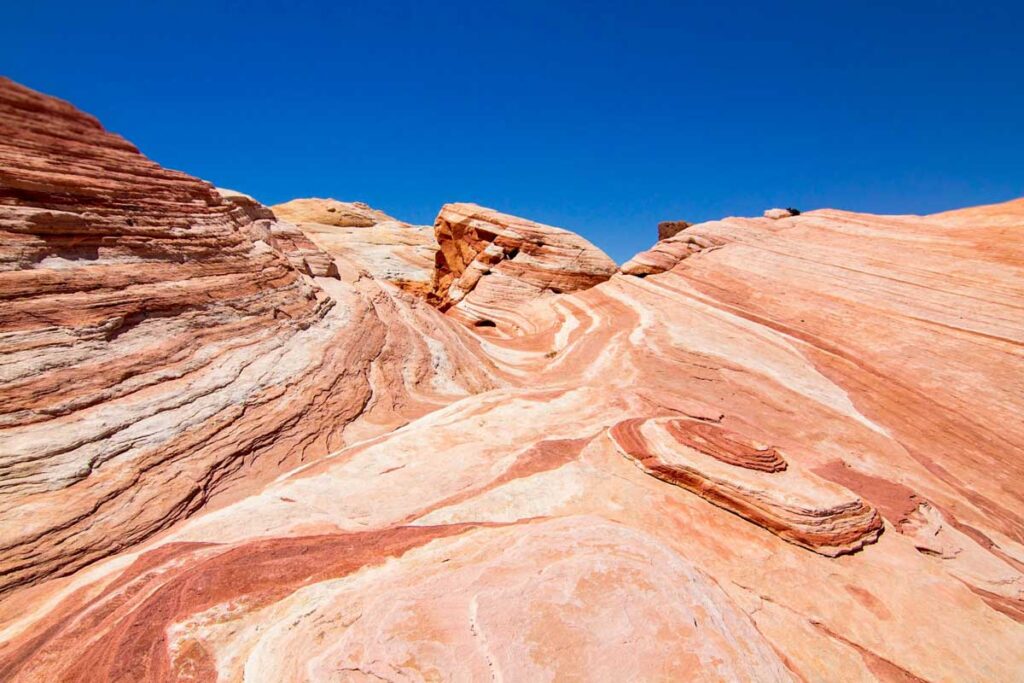
There is a moment, somewhere along the road into Valley of Fire State Park, when the desert stops being a backdrop and becomes something altogether more confrontational. The Mojave scrub falls away. The rock — Aztec sandstone deposited by vast dune fields some 150 million years ago — erupts from the earth in formations of deep arterial red, swirling pink, and vivid ochre. The effect is less like arriving somewhere and more like being swallowed whole.
Nevada‘s oldest state park, established in 1935, sits roughly 55 miles northeast of Las Vegas and covers nearly 46,000 acres of a landscape that feels simultaneously primordial and extraterrestrial. It has served as a filming location for Star Trek Generations, Total Recall, and countless other productions requiring a plausible stand-in for another world. And yet nothing Hollywood has conjured here quite matches the real thing on a clear winter morning, when the low sun ignites the sandstone cliffs and the shadows cut deep and dramatic across the canyon walls.
What makes Valley of Fire worth the trip
The park’s defining characteristic is its geological drama. The Aztec sandstone that makes up its most recognisable formations was laid down during the Jurassic period, when this part of North America was a vast inland desert of shifting sand dunes — not unlike the modern-day Sahara. Over millions of years, iron oxide in the rock produced its signature red and orange palette, while mineral-rich groundwater created the banded pastels and creamy whites that appear in formations like Rainbow Vista and the Beehives.
Beyond geology, Valley of Fire is one of the best sites in the American Southwest for viewing ancient rock art. The Ancestral Puebloan people lived and passed through this region from roughly 300 BCE to 1150 CE, leaving behind petroglyphs at dozens of sites across the park. Atlatl Rock, named for the spear-throwing device depicted in its carvings, is among the finest and most accessible.
What the park lacks — and this is part of its appeal — is crowds on the scale of other Southwest icons. Compared with Zion, Arches, or the Grand Canyon, Valley of Fire remains relatively uncrowded. Come on a weekday in January or February and you may find yourself alone with the rocks and the ravens.
Why book the Small-Group Valley of Fire half-day hiking tour from Las Vegas?
- Discover Valley of Fire State Park: Explore Nevada’s oldest state park, known for its vivid red sandstone formations and dramatic desert scenery.
- Guided hiking experience: Enjoy led walks with a local guide who shares insight into the geology, wildlife and history of the area.
- Small-group format: Limited group size keeps the experience personal and relaxed, with plenty of time to ask questions and enjoy the landscape.
- Photo opportunities: Visit iconic spots like the Fire Wave, Elephant Rock and scenic overlooks perfect for striking photos.
- Easy half-day adventure: A compact outing ideal if you’re short on time but still want to experience Nevada’s spectacular desert landscapes without self-drive stress.
When to go
The park’s name is not merely poetic. Summer temperatures routinely exceed 110°F (43°C), making hiking genuinely dangerous between June and September. The optimal visiting window runs from October through April, with midwinter offering the most comfortable temperatures — typically between 50°F and 70°F (10–21°C) — and the most dramatic light. Spring wildflowers are an added bonus in March and April, when patches of desert gold and purple bloom around the canyon floors.
Sunrise and sunset are the golden hours for photography, when the oblique light transforms the sandstone from red to amber to burning orange and back again. The park’s western entrance faces east, meaning morning light strikes the main formations head-on. Plan accordingly.
Practical information
| Location | 55 miles northeast of Las Vegas, Nevada |
| Getting there | Interstate 15 North, exit 75 to NV-169 East. No public transport serves the park. |
| Entry fee | $10 per vehicle (Nevada residents) / $15 (out-of-state). Annual Nevada State Parks pass accepted. |
| Opening hours | Open daily year-round. Visitor centre opens 8:30am. |
| Best time to visit | October to April. Summer temperatures frequently exceed 110°F (43°C). |
| How long to allow | Half a day minimum; a full day to do the park justice. |
Top sights in Valley of Fire
The park contains dozens of named formations and trailheads, but the following six are the highlights most visitors should prioritise. Click through for detailed guides to each, including parking, trail information, and photography tips.
- The Seven Sisters — Seven eroded sandstone buttes rising from the valley floor, among the park’s most striking formations.
- Atlatl Rock — An accessible petroglyph site featuring ancient carvings by Ancestral Puebloan people, including a rare depiction of an atlatl spear-thrower.
- Rainbow Vista — A canyon of banded sandstone in shades of red, pink, cream, and purple — the park’s most colourful and painterly landscape.
- Elephant Rock — A remarkably lifelike sandstone formation near the eastern entrance, reached via a short and easy walk.
- The Beehives — Rounded, layered domes of pale sandstone shaped over millennia by wind and rain, otherworldly in golden hour light.
- Fire Wave — Swirling red-and-white banded rock resembling a frozen wave, and the park’s single most iconic image.
Taking a tour from Las Vegas vs. driving independently
Valley of Fire is an easy day trip from Las Vegas, but the question of whether to join a guided tour or hire a car and go independently is worth thinking through carefully. Both options have real merits depending on your circumstances.
| Criteria | Guided Tour | Independent Visit |
|---|---|---|
| Transport | Included from Las Vegas — no hire car needed | Requires a hire car or your own vehicle |
| Flexibility | Fixed itinerary and timings | Go at your own pace, stay as long as you like |
| Expert knowledge | Local guide provides geological and cultural context | Self-guided — do your research in advance |
| Cost | Higher per-person cost, but all-inclusive | Cheaper for groups sharing a car |
| Best for | Solo travellers, first-timers, those without a car | Couples and groups, photographers, repeat visitors |
| Golden hour access | Limited by group schedule | Full control over arrival and departure times |
The case for taking a tour
If you don’t have access to a car, a guided tour is the only realistic way to reach Valley of Fire from Las Vegas — there is no public transport to the park. Beyond the logistics, a good guide transforms the experience. The geology of this park is extraordinary but also complex; knowing what you’re looking at, and why it looks that way, adds considerable depth to what might otherwise be a series of impressive but anonymous rocks.
Small-group tours in particular offer a good balance of structure and intimacy. The Small-Group Valley of Fire Half-Day Hiking Tour from Las Vegas is a well-regarded option, covering the park’s highlights with an expert local guide and departing directly from the city. It’s a particularly good fit for solo travellers and first-time visitors who want to make the most of a single day without the overhead of planning and navigation.
The Case for Going Independently
For anyone with access to a car, driving independently gives you something a tour cannot: time. You can be at the trailhead for Fire Wave before the coach parties arrive, linger at Rainbow Vista until the light is exactly right, and leave whenever you choose. For photographers especially, this freedom is worth a great deal.
Going independently also makes it easier to combine Valley of Fire with other nearby stops — Lake Mead, the ghost town of St. Thomas, or the small town of Overton and its excellent lost city museum. And for groups of three or more, the cost of a hire car will often undercut the per-person price of a tour.
Final Word
Valley of Fire rewards those willing to slow down. Its finest moments — the petroglyphs at Atlatl Rock, the chromatic intensity of Rainbow Vista, the eerie geometry of the Beehives at dusk — are not things you absorb from a moving vehicle. Get out, walk, and give the place time to work on you.
Whether you arrive on a guided tour from Las Vegas or under your own steam, the essential advice is the same: go early, go slow, and go more than once. Valley of Fire has a habit of revealing something new on every visit — a different angle on a familiar formation, a quality of light that turns the whole canyon wall briefly, brilliantly gold.
Guides to the top sights in Valley of Fire State Park: The Seven Sisters, Atlatl Rock, Rainbow Vista, Elephant Rock, the Beehives and Fire Wave.
This post contains affiliate links. If you book a tour through our links, we may earn a small commission at no additional cost to you.
More Nevada travel
Other Nevada travel stories on Planet Whitley include:
- Is it worth visiting Seven Magic Mountains from Las Vegas?
- Why an ebike tour is the best way to explore Red Rock Canyon.
- The quirky tour of the Techatticup Gold Mine.
- How to see Hoover Dam from the water.
- A practical guide to visiting Rhyolite, Nevada’s most spectacular ghost town.