Goosenecks State Park is a primitive, remote state park in southeastern Utah, offering a dramatic overlook of a deep, twisting canyon carved by the San Juan River. This guide covers opening hours, ticket prices, transport or parking, accessibility, and practical visitor tips.
This guide was last updated in April 2026.
Quick facts
| Opening hours | Open 24 hours a day, year-round |
| Ticket prices | $5 per private vehicle (up to 8 people) |
| Address | UT-316, Mexican Hat, UT 84531 |
| Nearest public transport or parking | Free on-site parking at the rim overlook; no public transport available |
| Typical time needed to visit | 30 to 60 minutes |
Goosenecks State Park opening hours
Goosenecks State Park is open 24 hours a day, seven days a week, 365 days a year. Because it is a designated International Dark Sky Park, the site remains open overnight for stargazers and campers.
There are no locked gates restricting entry or exit, meaning visitors can arrive well before dawn for sunrise photography or stay late into the evening.
Goosenecks State Park ticket prices
The standard day-use fee for Goosenecks State Park is $5 per private vehicle (covering up to eight people). Utah seniors aged 65 and older pay a discounted rate of $2 per vehicle, while commercial bus tour groups pay $2 per person.
Opening hours and ticket prices were checked on the official Utah State Parks website and last updated in April 2026. The park accepts the Utah State Park Annual Day-Use Pass. Please note that the federal America the Beautiful Pass is not accepted here, as this is a state-managed park, not a national park.
How to get to Goosenecks State Park
To get to Goosenecks State Park, visitors must drive, as the remote desert location has no public transport links. The park is located at the end of Utah State Route 316.
From the small town of Mexican Hat, drive four miles north on US Highway 163, turn left onto UT-261 for one mile, and then turn left again onto UT-316, which ends directly at the park’s overlook after three miles. The entire route is paved and accessible for all vehicle types.
Parking at Goosenecks State Park
There is dedicated parking at Goosenecks State Park located right along the rim of the canyon. The paved road loops through a large dirt and gravel parking area next to the main observation shelter.
The parking lot provides ample room for cars, motorcycles, and large recreational vehicles (RVs) to pull up and park just steps away from the canyon edge.
How long to spend at Goosenecks State Park
A typical visit to Goosenecks State Park takes between 30 and 60 minutes. This is primarily a “viewpoint” park with no maintained hiking trails leading down to the water, so most visitors simply park, walk to the edge, read the interpretive signs, and take photographs.
If you are staying for a picnic, setting up a tripod to capture the sunset, or camping overnight to view the stars, your stay will naturally be longer.
Accessibility at Goosenecks State Park
Accessibility at Goosenecks State Park is relatively straightforward due to the layout, though the site remains largely primitive. The drive leads directly to the main viewing area, allowing visitors with limited mobility or wheelchair users to see the entrenched river meanders just a short, flat distance from their vehicles.
The park features an accessible observation shelter and standard vault toilets. However, because the site is perched on a natural, rugged cliff edge, there are no paved walking paths along the rim, and the dirt surfaces can be uneven.
Inside / what to see at Goosenecks State Park
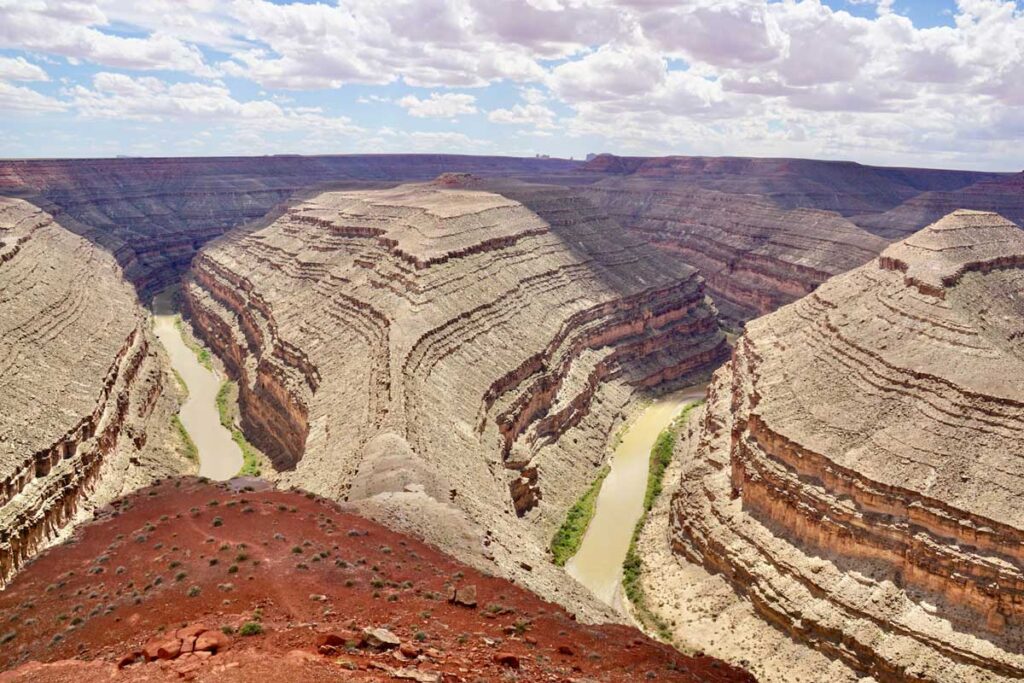
Inside Goosenecks State Park, the singular and spectacular attraction is the view of the “entrenched meanders” of the San Juan River. Looking down from the rim, the canyon drops roughly 1,000 feet, revealing intricate layers of limestone and shale that showcase 300 million years of geological history.
Over a straight-line distance of just 1.5 miles, the river winds and twists for more than six miles, creating shapes that resemble the necks of geese. On clear days, the expansive panoramic views stretch for miles across the desolate desert landscape toward Monument Valley and Arizona.
Because of its extreme remoteness and lack of light pollution, the park was certified as an International Dark Sky Park in 2021, making it one of the premier locations in the American Southwest for naked-eye stargazing and astrophotography.
Practical visitor tips
| Tip Category | Visitor Advice |
| Timing | Visit during the spring or autumn to avoid the intense summer heat, as there is absolutely zero natural shade at the park. |
| Crowds | If you plan to use one of the eight primitive campsites along the rim, arrive early in the afternoon, as they are first-come, first-served. |
| Layout | Maintain a safe distance from the canyon edge; there are no guardrails or fences, and the cliff edges can be unstable. |
| Entry process | If no park ranger is staffing the entrance booth, use the self-serve fee envelopes and the drop tube to pay your $5 entry fee in cash. |
| On-site logistics | Bring all the drinking water and supplies you will need. There is no running water, no firewood, and no food sold on-site. |
Frequently asked questions about Goosenecks State Park
| Question | Answer |
| Is Goosenecks State Park suitable for children? | Yes, the views are easily accessible for children, but strict and constant supervision is absolutely mandatory due to the sheer, unfenced 1,000-foot drop-offs. |
| Do you need to book tickets in advance for Goosenecks State Park? | No, advance booking is not required. Both day-use entry and overnight camping are strictly on a first-come, first-served basis. |
| Is Goosenecks State Park open on Sundays? | Yes, the park is open 24 hours a day, including Sundays and all public holidays. |
| Are dogs allowed at Goosenecks State Park? | Yes, dogs are welcome in the park, but they must be kept on a leash no longer than six feet at all times. |
Things to do near Goosenecks State Park
- Monument Valley Navajo Tribal Park: World-famous, towering red sandstone buttes situated along the Utah-Arizona border, roughly a 45-minute drive south.
- Valley of the Gods: A spectacular, unpaved 17-mile scenic loop drive through a valley of isolated monoliths and pinnacles, located just north of Mexican Hat.
- Moki Dugway: A thrilling, steep, and unpaved series of switchbacks carved into the side of Cedar Mesa on UT-261, offering massive views over the valley.
- Natural Bridges National Monument: A park featuring three massive natural rock bridges accessible via a scenic drive and short hiking trails, located about an hour northwest.
- Bluff Fort: A reconstructed historic pioneer fort and visitor center in the town of Bluff, detailing the history of the 1880 Hole-in-the-Rock expedition.
More Utah travel
Other Utah travel articles on Planet Whitley include:
- Driving Utah Highway 12 – one of America’s most spectacular drives.
- A taste of cowboy country at the Bryce Canyon City Rodeo.
- Practical guides to the Navajo Loop Trail, Inspiration Point and Rainbow Point in Bryce Canyon National Park.
- First time visitor’s guide to Dead Horse Point State Park.
- How to see Delicate Arch.