Orvieto Cathedral, officially known as the Cattedrale di Santa Maria Assunta, is a 14th-century Roman Catholic cathedral situated in the heart of Orvieto, Umbria. This guide covers opening hours, ticket prices, transport or parking, accessibility, and practical visitor tips for those planning a trip to the site.
The information in this guide was last updated in April 2026 to reflect the current unified ticketing system, which now integrates digital QR code entry for the San Brizio Chapel.
Quick facts section
| Feature | Details |
| Opening hours | 09:30 – 19:00 (Daily, April–September) |
| Ticket prices | €8.00 (Standard), Free for children under 10 |
| Address | Piazza del Duomo, 26, 05018 Orvieto TR, Italy |
| Nearest transport | Orvieto Funicular (Piazza Cahen) + Local Bus Line A |
| Nearest parking | Parcheggio Piazza Marconi (Blue Zone) |
| Time needed | 1 – 1.5 hours |
Orvieto Cathedral opening hours
Orvieto Cathedral is open daily, though hours vary based on the liturgical calendar and seasonal shifts. Between April and September, the cathedral is open from 09:30 to 19:00, with Sunday hours typically restricted to 13:00 to 17:30 due to morning services.
From November to February, the site closes earlier at 17:00, while in March and October, it typically closes at 18:00. Note that the last entry is permitted 30 minutes before the scheduled closing time.
Orvieto Cathedral ticket prices
A standard entry ticket for Orvieto Cathedral costs €8.00 and provides access to the nave, the Chapel of the Corporale, and the San Brizio Chapel. Children aged 10 and under enter for free when accompanied by an adult.
Opening hours and ticket prices were checked on the official website and last updated in April 2026. The cathedral is included in the Orvieto Carta Unica (City Pass), which also provides access to St. Patrick’s Well, the Orvieto Underground, the Moro Tower, and the National Archaeological Museum.
How to get to Orvieto Cathedral
The most direct way to reach Orvieto Cathedral is by using the funicular from the Orvieto train station to the upper town (Piazza Cahen). From Piazza Cahen, visitors can take the small “Line A” electric bus, which drops passengers directly at Piazza del Duomo.
Alternatively, the walk from the funicular station to the cathedral takes approximately 10 to 15 minutes through the historic centre. The route follows Corso Cavour and is well-signposted for pedestrians.
Parking at Orvieto Cathedral
The closest parking to Orvieto Cathedral is located at Piazza Marconi, which offers paid “blue line” spaces just behind the cathedral. For those with larger vehicles, the Campo della Fiera multi-storey car park is recommended, as it connects to the centre via a series of lifts and escalators.
Visitors should be aware that much of the historic centre is a Limited Traffic Zone (ZTL). Driving directly to the cathedral without a specific permit from a local hotel may result in automated fines.
How long to spend at Orvieto Cathedral
Most visitors spend between 60 and 90 minutes inside Orvieto Cathedral. This allows sufficient time to view the nave, the exterior mosaics, and the detailed frescoes in the San Brizio Chapel.
If you intend to visit the adjacent Opera del Duomo Museum (MODO) or the underground galleries, you should allow for an additional hour. The square outside is often busy, so factor in extra time for photography of the facade.
Accessibility at Orvieto Cathedral
The main floor of Orvieto Cathedral is accessible to visitors with limited mobility via a ramp located at the side entrance. The interior is largely flat and paved, allowing for wheelchair movement through the central nave and side aisles.
Access to certain smaller chapels or the underground crypt may involve steps or narrow passages. The local electric bus (Line A) is equipped to handle manual wheelchairs for transport from the funicular station to the cathedral square.
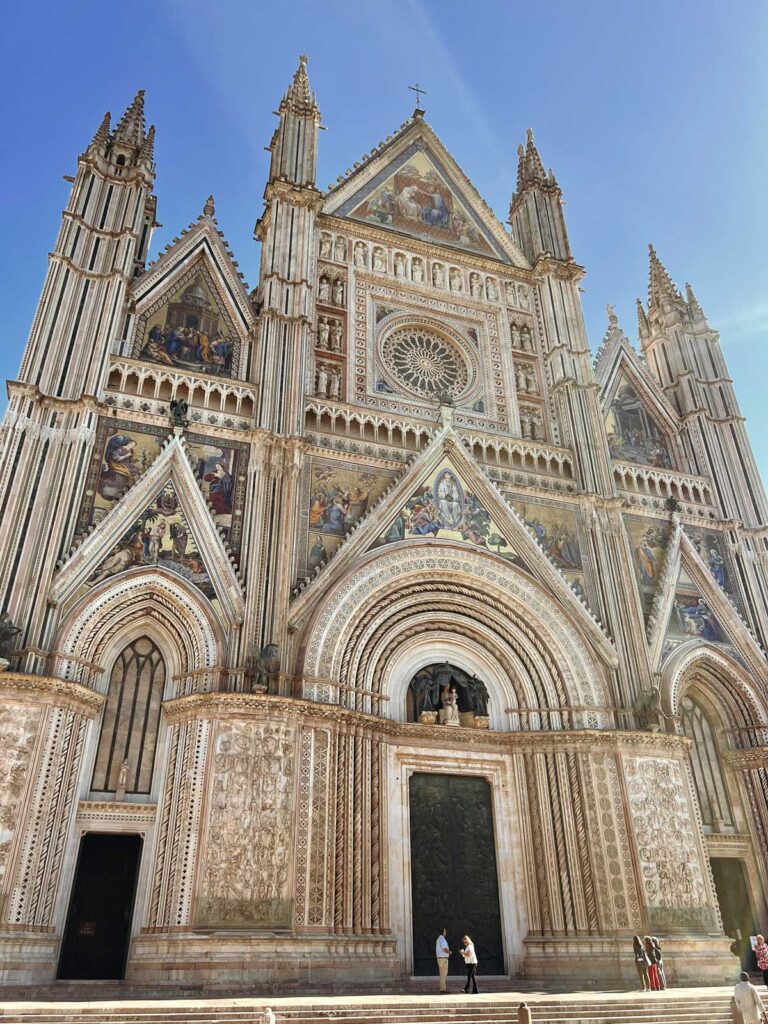
Inside Orvieto Cathedral
The interior of the cathedral is defined by its striking black and white basalt and travertine stripes. The nave is spacious and leads toward the high altar, which is surrounded by large-scale Gothic frescoes.
The San Brizio Chapel is the primary interior highlight, containing a renowned fresco cycle depicting the Last Judgment by Luca Signorelli. Visitors can also view the Chapel of the Corporale, which houses the sacred linen associated with the Miracle of Bolsena.
The cathedral also features a massive 16th-century organ and a series of monumental statues of the Apostles. On the facade, four large bronze sculptures representing the Evangelists are visible above the central doors.
Practical visitor tips
| Aspect | Tip |
| Dress Code | Shoulders and knees must be covered to enter the consecrated areas. |
| Photography | Non-flash photography is permitted inside the nave but prohibited in the San Brizio Chapel. |
| Crowds | Midweek mornings before 11:00 are generally the quietest times to visit. |
| Tickets | The ticket office is located across the square from the cathedral, not inside the building. |
| Mass | Entry for sightseeing is restricted during active religious services and Mass. |
Frequently asked questions about Orvieto Cathedral
| Query | Answer |
| Is Orvieto Cathedral suitable for children? | Yes, though strollers may be difficult to use in the narrow side chapels. |
| Do you need to book tickets in advance for Orvieto Cathedral? | Advance booking is not mandatory but recommended for groups or during peak holidays. |
| Is Orvieto Cathedral open on Sundays? | Yes, but it typically opens to tourists only after 13:00 following morning Mass. |
| Are bags allowed at Orvieto Cathedral? | Small bags are allowed; large suitcases or backpacks must be left in external lockers or vehicles. |
Things to do near Orvieto Cathedral
- Torre del Moro: A medieval clock tower offering 360-degree views of the city and the Umbrian countryside.
- Orvieto Underground: A guided tour through a network of Etruscan-era tunnels and pigeon houses located beneath the city.
- Museo Claudio Faina: An archaeological museum directly opposite the cathedral housing a significant collection of Etruscan artefacts.
- Pozzo di San Patrizio (St. Patrick’s Well): A 16th-century well featuring a double-helix staircase designed for water transport.
- Palazzo del Popolo: A historic communal palace located in a nearby square, often used for local exhibitions and conferences.
More Italian churches and cathedrals
- Key information for visiting Palermo Cathedral in Sicily.
- A guide to Padua for first time visitors – including the Palazzo Bo, Cappella degli Scrovegni and Orto Botanico.
- What you need to know before visiting the San Nicolo church in Treviso.
- A realistic guide to visiting the Pantheon in Rome.
- Why I hated the Sistine Chapel.