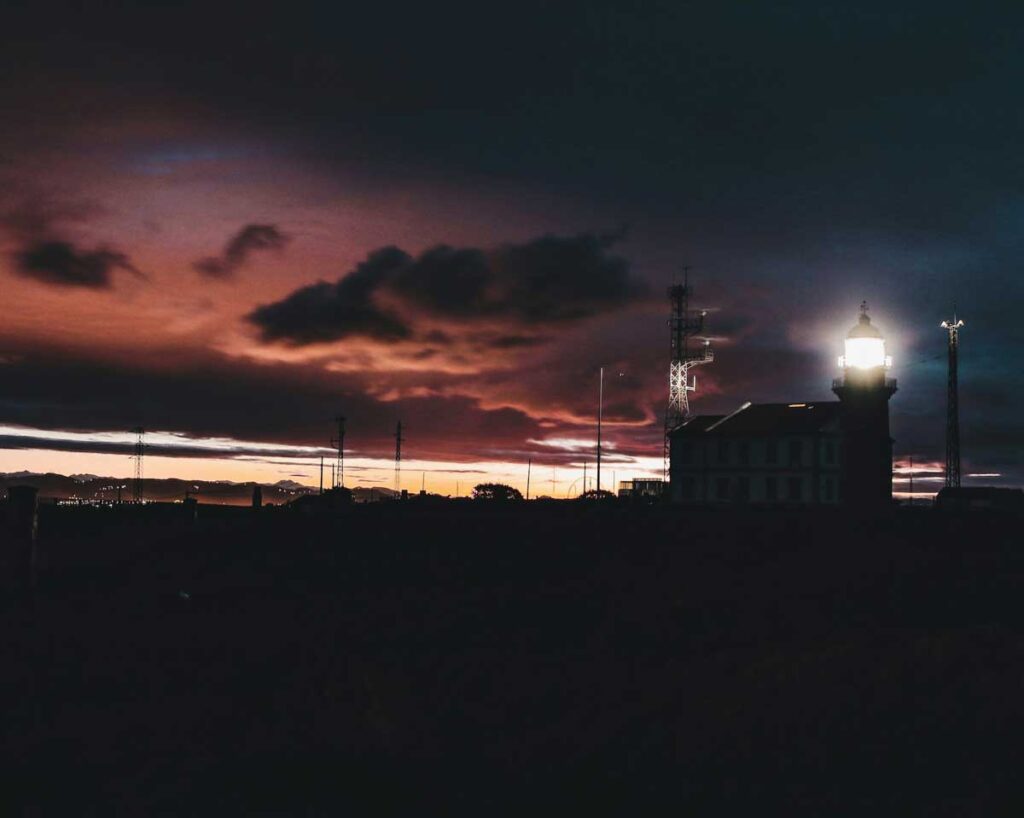
The Cabo Peñas Lighthouse is the northernmost maritime signal in Asturias, situated atop cliffs exceeding 100 metres in height in the municipality of Gozón, Spain. This guide covers opening hours, ticket prices for the interpretation centre, transport, accessibility, and practical visitor tips to assist in planning a visit to this protected landscape.
The information in this guide was last updated in April 2026. A key update for this season is the implementation of a unified digital entry system at the Marine Environment Interpretation Centre, which now allows for contactless payment of the small admission fee at the main desk.
Quick facts
| Feature | Detail |
| Opening hours | Daily 10:00 – 13:00 and 16:30 – 19:00 (Summer) |
| Ticket prices | General: €1.00; Reduced: €0.50 |
| Address | Lugar Faro de Peñas, s/n, 33448 Gozón, Asturias |
| Nearest transport | Luanco bus station (6 km away) |
| Typical time needed | 1 to 2 hours |
Cabo Peñas Lighthouse opening hours
The exterior grounds and the cliff-top walking paths of Cabo Peñas are accessible 24 hours a day, year-round. However, the Marine Environment Interpretation Centre (located inside the lighthouse buildings) follows a specific seasonal schedule. From July to September, the centre is open Monday to Sunday from 10:00 to 13:00 and 16:30 to 19:00.
During the winter season (October to March), the interpretation centre operates from 10:00 to 14:00 and 16:30 to 18:00. In the intermediate months of April, May, and June, the centre typically opens from 11:00 to 14:00 and 17:00 to 20:00. Visitors should note that the last entry to the museum is 30 minutes before the scheduled closing time.
Cabo Peñas Lighthouse ticket prices
Access to the cliffs, the wooden boardwalks, and the exterior of the lighthouse is free of charge. Admission to the Marine Environment Interpretation Centre is €1.00 for adults. A reduced rate of €0.50 applies to children, students, and seniors over 65.
Opening hours and ticket prices were checked on the official website and last updated in April 2026. Cabo Peñas is a natural monument and is not included in standard city passes, but it is a frequent stop on regional tours starting from Oviedo or Gijón. Nearby attractions with similar cultural significance include the Maritime Museum of Asturias in Luanco and the Candás Sculpture Museum, both of which require separate admission.
How to get to the Cabo Peñas Lighthouse
The most practical way to reach Cabo Peñas is by car via the AS-238 road from Avilés or the AS-118 from Gijón, following signs for Luanco and then Cabo de Peñas. The lighthouse is located approximately 10 kilometres from Luanco and 20 kilometres from Avilés.
Public transport access is limited. Visitors can take an ALSA bus to the town of Luanco, which is the nearest major transport hub. From Luanco, there is no direct public shuttle to the lighthouse; visitors must use a local taxi service or hike the coastal trail (PR-AS 25), which is approximately 6 kilometres each way.
Parking at the Cabo Peñas Lighthouse
There is a large, designated public car park located within 200 metres of the lighthouse entrance. Parking is free of charge and typically has ample space for passenger cars and motorcycles. During peak summer weekends, the lot can fill by mid-day, but turnover is generally high.
The access road (GO-1) is paved but becomes narrow as it approaches the cape. Motorhomes are permitted to park in the main lot during the day, but overnight camping is strictly prohibited as the site is part of a Protected Protected Landscape.
How long to spend at the Cabo Peñas Lighthouse
A visit to Cabo Peñas typically lasts between 1 and 2 hours. This provides sufficient time to walk the wooden boardwalk system along the cliff edge, visit the exhibits inside the Interpretation Centre, and view the automated lighthouse tower from the exterior.
Visitors who wish to follow the extended coastal paths toward the Sabín or Ferrero beaches should allow for 3 to 4 hours. The area is highly exposed to wind, which may influence the duration of an outdoor visit depending on weather conditions.
Accessibility at the Cabo Peñas Lighthouse
The site has been adapted to provide a “practicable” level of accessibility for visitors with reduced mobility. A network of elevated wooden boardwalks allows wheelchairs and strollers to safely navigate the clifftop and reach the primary viewpoints without traversing the uneven natural terrain.
The Marine Environment Interpretation Centre is located on the ground floor and is accessible via a ramp. Accessible toilets are available within the lighthouse complex. However, the natural dirt trails that lead further away from the lighthouse toward the lower cliffs remain inaccessible to wheelchairs due to steep gradients and rocky surfaces.
Inside the Cabo Peñas Lighthouse
The interior of the lighthouse buildings houses the Marine Environment Interpretation Centre of Peñas. The museum is divided into several themed rooms that detail the history of lighthouses, the maritime trade of the Bay of Biscay, and the biodiversity of the Cantabrian Sea.
Key exhibits include large-scale models of different lighthouse types and interactive displays about the local flora and fauna, specifically the migratory birds and cetaceans often spotted from the cape. The central courtyard provides a close-up view of the 19th-century masonry of the main tower, although the lantern room at the top is not open to the public. The wooden boardwalks outside are an extension of the visitor experience, featuring interpretive panels about the geological formation of the cliffs.
Practical visitor tips
| Category | Advice |
| Timing | Visit in the late afternoon for the best photographic light on the cliffs and the lighthouse. |
| Crowds | Weekday mornings are the quietest times; Sunday afternoons often see a surge of local visitors. |
| Layout | Stay on the marked boardwalks; the cliff edges are unstable and the wind can be unpredictable. |
| Entry process | Pay the museum admission fee at the reception desk inside the main lighthouse building. |
| Logistics | No shops are located on the cape; bring water and snacks, especially if planning a longer hike. |
Frequently asked questions about the Cabo Peñas Lighthouse
| Question | Answer |
| Is the Cabo Peñas Lighthouse suitable for children? | Yes, the boardwalks make it safe for children, and the museum has interactive nature displays. |
| Do you need to book tickets in advance? | No, tickets for the interpretation centre are purchased on-site upon arrival. |
| Is the Cabo Peñas Lighthouse open on Sundays? | Yes, both the grounds and the interpretation centre are open on Sundays. |
| Are dogs allowed at the Cabo Peñas Lighthouse? | Dogs are allowed on the outdoor paths if kept on a lead; they are not permitted inside the museum. |
Things to do near the Cabo Peñas Lighthouse
- Luanco: A 15-minute drive to this historic fishing town, home to the Maritime Museum of Asturias and a scenic promenade.
- Candás: A nearby coastal village 20 minutes away, known for its canning heritage and the Antón Sculpture Museum.
- Playa de Verdicio: A popular beach 10 minutes away, famous for its large sand dunes and excellent surfing conditions.
- San Juan de Nieva: A 20-minute drive to the entrance of the Avilés estuary, offering views of the lighthouse at the other end of the bay.
- Xagó Beach: A expansive sandy beach and wetland area 15 minutes away, popular for paragliding from the surrounding cliffs.
What to visit tomorrow
- Cabo Vidio Lighthouse: Located 40 minutes away, offering another dramatic headland perspective with views of the “Iglesiona” sea cave. Playa del Silencio is nearby.
- Oscar Niemeyer International Cultural Centre: A 25-minute drive to Avilés to see this modern architectural landmark.
- Laboral Ciudad de la Cultura: Roughly 30 minutes away in Gijón, featuring the tallest stone tower in Spain.
- Museum of Fine Arts of Asturias: Located 45 minutes away in Oviedo’s old town, housing a major collection of Spanish art.
- San Lorenzo Beach: A 30-minute drive to Gijón’s main urban beach, featuring a long boardwalk and Roman remains at one end.