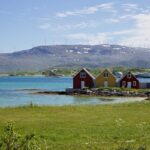
The Tromsø Arctic-Alpine Botanic Garden (Arktisk-alpin botanisk hage) is the world’s northernmost botanic garden. It is operated by the Arctic University Museum of Norway and located at Stakkevollvegen 200 on the UiT campus in Tromsø, Norway. This guide covers opening season, admission, how to get there, parking, accessibility and practical tips to help you plan your visit.
Last updated: April 2026. The garden is currently closed for winter and will reopen in May 2026, with the exact date depending on snow conditions. The café — Hansine Hansen’s Café — is only open during June, July and August, not throughout the full open season as some guides suggest. Visitors planning to visit in May, September or October should not expect café facilities to be available.
Quick facts
| Detail | Information |
|---|---|
| Season open | May to October (exact opening depends on snow conditions) |
| Hours when open | 24 hours a day, 7 days a week — no gates |
| Season closed | November to April |
| Admission | Free |
| Address | Stakkevollvegen 200, 9019 Tromsø |
| Nearest bus | Bus 20 (stop: Science Centre / Planetarium, then 5-min walk); Bus 42 (stop: Breivika harbour terminal) |
| Parking | Paid car park in front of garden (07:00–17:00); free after 17:00 and at weekends |
| Café | Open June, July and August only |
| Typical visit length | 1–2 hours |
| Managed by | Arctic University Museum of Norway (UiT) |
UiT Arctic-Alpine Botanic Garden opening times
The garden is open every day from May to October, 24 hours a day, with no gates or barriers. There is no set daily opening or closing time during this period. The exact date on which the garden opens each May depends on snow conditions and varies from year to year; the ground is typically clear from early to mid-May at the lower sections.
The garden is closed from November to April. During winter the plants are in dormancy and the garden is usually under snow. Visiting outside the May–October window is not practical. To confirm whether the garden has opened for the season, check the official page at en.uit.no/tmu/botanisk or follow the Tromsø Arctic-Alpine Botanic Garden Facebook page, which publishes weekly bloom updates throughout the season.
The garden is an outdoor attraction with no indoor exhibition space. There is no shelter from weather except in the vicinity of the café building, which is itself only open June to August.
UiT Arctic-Alpine Botanic Garden admission
Entry to the garden is completely free. There are no tickets, no booking system and no entry barriers. Visitors simply walk in. No advance booking is required or available for individual visitors.
The garden is not included in the Tromsø Pass because it has no admission charge. Visiting the botanic garden can be combined with nearby paid attractions — including the Science Centre of Northern Norway and the Arctic University Museum of Norway — without affecting the value of any pass held.
The museum group does accept donations to support the garden’s research and conservation work; there is no formal mechanism for this on site, but donations can be made via the UiT museum website.
Admission status and opening season were checked on the official UiT museum website and last updated in April 2026.
Five great things to do in Tromso
- 🌌 Head out in search of the Northern Lights – on a guided tour with bonfire, dinner and winter suits.
- 🚤 Combine an Arctic fjord cruise – with wildlife-watching and a guided fishing experience.
- 🐋 Go silent whale-watching – in a hybrid electric boat.
- 🦌 On a Sami culture tour – feed reindeer and go reindeer-sledding.
- 📸 Take a fjord photographic tour – to Sommaroy with a professional photographer.
How to get to the UiT Arctic-Alpine Botanic Garden
The garden is located on the southern end of the UiT campus, approximately 2.5–3 km from Tromsø city centre. It is adjacent to the Science Centre of Northern Norway and within walking distance of the Arctic University Museum of Norway.
By bus — Bus 20 from the city centre stops at the Science Centre / Northern Lights Planetarium, from where a short footpath through the birch forest leads directly down to the garden (approximately five minutes on foot). Bus 42 stops at Breivika harbour terminal, which is also close to the garden. Use the journey planner at svipper.no for current timetables. Bus tickets cannot be purchased at the garden; buy in advance via the Troms Billett app or at kiosks in the city centre.
On foot or by bike — The walk from the city centre takes approximately 40 minutes along low-traffic roads and waterfront paths. A cycle path also connects the garden to the city centre. The garden is on a slope, so the approach from the Science Centre through the birch forest involves a gentle downhill gradient.
From the cruise terminal — The garden is a short walk from the Breivika cruise ship terminal, making it a practical stop for cruise passengers without transport.
Parking at the UiT Arctic-Alpine Botanic Garden
A dedicated guest car park is located directly in front of the garden entrance. Parking fees apply between 07:00 and 17:00; payment is at the machine in the car park, by card or cash. Parking is free after 17:00 and at weekends. A visit timed for a weekend afternoon or early evening during the summer would avoid parking costs entirely.
Additional campus parking is available nearby. If parking at the Science Centre of Northern Norway car park, the garden is a short walk through the birch forest.
How long to spend at the UiT Arctic-Alpine Botanic Garden
Most visitors spend between one and two hours in the garden. The garden covers a substantial area set on a hillside, with paved paths, rocky trails between planted boulders and a birch forest at the upper end of the site. Visitors who read plant labels and information boards throughout tend towards two hours; those who make a casual pass through the main paths may find an hour sufficient.
Because entry is free and the garden has no closing time during summer, there is no pressure to plan a fixed visit duration. The garden is well suited to being combined in a half-day trip with the Science Centre of Northern Norway or the Arctic University Museum of Norway on the same campus.
Accessibility at the UiT Arctic-Alpine Botanic Garden
The garden has mixed accessibility. The main paved path is flat and suitable for wheelchairs and pushchairs throughout. However, a significant part of the garden’s character comes from its rocky terrain — plants grow in the crevices of boulders and along unmade stone paths that climb between planted sections. These paths are uneven and are not wheelchair accessible. Visitors with limited mobility can see a substantial portion of the garden from the paved paths but will not be able to access all sections.
The garden is entirely outdoors and there is no shelter outside the café area (open June to August only). Weather in Tromsø changes quickly and temperatures are cool even in midsummer; warm and waterproof layers are advisable regardless of conditions at departure.
Inside the UiT Arctic-Alpine Botanic Garden: what to see
Rock garden collections — The garden’s central feature is a series of themed collections planted among boulders and lichen-covered rocks that recreate the natural habitats of the plants. The garden contains 25 themed collections covering plants from polar and alpine regions on all continents, grouped broadly by geography or plant family. Every plant is individually labelled in Latin and Norwegian, with some English.
Arctic and Svalbard collection — Plants native to the High Arctic, including species found on Svalbard. The collection includes Ranunculus wilanderi, one of Europe’s rarest plants, which in the wild exists at only a single location: Kapp Thordsen in Svalbard. Arctic poppies, saxifrages and dwarf willows are also present.
Meconopsis (Himalayan blue poppies) — The garden holds a collection of large-flowered Meconopsis species, including the deep-blue Meconopsis betonicifolia. These flower in June and July and are among the most photographed plants in the garden.
Saxifrages, gentians and primroses — The garden’s collections of these three genera are particularly noted by visiting botanists. They bloom across a long period from late May through August, providing colour throughout the season.
Rhododendron collection — Including Rhododendron lapponicum, native to the Arctic and Subarctic regions. These flower from late May into June.
Birch forest — The upper part of the garden merges into a natural birch forest with ferns and mosses beneath the canopy. A footpath through the forest connects the garden to the Science Centre of Northern Norway above. The forest has a distinctly different character from the open rock garden below.
Lakes and streams — The garden incorporates several small ponds and a stream running between planted sections, which support moisture-loving species and add a further habitat type to the collection.
Hansine Hansen’s Café — A café occupying a reconstruction of the farmhouse that once stood on the site. Open during June, July and August. Staffed at weekends; self-service on weekdays. Serves coffee, tea, ice cream, waffles and cakes. Closed in May, September and October even when the garden is open.
Bloom season guide
| Period | What is typically in flower |
|---|---|
| Early–mid May | First Arctic and alpine species emerge; Svalbard plants, early saxifrages, dwarf willows |
| Late May–June | Rhododendrons, primroses, early gentians, Arctic poppies; the garden reaches its first peak |
| July | Meconopsis blue poppies, alliums, most alpine collections in full bloom; peak summer colour |
| August | Later-flowering alpines, asters, continued Himalayan collections; café open |
| September–October | Autumn colour in the birch forest; late-flowering species; café closed |
To find out what is currently flowering before your visit, subscribe to the garden’s weekly “Highlights” newsletter via the UiT museum website or follow the Tromsø Arctic-Alpine Botanic Garden on Facebook.
Practical visitor tips
| Tip | Detail |
|---|---|
| Check the official Facebook page before visiting in May | The garden’s opening date each spring depends on snowmelt and varies year to year. The Facebook page and UiT website publish updates when the garden opens and when specific collections come into flower. |
| Wear waterproof footwear and layers | The garden is entirely outdoors with limited shelter. Tromsø weather is unpredictable in summer; rain is common and temperatures are cool even in July. The rocky paths can be wet and uneven. |
| The café is only open June to August | Visitors arriving in May, September or October will find the café closed. There are no other food or drink facilities on site. The nearest alternatives are at the Science Centre of Northern Norway or the Arctic University Museum, both a short walk away on campus. |
| Visit during the midnight sun for different light | From mid-May to late July, the sun does not set in Tromsø. The garden is accessible at any hour during this period and the light at midnight is distinct from midday; some visitors specifically time a visit for late evening. |
| Combine with the Science Centre and the Arctic University Museum | All three attractions are within a short walk of each other on the UiT campus. The botanic garden requires no ticket and can be added to a campus visit without extra cost or planning. |
Frequently asked questions about the UiT Arctic-Alpine Botanic Garden
| Question | Answer |
|---|---|
| Is the UiT Arctic-Alpine Botanic Garden free to visit? | Yes. Entry is completely free at all times. There are no tickets, no booking and no gates. |
| When is the best time to visit the UiT Arctic-Alpine Botanic Garden? | July is generally considered peak season, when the greatest number of collections are simultaneously in flower, including the Meconopsis blue poppies. Late May to June is also excellent for rhododendrons and primroses. The garden is open until the first snows, usually in October. |
| Is the UiT Arctic-Alpine Botanic Garden open in winter? | No. The garden is closed from November to April. The plants are in dormancy and the ground is under snow during these months. |
| Is the UiT Arctic-Alpine Botanic Garden wheelchair accessible? | Partially. The main paved path is flat and accessible. Rocky paths between planted sections are uneven and not suitable for wheelchairs. Visitors with limited mobility can see a substantial part of the garden without using the rocky paths. |
| Is the café at the UiT Arctic-Alpine Botanic Garden open throughout the season? | No. Hansine Hansen’s Café is open only during June, July and August. It is closed in May, September and October, even though the garden itself is open throughout this period. |
Things to do near the UiT Arctic-Alpine Botanic Garden
Science Centre of Northern Norway — Directly above the garden on the UiT campus, reachable via the footpath through the birch forest. An interactive science centre and planetarium with over 100 exhibits covering climate, weather, energy and the Northern Lights. Adult admission 150 NOK; planetarium shows included.
The Arctic University Museum of Norway — A 10–15 minute walk from the garden on the same campus. Covers Arctic geology, Sámi culture, Viking history and the Northern Lights in permanent exhibitions across two floors. Adult admission 130 NOK.
Telegrafbukta beach — Tromsø’s most popular city beach, approximately 15–20 minutes on foot from the garden along the waterfront path. Flat and easy walking with views towards the mainland mountains.
MS Polstjerna — A historic sealing vessel moored at Hjalmar Johansens gate 10 in the city centre, operated by the same museum group as the botanic garden. An on-board exhibition covers life on a 20th-century Arctic sealing vessel.
The Polar Museum — On the city waterfront, approximately 15 minutes by bus from the UiT campus. Covers Arctic exploration and trapping history, including expeditions by Roald Amundsen and Fridtjof Nansen.
What to visit next: similar botanical gardens within the region
Botanic gardens and plant collections comparable to the Arctic-Alpine Botanic Garden are rare in northern Norway. The following are the most practical options for visitors with a specific interest in this type of attraction.
Tromsø University Museum Herbarium collections — Held within the Arctic University Museum of Norway on the same campus, the herbarium is a research collection rather than a public exhibition, but the museum’s natural history exhibitions directly complement the botanic garden.
Senja Botanical Garden (Senjahopen, Senja island) — A small community botanic garden on the island of Senja, approximately two and a half hours south of Tromsø by road and ferry. Senja is one of Norway’s most scenic islands and the garden can be combined with a wider visit to the island.
Bodø Botanical Garden — A municipal botanic garden in Bodø, reachable by a short domestic flight from Tromsø or a full day’s drive south. Bodø is at a similarly high latitude and contains northern Norwegian and Scandinavian plant collections.
Kongsberg Silver Mines botanic garden area, Kongsberg — Much further south (central Norway), but one of Norway’s more established public gardens, and accessible as part of a broader Norwegian itinerary.
Svalbard Global Seed Vault and local flora, Longyearbyen, Svalbard — For visitors with a serious interest in Arctic plant ecology, Svalbard’s tundra flora represents the plants at the extreme end of the spectrum covered by the Tromsø garden. Longyearbyen is reachable by a 45-minute domestic flight from Tromsø. Guided flora walks operate during the summer season.
More Tromso travel
Other Tromso travel guides on Planet Whitley include:
- Plan your visit to Polaria, Tromso’s Arctic aquarium.
- What to know before visiting the Arctic Cathedral in Tromso.
- A practical guide to tackling the Sherpa Stairs in Tromso.
- Why a Sami reindeer experience is Tromso’s best day trip.
- The best way to get the white sand beaches of Sommaroy near Tromso.