
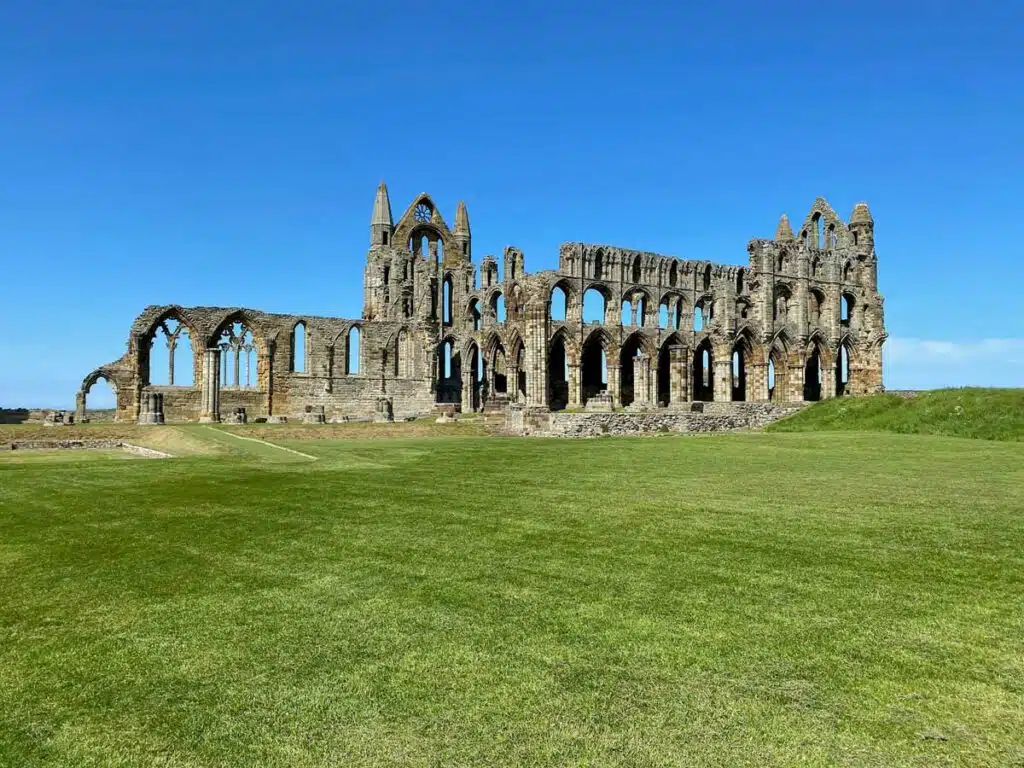
Perched above Whitby harbour, Whitby Abbey is a dramatic – and highly atmospheric – ruin with a lengthy history and coastal views. This practical 2026 visitor guide explains how to get there, opening hours, ticket prices, parking, accessibility and the best times to visit, plus nearby attractions and an FAQ to help you plan a straightforward trip.
To skip the detail and just book your tickets, head here.
This guide was updated in March 2026 to reflect new season price increases.
History and overview of Whitby Abbey
Whitby Abbey dates back to 657 AD when King Oswy founded a monastery at Streoneshalh. Over the centuries the site was destroyed, rebuilt and dissolved in 1540 under Henry VIII, leaving the Gothic ruins you see today.
One of the finest ruined abbeys in England sits on the East Cliff above the North Sea and has inspired writers and artists for generations. The site is managed by English Heritage and includes a small museum and visitor centre housed in the old manor house.
Why book a Whitby Abbey Ticket?
- 🏛 Explore the dramatic ruins of Whitby Abbey perched above the North Sea with striking views
- 📚 Museum admission included—discover tales of saints, poetry, Viking raids, and how Whitby inspired *Dracula*
- 🌿 Spacious grounds to roam freely—perfect for photography, reflection, and coastal walks
- 🔄 Valid for 1 day with free cancellation up to 24 hours prior to booking
- ⭐ Highly rated—average 4.7 out of 5 from over 50 reviews for value, atmosphere, and storytelling
- ✅ Mobile ticket accepted; accessible entry and flexible booking options
How to get to Whitby Abbey
By car, use postcode YO22 4JT to reach the approach roads into Whitby. Follow signs for the abbey and the cliff car parks; the main council car park sits a short walk from the south entrance.
If you arrive by train, Whitby station is a short bus or taxi ride from the town centre. From the town there are two obvious routes up to the abbey: the famous 199 steps from Church Street, or the gentler cliff top road for a less strenuous walk.
Opening hours, ticket prices and what is included
The abbey’s opening times vary by season; during spring and summer the site typically opens in the morning and closes in the early evening. Last admission is usually about 30 minutes before closing so check the official site before you travel.
Admission prices at Whitby Abbey are complicated by English Heritage’s insane pricing structure, and they vary depending on the time of year and day of the week. The prices below are for tickets booked online at least one day in advance, without a Gift Aid donation, and represent a saving of around 15% compared to tickets bought on the day at the entrance.
Super Saver — Fridays, 28 Mar–22 May & 1 Sep–1 Nov; daily from 2 Nov–16 Mar
| Visitor | Price |
|---|---|
| Adult | £10.79 |
| Concession | £10.03 |
| Child | £5.35 |
Saver — Sat–Thu, 28 Mar–22 May & 1 Sep–1 Nov; Fridays, 23 May–31 Aug
| Visitor | Price |
|---|---|
| Adult | £12.32 |
| Concession | £11.56 |
| Child | £6.12 |
Standard — Sat–Thu, 23 May–31 Aug
| Visitor | Price |
|---|---|
| Adult | £13.85 |
| Concession | £13.09 |
| Child | £6.88 |
Concession prices apply to over-65s, students with a valid student ID, and jobseekers with relevant ID. English Heritage members enter free.
Prices checked and updated March 2026.
Is it worth paying for English Heritage membership?
Entry prices for English Heritage sites, including Dover Castle, Stonehenge and Tintagel Castle, can seem extremely expensive. This is clearly a deliberate ploy to push visitors towards taking out annual English Heritage membership.
Membership gives free access to more than 400 sites across the country, and costs £82. That is, unless you get a special deal – there was a 25%-off Black Friday deal in November 2025, for example.
Whether that £82 is worth it depends on how many sites are near you (there are lots in the south of the country, not so many near me in Yorkshire). And, critically, whether you’re going to visit them with children.
Each member can take up to six children with them free of charge. Given the steep one-time entry fees, an adult member with two children is likely to recoup the cost of their membership by visiting just two or three sites within the year.
For an individual without children, I’d say English Heritage membership is worth it only if you’re planning to blitz a few sites in one year. For an individual with children, membership is a smart investment that will likely pay itself back within one school holiday. To me, it’s a no-brainer.
The real question is whether it’s worth renewing English Heritage membership after a year. That’s debatable, as you’re unlikely to go to many of these sites twice. I eventually renewed after I was offered 20% off the price. I’ll probably recoup the membership price visiting two sites in summer next year, even if I’ve ticked off most of the best ones near me.
If you buy membership through this link, I earn a small commission at no extra cost to you.
Parking, accessibility and facilities
There is a council-run paid car park about 100 metres from the south entrance and drop-off access near the visitor centre. Accessible parking bays are available and Blue Badge holders can use nearby spaces.
The route from the car park to the visitor centre is relatively flat and paved, but the ruins involve grass, slopes and uneven stone. Wheelchair users can see much of the site without necessarily reaching every viewpoint; the visitor centre provides accessible toilets and seating.
Best times to visit Whitby Abbey
To avoid crowds and to get better light for photography, arrive early in the morning just after opening. Weekdays are generally quieter than weekends and school holidays.
Spring and early autumn often bring milder weather and fewer tourists than high summer. Remember the cliff top can be windy and cooler than town, so bring a layer even on sunny days.
What to expect on site
Expect exposed stone, grassy banks and open views over the harbour. Paths around the ruins can be muddy after rain and some areas have steps or uneven surfaces.
The visitor centre houses interpretive displays about Saint Hild, the monastic history and local maritime links. There is a small gift shop and a café near the centre, though many visitors prefer to descend into town for a fuller range of food options.
Nearby attractions to combine with your visit
After the abbey, descend the 199 steps into Whitby town and the harbour. A short walk brings you to museums, jet jewellery shops and harbour-side restaurants serving fish and chips.
Other nearby stops worth combining include the Captain Cook Memorial Museum, Pannett Park and the Whitby Museum.
Practical tips and FAQ
Are the paths wheelchair-friendly?
Partly. The route from the main car park to the visitor centre is accessible. The ruins themselves include slopes, grass and uneven stone so some viewpoints are not fully accessible from a wheelchair.
Is there accessible parking close to the entrance?
Yes. Accessible parking bays and drop-off points are available close to the visitor centre.
Is it better to visit early morning, late afternoon or on weekdays?
Early morning and weekdays are best for fewer crowds and gentler light. Late afternoon gives warm light but facilities may begin to close earlier in the season.
How long should I budget for a visit?
Most visitors spend about 1.5 to 2 hours on the abbey, visitor centre and viewpoints. If you plan to include lunch and a stroll in town, allow 3 to 4 hours in total.
Are there cafés or restaurants on site?
There is a café near the visitor centre, and a selection of somewhat fish and chip-centric places to eat in Whitby town once you descend the steps. If you arrive very early, bring water as on-site services may open later.
Can I bring my own food?
Yes. There are picnic areas on the grounds and benches on the cliff top. Visitors are requested to take any litter with them and use the bins provided.
Is the terrain steep or are there many stairs?
Yes. The 199 steps are steep and cobbled. Cliff top paths have inclines and can be slippery in wet weather. If mobility is an issue use the road access and car park close to the visitor centre.
Are photos allowed everywhere?
Personal photography is allowed for most of the site. Tripods may be permitted but check with staff; drone use is restricted for safety and conservation reasons.
Final practical tips
Book tickets online if possible to avoid queues, get lower prices and check seasonal opening times. Wear sensible shoes for uneven ground and bring a jacket for cliff top wind.
More Yorkshire travel
Other Yorkshire travel articles on Planet Whitley include:


