Short answer
The inland taipan or the eastern brown snake is the most dangerous snake in Australia, depending on your definition.
Detailed answer
All those scare stories you’ve heard about Australia being home to some seriously nasty snakes? Well, I’m afraid they’re probably true. Australia has frankly unnerving numbers of highly venomous snakes that you really don’t want to encounter.
The inland taipan
And, joy of joys, these include the most venomous snake in the world – the inland taipan. These fellas tend to be just under two metres long, with olive-coloured skin in summer and darker brown skin in winter.
Luckily, the inland taipan is fairly placid. It’ll strike if it feels it has to, but much prefers to move away from any potential threat. Even more luckily, it lives in the arid parts of Australia – in the outback border region between Queensland and South Australia – that hardly anyone ever goes to. There is no record of a fatal inland taipan bite – although a few people have died courtesy of bites from its slightly less venomous cousin, the coastal taipan. These are sometimes found in coastal Queensland.
That’s where the good news ends, because the world’s second most venomous land snake is also found in Australia, and puts in an appearance far more regularly.
The eastern brown snake
An average of two people a year die from snake bites in Australia, and around 60% of the fatalities are due to bites from the eastern brown snake.
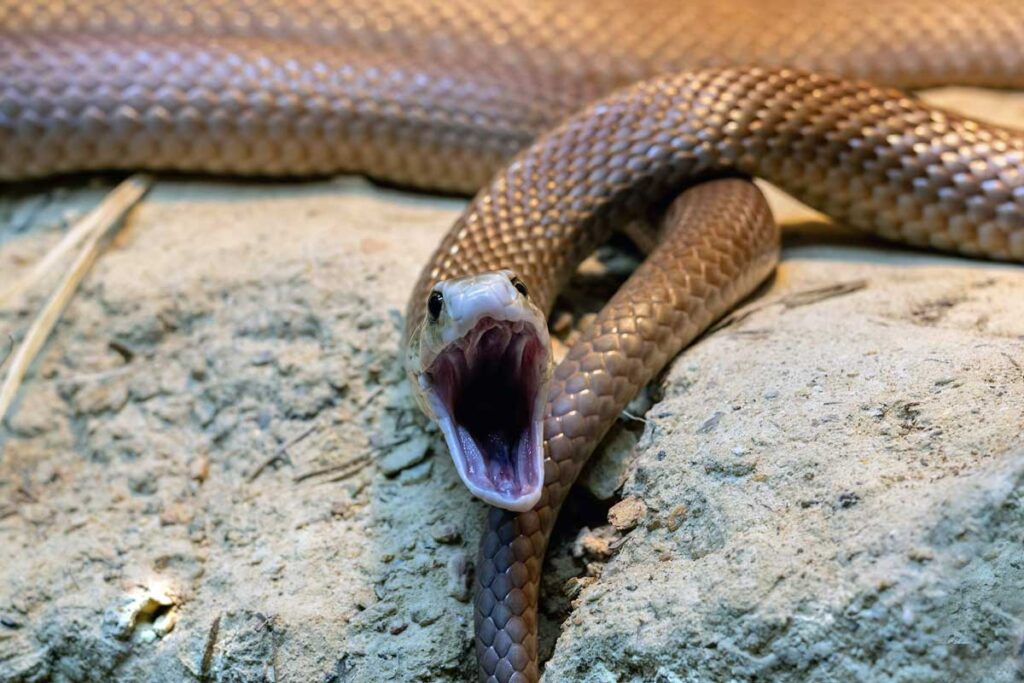
As the name suggests, it is brown (shades vary from snake to snake), and adults are usually around two metres long. They’re found along much of the east coast and inland mountain ranges, which is where the bulk of Australia’s population can be found too. The eastern browns are also active during the day, which means they’re encountered far more than is strictly ideal.
They’re most likely to be found on rural farms, but bushwalkers should always look out ahead and watch where they’re putting their feet. Making noise when you walk helps, too, as it lets the snakes know you’re coming and gives them time to get safely out of the way.
Eastern brown snakes are fast-moving, and have a not-entirely-fair reputation for being aggressive and bad-tempered. Most would still prefer to move away from danger, but they can have a rather liberal interpretation of when they’re under imminent threat and need to bite to protect themselves.
If an eastern brown is going to strike, it will raise its body off the ground in an S shape, and open its mouth. Try not to let it get to this stage – if you’re unfortunate enough to see one, remain calm, stay still, then move away slowly.
More Australia travel
Other Australia travel articles on Planet Whitley include: