
From Machu Picchu to Angkor Thom, and Tikal to Troy, the mystery is part of the appeal in rediscovered ancient cities. And these ten are definitely worth visiting…
Troy, Turkey
In the 1860s, excavations in north-western Turkey uncovered the remains of a series of cities built on top of each other. The 7th incarnation is generally accepted to be the major city in the Greek epics – particularly Homer’s Iliad – although the most substantial remains are from the Roman era. These include the Amphitheatre.
Angkor Thom, Cambodia
Angkor Wat is the one that makes the postcards, but the giant Angkor Thom complex was the real hub of the ancient Khmer kingdom. Rediscovered by French archaeologists in the 19th century, it’s thought that at least 80,000 people lived within the walls during the 13th century peak. The centrepiece is the Bayon temple, where somewhat disturbing and remarkably well-preserved carved giant heads stare from all angles.
Wat Phu, Laos
If the other Angkorian sites are about size and detail, Wat Phu in southern Laos is all about setting and intimidation. The complex is built on to a hillside After passing between two large ponds, visitors have to climb up seemingly endless steep stone steps to eventually reach the sanctuary at the top.

Tikal, Guatemala
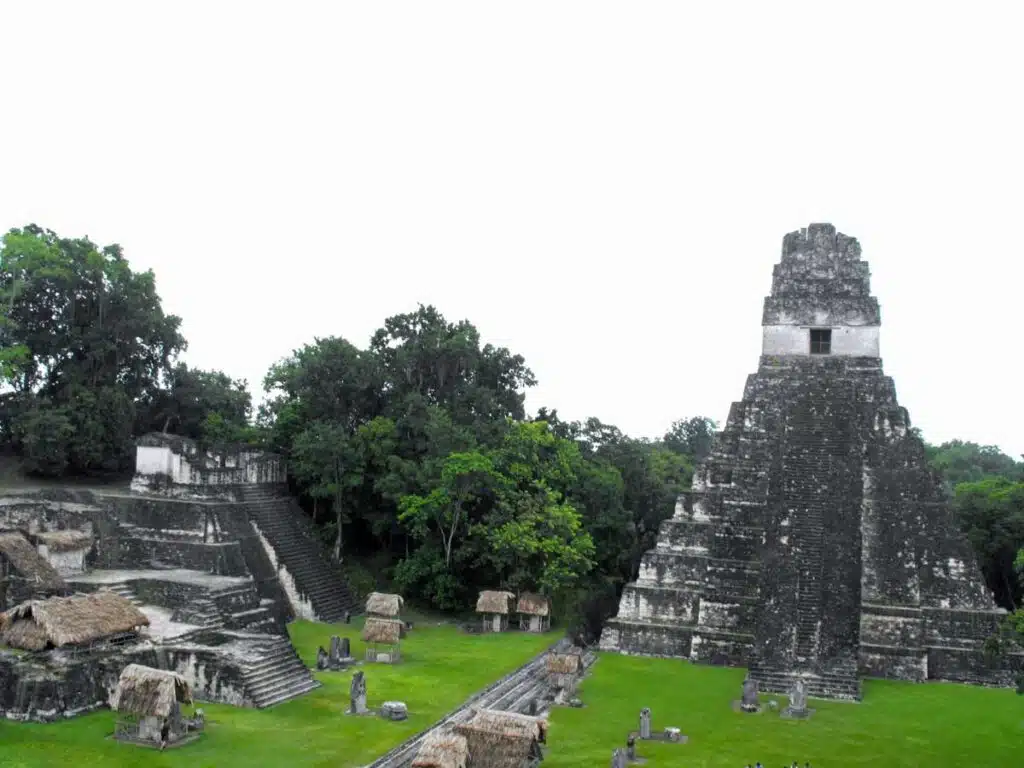
As howler monkeys screech, Tikal’s pyramid-like temple tops (the tallest is 70m high) rise above the jungle canopy.
Tikal was one of the dominant, if not the dominant, Mayan cities until it was abandoned in the 10th century. The stelae, glyphs and carvings have proved vital for archaeologists, revealing much of what we know about ancient Mayan culture and ruling dynasties.
Copán, Honduras
Tikal goes for sheer monumental scale, but Copán’s strength is in the preservation of the detail. Stone parrot heads still line the Mayan ball game court, monkey sculptures are virtually unspoilt on the sides of buildings and the free-standing stelae have kept their carved intricacies remarkably well for over a millennium. The other key difference? You can go inside the temples, seeing clearly how ever more impressive structures were built on top of each other.
There’s also a heartening story about how the scarlet macaw has returned to the ruins.
Machu Picchu, Peru
It’s the sense of mystery that makes Machu Picchu so compelling. When Hiram Bingham rediscovered it in 1911, he thought it was the last Inca city. Theories still abound – was it a royal retreat, something built in honour of the landscape or just a normal, everyday settlement?
But admiration for the stone temples, terraced fields and dizzying mountain setting take precedence after the multi-day hike to get there.
Great Zimbabwe, Zimbabwe
Occupied between the 11th and 15th centuries by the ancestors of today’s Shona people, Great Zimbabwe is split into three complexes, the most impressive of which is the Great Enclosure. The latter is thought to have been the royal compound, and has 11m-high walls built without mortar. The 10m high conical tower may well have been a fertility symbol.
Skara Brae, Scotland
In 1850, a storm in the Orkney Islands uncovered a simple, stacked-stone village, and basic stone furniture and pottery was found in the dwellings.
Originally thought to date back to around 500BC, subsequent excavations showed Skara Brae was a Neolithic village, well over 4,000 years old. And no-one really knows what happened to the ‘Grooved Ware people’ that lived there.
Karakorum, Mongolia
The base city of Genghis Khan hasn’t got much left in-situ – much of stone was used to build the huge Erdene Zuu monastery next to it. The monastery acts as a museum, with plenty of artefacts recovered from the site – while a few intricately carved stones still remain in the neighbouring fields.
Italica, Spain
Birthplace of Roman emperors Trajan and Hadrian, the ruins of Italica are next to the town of Santiponce. Most of the buildings have gone, but the layout of Italica remains fabulously intact. Some mosaics, nearly 2,000 years old, can still be seen on the floor, while the giant amphitheatre – the third largest in the Roman world – is still a staggering centrepiece.
