
Mostar draws visitors for its Ottoman bridge and its story. Both are worth a day of anyone’s time. But the city sits in the middle of a region whose other sights — a Sufi monastery carved into a cliff above a turquoise spring, a medieval stone town abandoned on a hillside, a waterfall wide enough to swim under — are less photographed and, for many visitors, more memorable. This eight-hour day tour from Mostar covers all three, with a small group of no more than 12 people.
Check dates and book the Herzegovina day tour from Mostar →
The starting point: Mostar’s war history
The tour begins with a panoramic viewpoint over Mostar and a briefing on the city’s recent history — specifically the 1992–1995 siege and what happened in the city during the Bosnian War. This is delivered through first-hand accounts and personal stories, not a textbook summary. It sets context for everything that follows.
Mostar’s Old Bridge (Stari Most) was built in 1566 by the Ottoman architect Mimar Hayruddin. It stood for 427 years before being deliberately destroyed by artillery fire in November 1993. The rebuilt bridge — reconstructed using the same limestone quarried from the same source — was completed in 2004 and designated a UNESCO World Heritage Site the following year. The story of its destruction and reconstruction runs through the entire tour.
The tour ends the day with a stop at the small Mostar War Museum — a compact outdoor installation that gives direct context to the sites seen during the day.
Blagaj: the spring and the monastery
Blagaj is a village 12 kilometres south of Mostar, at the point where the River Buna emerges from a cliff as one of the most powerful karst springs in Europe. The water appears from inside the rock at a rate of around 43 cubic metres per second. It is intensely cold, extraordinarily clear and a vivid blue-green where it meets the light.
At the cliff’s base sits the Blagaj Tekke — a Dervish monastery established in the 15th century, when the Ottomans arrived in Bosnia. The Dervishes were members of the Sufi branch of Islam, known for their meditative and ascetic practices. The tekke was their place of retreat, prayer and initiation. The building you see today dates largely from the 16th century and is still an active place of worship. Entry costs €5.
The setting — white-walled monastery, sheer grey cliff, turquoise water, overhanging trees — is one of the most photographically striking in the Balkans. The riverside restaurants serve fresh trout from the Buna and traditional Bosnian coffee. Allow time for both.
Book the Herzegovina day tour from Mostar on Viator →
Počitelj: the open-air museum
Počitelj is a medieval stone town built in the 14th century on the order of Bosnian king Tvrtko, stacked up a hillside above the Neretva River in a natural karst amphitheatre. Almost entirely built from pale limestone, it is often described as Bosnia’s best-preserved Ottoman-era settlement — an open-air museum with a handful of actual residents still living inside its walls.
The town’s landmarks include the Sahat-Kula clock tower, the Hadži Alija Mosque and the castle ruins at the summit, which give views across the Neretva valley and the surrounding hills. The cobblestone lanes between them pass stone houses, gallery spaces and craft workshops. The climb to the top is steep and uneven — wear appropriate shoes.
Počitelj was heavily damaged during the Bosnian War and has been under slow restoration since. Some buildings remain roofless; scaffolding is visible in parts. This does not diminish the place; it adds another layer to the same story the tour has been telling since Mostar.
Kravica Waterfalls
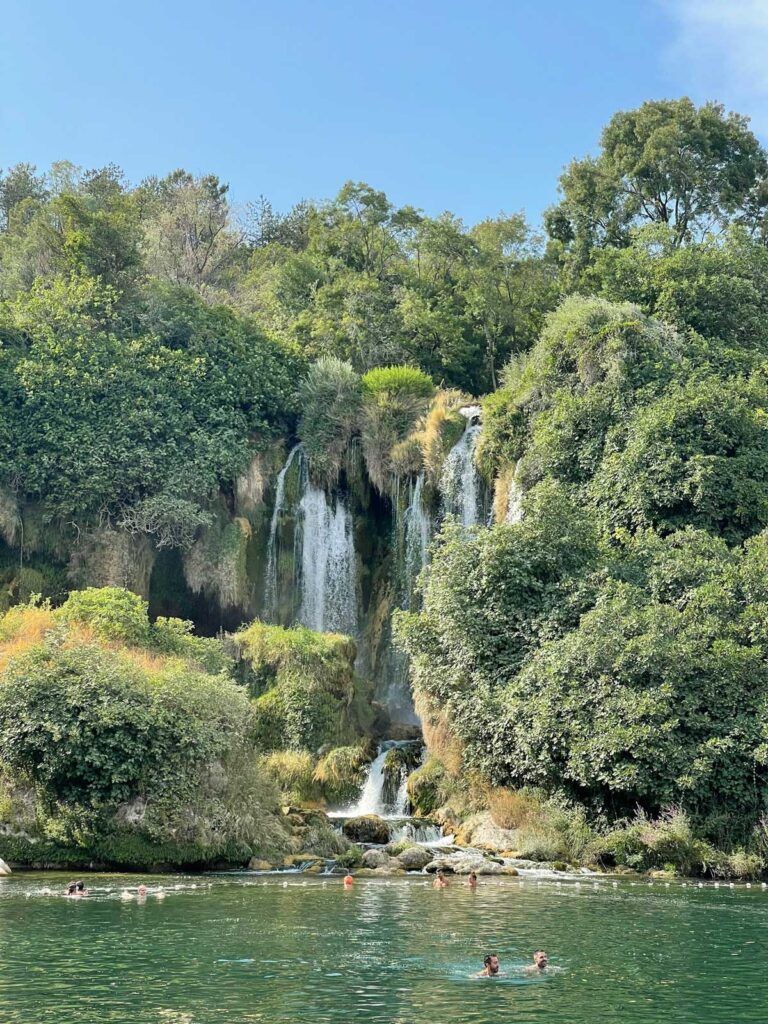
Kravica is a tufa waterfall on the Trebižat River, around 40 kilometres south-west of Mostar. It is approximately 25 metres high and 120 metres wide — a horseshoe of cascades dropping into a turquoise pool large enough to swim in. The surrounding rocks and shallow beaches make it a natural stopping place for an hour or two in the heat of the day.
Swimming is permitted and encouraged. The water is cold but not uncomfortably so in summer. Cafés and small restaurants operate around the site. Entrance costs €10 per person, payable on the day.
Kravica is most visited between June and September, when the flow is lower and the swimming conditions are best. In spring — April and May — the falls run faster and are considerably more dramatic, but swimming is not advisable. The tour visits regardless of season; adjust expectations accordingly.
Practical details
| Duration | 8 hours |
| Price | From $52 per adult (multiple-adult discount available) |
| Group size | Maximum 12 people |
| Rating | Rated Exceptional (10/10) across verified booking platforms |
| Pick-up | Orange Bus Stop (Bulevar), 8:30am; Bosna Bank International, 8:35am |
| What’s included | Air-conditioned minivan, English-speaking local guide, hotel pick-up |
| Not included | Blagaj Tekke entry (€5), Kravica Waterfalls entry (€10), lunch, gratuities |
| Footwear | Sports shoes or summer hiking shoes recommended — terrain can be uneven |
| Swimming | Bring a swimsuit and towel for Kravica; swimming shoes useful on the rocks |
| Cancellation | Full refund if cancelled at least 24 hours before departure |
What visitors say
This tour holds an exceptional rating across booking platforms, with reviewers consistently citing the quality of the local guide’s knowledge — particularly the personal accounts of the 1992–1995 war delivered at the Mostar viewpoint. Visitors who expected a standard scenic day trip regularly note that the historical and political context elevated the experience considerably.
The most practical advice from recent travellers: bring more cash than you think you need. Entrance fees at each site are cash-only, and the riverside restaurants at Blagaj and Kravica do not always accept cards.
See availability and book the Herzegovina tour from Mostar →
Frequently asked questions
What is the Blagaj Tekke?
The Blagaj Tekke (also written Tekija) is a Dervish monastery established in the 15th century at the source of the River Buna, near Mostar. The Dervishes were followers of Sufism — the mystical branch of Islam — who used the tekke as a place of religious retreat and spiritual practice. The building sits at the base of a vertical cliff, directly above the spring where the Buna emerges from the rock. It remains an active place of worship and is one of the best-preserved Ottoman-era religious sites in Bosnia and Herzegovina.
Can you swim at Kravica Waterfalls?
Yes. Kravica Waterfalls is one of the few large waterfall sites in the Balkans where swimming is actively permitted. The pool below the falls is broad, relatively shallow near the edges and generally calm enough for confident swimmers. The best swimming conditions are from June to September, when the water level is lower and the temperature is more comfortable. Entrance to the site costs €10 per person.
Is Počitelj a UNESCO World Heritage Site?
Počitelj is on Bosnia and Herzegovina’s UNESCO World Heritage tentative list, rather than the full list — a distinction worth noting. It is widely described as the country’s best-preserved Ottoman-era fortified town. The site suffered significant damage during the Bosnian War and restoration has been ongoing since the late 1990s. It is fully accessible to visitors and, despite the restoration work still visible in parts, one of the most atmospheric historical sites in the region.
What happened in Mostar during the Bosnian War?
Mostar was besieged between 1992 and 1994. The city’s population — previously mixed between Bosniak, Croat and Serb communities — was divided along ethnic lines. The eastern, largely Bosniak part of the city was besieged and heavily shelled. The Stari Most (Old Bridge), a symbol of the city’s Ottoman heritage and multi-ethnic identity, was deliberately targeted and destroyed in November 1993. The war left widespread physical destruction and deep social division that the city continues to navigate. The tour addresses this history directly, through personal accounts rather than generalised summaries.
Do I need cash for the Herzegovina day tour?
Yes — bring cash in euros. Entrance fees at Blagaj Tekke (€5) and Kravica Waterfalls (€10) are payable on the day and cash is the most reliable option at both sites. Lunch at Kravica and drinks at Blagaj are typically cash only. Bosnia and Herzegovina uses the Bosnian convertible mark (BAM), pegged 1:2 to the euro, but euros are widely accepted at tourist sites throughout Bosnia and Herzegovina.
