First time visiting Alcázar of Segovia in Spain? This guide covers opening hours, ticket prices, how to get there, what to expect — and nearby attractions. It was updated in September 2026 to reflect current ticket pricing and opening hours.
What is the Alcázar of Segovia
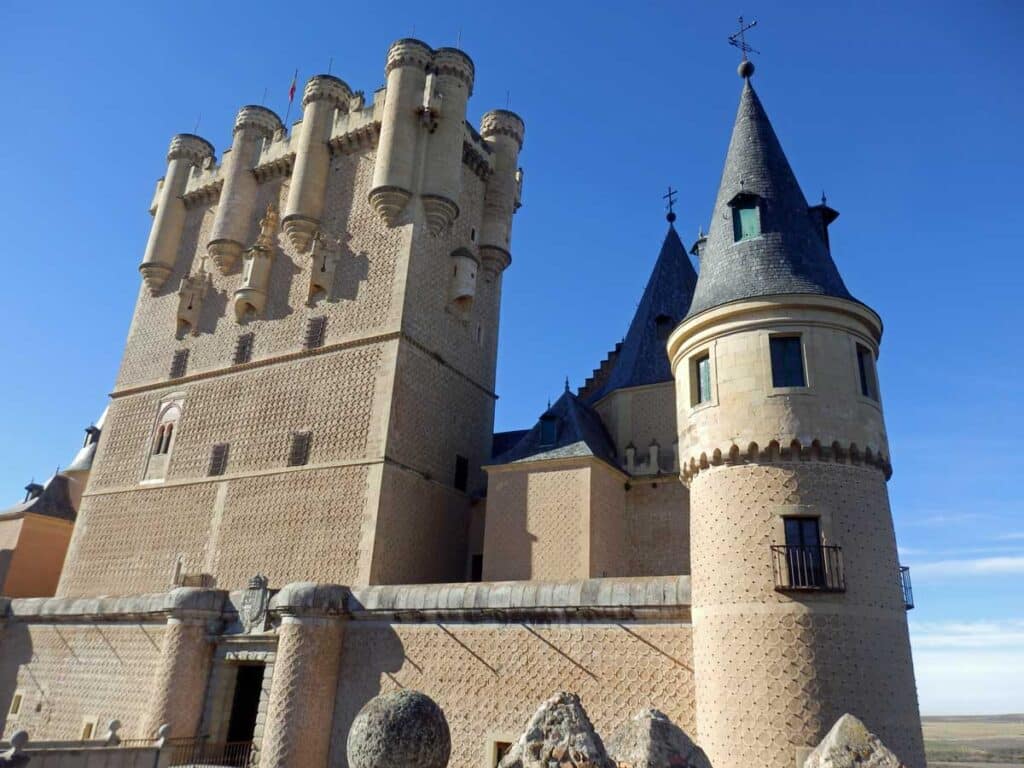
The Alcázar of Segovia is a castle-fortress perched atop a rocky crag where the rivers Eresma and Clamores meet, dominating the skyline of Segovia. Its imposing towers, sloping slate roofs and fairytale-like silhouette have earned it a reputation as one of the most picturesque castles in Europe. The combination of its medieval architecture, royal heritage and panoramic views over the historic city and surrounding countryside make it a popular target for day trips from Madrid.
Inside, visitors can explore the palace rooms, a museum and the historic artillary collection, which together offer insight into the castle’s strategic and royal past. Climbing the Torre de Juan II (Tower of Juan II) rewards you with sweeping views over Segovia’s old town and the distant Sierra de Guadarrama.
The Alcázar’s compact layout means you can get a good sense of it from a shorter visit, such as those on the fairly rushed three cities tours from Madrid. You can appreciate this Spanish castle‘s main highlights, atmospheric ramparts and commanding views without needing a full day. As photo stops go, the hilltop setting beside the narrow medieval streets makes the Alcázar a pretty excellent one.
There are also tours from Madrid that just concentrate on Segovia.
Alcázar of Segovia opening hours
From 1 April to 31 October the Alcázar is open daily from 10:00 to 19:30, with last entry 30 minutes before closing.
From 1 November to 31 March the opening hours are 10:00 to 18:00.
The site is closed on certain dates and may have modified hours on holidays — it is worth checking before visiting.
Alcázar of Segovia ticket prices
A full ticket granting access to the palace, museum and the Tower of Juan II costs €10. Reduced tickets for eligible visitors (children, seniors, students, etc.) cost €8.
There is also a lower-price option for just the palace and museum (without tower access) at €7. The reduced rate for eligible visitors is €5.
What to see at the Alcázar of Segovia
Inside the Alcázar you can visit historic palace rooms, including halls and chambers reflecting centuries of history. The artillery museum showcases military artefacts and the castle’s defensive heritage.
Climbing the Tower of Juan II involves a spiral staircase — the narrow steps lead up to panoramic views over Segovia’s rooftops, the old town and nearby hills.
How to get to the Alcázar of Segovia & practical information
The address is Plaza de la Reina Victoria Eugenia, s/n, 40003 Segovia.
If you arrive by car, note that parking in the immediate vicinity of the castle is essentially unavailable — narrow streets and restricted zones are common in the old town, so most visitors leave their car outside the historic centre and walk in.
The castle is walkable from much of Segovia’s historic area, and local buses or taxis from the train station can bring you close to the old town if arriving by train.
Because some parts (especially the tower) involve stairs and uneven surfaces, access may be difficult for visitors with limited mobility.
Best time to visit the Alcázar of Segovia
Visiting early in the morning or late afternoon tends to be less crowded, making it easier to climb the tower or enjoy the views without the tour group crowds from Madrid.
In summer, checking the weather and time of day helps: late afternoon visits often mean softer light over the castle and city. The castle’s hill-top position means wind or sun can be stronger, so plan accordingly.
Visitor tips for the Alcázar of Segovia
- Buy tickets online where possible; this can help avoid queues, especially in peak season.
- Wear comfortable shoes if you plan to climb the tower — the staircases are narrow and steep.
- Allow at least 1.5 to 2 hours to explore the castle, palace interiors, museum and tower for a satisfying visit.
- Check opening hours and closures before visiting — hours vary by season, and there are occasional full-day closures or reduced hours.
- If you arrive by car, plan parking outside the historic centre and walk to the castle to avoid difficulties with narrow streets or restricted access.
- Consider visiting early or late in the day to avoid larger crowds and to enjoy better light for photos or views.
Things to do near the Alcázar of Segovia
- Segovia Cathedral – This large Gothic cathedral stands in the Plaza Mayor, around a 10-minute walk from the Alcázar through Segovia’s historic centre.
- Roman Aqueduct of Segovia – The enormous Roman aqueduct is at the opposite end of the old town and can be reached on foot from the Alcázar in around 20 minutes.
- Casa de los Picos – This distinctive 15th-century townhouse has a façade covered in granite diamond-shaped blocks and stands on Calle Juan Bravo in the historic centre.
- Monastery of San Antonio el Real – This former royal monastery contains a church and Mudéjar-style ceilings and is about 2km from the Alcázar.
- Jewish Quarter of Segovia – The medieval Jewish quarter occupies the streets between the cathedral and old city walls, with historic buildings and narrow lanes to explore.
Alternative attractions
- Castillo de Coca – This distinctive brick-built Gothic-Mudéjar castle in Coca, around 50km from Segovia, provides a very different architectural contrast to the Alcázar.
- Ávila City Walls – The exceptionally well-preserved medieval walls encircle Ávila’s historic centre and can be explored from several access points.
- Ávila Cathedral – Built into the city’s defensive walls, this Romanesque-Gothic cathedral combines religious and military architecture in a way that echoes the defensive character of the Alcázar.
- Toledo Cathedral – This vast Gothic cathedral in Toledo is one of Spain’s major medieval religious buildings and contains an extensive collection of artworks.
- Royal Palace of Madrid – Madrid’s principal royal palace contains state rooms, historic collections and ceremonial spaces, providing another perspective on Spain’s royal heritage.
Disclosure: This guide contains affiliate links. Book through them, and I earn a small commission at no extra cost to you.
More Spain travel
Other Spain travel articles on Planet Whitley include:
- A first time visitor’s guide to Valladolid, Spain.
- In Barcelona, do I need to book Casa Vicens tickets in advance?
- A practical guide to the Dalí Theatre-Museum in Figueres, Catalonia.
- 10 things Spain does better than anywhere else.
- 6 underrated Spanish cities.