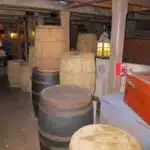
First time visiting Appleton Estate in Jamaica? This guide explores the Appleton rum distillery tour, its setting in Cockpit Country, and an unforgettable journey along the Black River.
From the top of the tower at Appleton Estate, there’s an awful lot of green to be seen, and not much else.
It’s a peek into Cockpit Country, a place where inland Jamaica’s already pothole-happy roads turn into dirt tracks, villages give way to the occasional hermit shack and the forest canopy pauses only for the odd covert field growing, ahem, plants closely associated with Rastafarian culture.
Appleton Estate and rural Jamaica
The Appleton Estate is found at the end of bumpy, snaking roads that step far away from the clichéd Jamaican image of beaches and reggae shacks.
But it is where the other cliché, rum, is made.
The distillery in the hills dates back to 1749 according to official documentation. But it’s probably older – other documents were destroyed in the 1907 Kingston earthquake.
And, due to its unique position amongst the rare Cockpit limestone karst, Appleton’s rums are amongst the few in the world that can claim a wine-style terroir.
Why book the Private Jamaican South Coast sightseeing tour?
- 🚗 Private, flexible itinerary: Travel at your own pace on a fully private tour, with stops tailored to what you most want to see along Jamaica’s south coast.
- 🌴 Appleton Estate and rum heritage: Visit Appleton Estate to learn how Jamaica’s most famous rum is made, set in the lush Nassau Valley.
- 🐊 Black River safari experience: Cruise through mangroves on the Black River, spotting crocodiles and birdlife in one of Jamaica’s most distinctive ecosystems.
- 🍹 Pelican Bar option: Choose to stop at Floyd’s Pelican Bar, a wooden bar perched on stilts in the Caribbean Sea, reached by boat.
- 🏨 Hotel pick-up and local insight: Includes pick-up and drop-off from Montego Bay hotels, with a knowledgeable local driver-guide throughout the day.
How Appleton rum is made
It’s not nature alone that decides the taste, however.
Barrel ageing, a proprietary strain of yeast and copper pot stills all play their part.
But the most important factor is the blending.
Appleton’s signature V/X rum is a blend of 15 different rums, all aged and treated slightly differently.
And when that much effort has gone into it, it seems a shame to knock it back so casually in the alarmingly liberal sampling session at the end of the distillery tour.

Water sources and the Black River
The water used in the distillation process comes an on-property spring.
And that spring just so happens to be the source of the Black River, which lazily saunters its way into the sea on Jamaica’s south coast.
It is not, however, a river you want to go for a dip in.
Crocodiles on the Black River safari
Arriving on the bank near the river mouth, an alarming sight can be seen on the mercifully fenced-off boat ramp.
“That’s the Terrorist,” captain Roger says as we prepare to board the Safari Fever.
“When he’s in the area, the other males have to leave. He’ll kill them.”
The Terrorist is the biggest crocodile in the river.
He’s about 14 foot long and not particularly cuddly.
But Roger has some reassurance.
“If the boat sinks,” he says, “remember that you only have to be able to swim faster than the person next to you.”
Jamaica’s south coast and mangrove ecosystem
While Jamaica’s north coast may be lined with resorts, the south coast is still largely swampy and undeveloped.
Some of the mangroves dragging their roots in the water are thought to be over 200 years old.
They’re a crucial part of an eco-system that sees fish get nutrients from the mangroves, birds eat the fish, and the crocs eat the birds.
As we chug gently upstream, smaller crocs can be spotted on the banks or swimming across in deadly silence in search of prey.
A couple of decades ago, it was thought that Jamaica’s crocodile population was down to about 300.
But protection measures and hefty fines for killing them mean that thousands can now be found hanging around near river mouths.
And there’s one waiting for us as we get back.
One of the Terrorist’s ladies has clambered on to the bank, a few metres from where we disembark.
Even with considerable rum-stoked emboldening, no-one’s going to step any nearer than strictly necessary.
There’s flexibility in that bird-only diet.
Things to do near Appleton Estate
- Black River safari, a boat trip to spot crocodiles and mangrove wildlife.
- YS Falls, one of Jamaica’s most accessible waterfall complexes.
- Pelican Bar, a wooden bar perched on stilts in the Caribbean Sea.
- Treasure Beach, a laid-back stretch of coastline on the south coast.
- Floyd’s Pelican Bar boat trips, often combined with coastal sightseeing.
Appleton Estate FAQs
| Where is Appleton Estate located? | Appleton Estate is located in rural southern Jamaica, within Cockpit Country. |
| How old is Appleton Estate? | Official records date the distillery to 1749, although it may be older. |
| What makes Appleton rum different? | The rum is influenced by local terroir, spring water, proprietary yeast and careful blending. |
| Can you visit Appleton Estate? | Yes, Appleton Estate offers guided distillery tours with tastings at the end. |
| Are there crocodiles on the Black River? | Yes, the Black River is home to a large population of American crocodiles. |
Disclosure: This guide contains affiliate links. Book through them, and I earn a small commission at no extra cost to you.