The Avebury Stone Circle is a massive Neolithic henge and prehistoric monument surrounding part of the village of Avebury in Wiltshire. This guide covers opening hours, ticket prices, transport or parking, accessibility, and practical visitor tips.
Many travellers will visit Avebury Stone Circle on Stonehenge tours from London, although there are also several tours running from Bath.
The information in this guide was updated in May 2026, confirming that the monument remains completely free to enter and operates without any advanced booking systems.
Quick facts
| Feature | Details |
| Opening hours | Open at any reasonable time during daylight hours, year-round. |
| Ticket prices | Free entry. |
| Address | Avebury, Marlborough, Wiltshire, SN8 1RF. |
| Nearest public transport or parking | Swindon railway station, or the main National Trust visitor car park. |
| Typical time needed to visit | 2 to 3 hours. |
Avebury Stone Circle opening hours
The Avebury Stone Circle is open to the public at any reasonable time during daylight hours, seven days a week. Visitors can access the open-air monument and its surrounding earthworks throughout the entire year. Seasonal variations directly affect visiting times, as the site lacks artificial lighting, meaning winter visits must conclude significantly earlier than summer visits.
The ancient monument is technically never closed, but visitors are strongly encouraged to arrive during daylight for safety. The nearby facilities, including the Alexander Keiller Museum and public restrooms, operate on standard daytime hours, typically opening at 10:00 AM and closing at 5:00 PM.
Avebury Stone Circle ticket prices
There is no cost to enter the monument. Opening hours and ticket prices were checked on the official English Heritage website and last updated in May 2026.
How to get to the Avebury Stone Circle
The most practical way to reach the site using public transport is by taking the railway network to Swindon station. Swindon is well connected to major cities, including direct services from London Paddington and Bristol Temple Meads. From Swindon station, visitors must catch the number 49 bus, which takes approximately thirty minutes to reach the village.
Visitors driving private vehicles should exit the M4 motorway at Junction 15 if travelling from the east. The route then follows the A4361 road south from Swindon through Wroughton directly to the site. There are no direct train stations located within the village of Avebury itself.
Parking at the Avebury Stone Circle
Parking at the Avebury Stone Circle is concentrated in a large, dedicated visitor car park situated just southeast of the main monument. This main car park is managed by the National Trust and currently charges £8 for all-day parking. Payment machines are located on-site, but mobile phone reception can be poor for parking applications, so bringing cash or a physical card is advised.
Parking is completely free for members of the National Trust and English Heritage who display a valid membership car sticker. Visitors must strictly avoid parking on the village streets marked with double yellow lines, as local traffic enforcement will issue immediate fines.
Is it worth paying for English Heritage membership?
Entry prices for English Heritage sites, including Dover Castle, Stonehenge and Tintagel Castle, can seem extremely expensive. This is clearly a deliberate ploy to push visitors towards taking out annual English Heritage membership.
Membership gives free access to more than 400 sites across the country, and costs £82. That is, unless you get a special deal – there was a 25%-off Black Friday deal in November 2025, for example.
Whether that £82 is worth it depends on how many sites are near you (there are lots in the south of the country, not so many near me in Yorkshire). And, critically, whether you’re going to visit them with children.
Each member can take up to six children with them free of charge. Given the steep one-time entry fees, an adult member with two children is likely to recoup the cost of their membership by visiting just two or three sites within the year.
For an individual without children, I’d say English Heritage membership is worth it only if you’re planning to blitz a few sites in one year. For an individual with children, membership is a smart investment that will likely pay itself back within one school holiday. To me, it’s a no-brainer.
The real question is whether it’s worth renewing English Heritage membership after a year. That’s debatable, as you’re unlikely to go to many of these sites twice. I eventually renewed after I was offered 20% off the price. I’ll probably recoup the membership price visiting two sites in summer next year, even if I’ve ticked off most of the best ones near me.
If you buy membership through this link, I earn a small commission at no extra cost to you.
How long to spend at the Avebury Stone Circle
A typical visit to the attraction lasts between two and three hours. This timeframe provides enough opportunity to walk the entire perimeter of the massive circular earthwork. It also allows time to closely examine the stones within the inner circles and take photographs.
Those who wish to explore the Alexander Keiller Museum, browse the National Trust shop, or stop for food in the village should allocate a full half-day. There are no mandatory guided tours, meaning visitors can set their own pace as they wander through the prehistoric landscape.
Accessibility at the Avebury Stone Circle
The monument presents significant challenges for wheelchair users and those with restricted mobility. Accessibility at the Avebury Stone Circle is limited because the site is an authentic prehistoric landscape composed of natural, uneven grass surfaces. Walking paths through the fields can quickly become very muddy and slippery following heavy rain.
Visitors must navigate kissing gates to enter the stone circle fields, which may restrict wider mobility scooters. Accessible public restrooms are available near the Alexander Keiller Museum in the village centre. Visitors with mobility requirements are advised to view the stones from the village pathways where the ground is paved and flat.
What to see at the Avebury Stone Circle
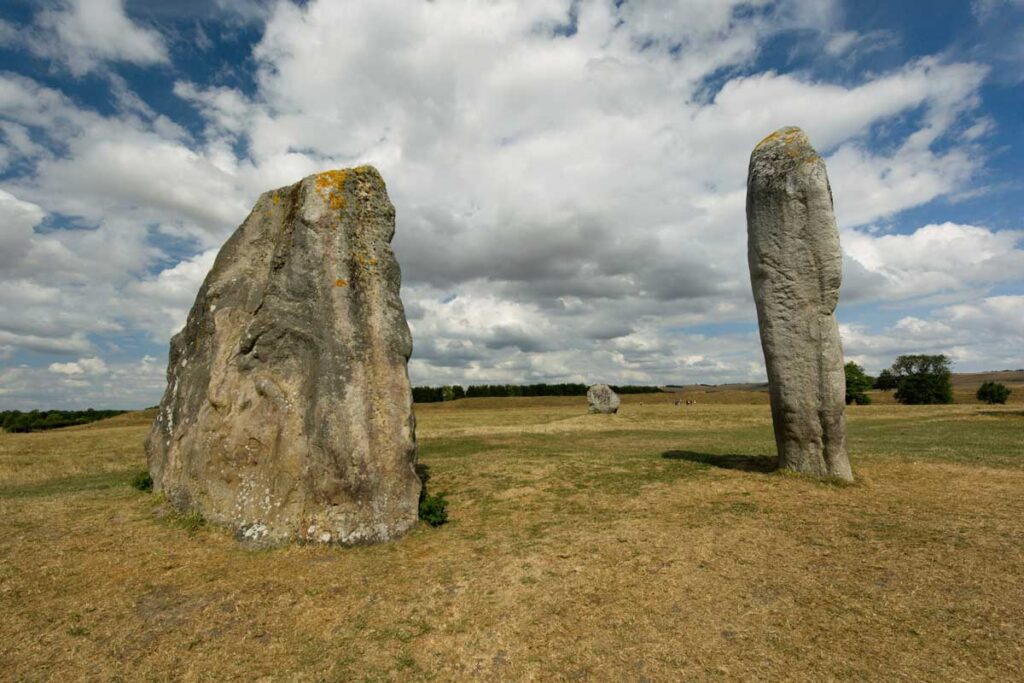
The primary attraction is the immense outer henge, consisting of a massive circular bank and a deep inner ditch. This earthwork originally enclosed an area of over twenty-eight acres, making it the largest of its kind in Britain. Visitors can walk along sections of this bank to gain elevated views looking down into the main circles and across the village.
Inside the earthwork is the great outer stone circle, which originally contained around one hundred massive, unworked sarsen stones. While many stones are now missing or replaced by concrete markers, the surviving megaliths are deeply impressive. Because the site is completely open, visitors can walk right up to these ancient stones and physically touch them.
Within the massive outer ring, visitors can identify the remains of two smaller, inner stone circles. The northern inner circle is heavily ruined, but its centre is marked by three large stones known as the Cove. The southern inner circle is more clearly defined and features a central feature known as the Obelisk, though only its historic location is currently marked.
The village of Avebury itself is uniquely situated directly inside the prehistoric earthworks, with a main road cutting straight through the monument. This creates a striking visual contrast between the ancient standing stones and the historic, thatched-roof cottages of the village. Visitors can also see the local sheep that graze freely among the megaliths, which helps to maintain the grass naturally.
Just off the main circles, visitors can also view the start of the West Kennet Avenue. This processional pathway originally consisted of paired standing stones that led from the main henge down into the surrounding landscape. Several reconstructed stones remain in place, demonstrating the sheer scale of the original Neolithic complex.
Practical visitor tips
| Category | Practical visitor tip |
| Timing | Arrive early in the morning or late in the afternoon to experience the stones in the best light and with the fewest crowds. |
| Crowds | Expect the highest concentration of visitors during the summer solstice in late June, when the site becomes exceptionally busy with celebrations. |
| Layout | Wear sturdy, waterproof walking boots as the grassy paths around the stones become extremely muddy, even after light rain. |
| Entry process | Walk directly into the fields through the wooden gates without needing to queue for a security check or ticket validation. |
| On-site logistics | Use the public restrooms located near the museum before heading out to explore the massive perimeter bank and ditch. |
Frequently asked questions about the Avebury Stone Circle
| Question | Answer |
| Is the Avebury Stone Circle suitable for children? | Yes, the site is suitable for children and offers vast open spaces for walking, though parents should supervise them near the deep ditch. |
| Do you need to book tickets in advance for the Avebury Stone Circle? | No, advance booking is not required because the monument is completely free and open to the general public. |
| Is the Avebury Stone Circle open on Sundays? | Yes, the open-air monument is accessible at any reasonable time during daylight hours on Sundays and every other day of the week. |
| Are bags allowed at the Avebury Stone Circle? | Yes, visitors can carry day bags and backpacks into the site without restriction, as there are no security checkpoints. |
| Are dogs allowed at the Avebury Stone Circle? | Yes, pet dogs are allowed but they must be kept on a lead at all times because sheep graze freely among the stones. |
Things to do near the Avebury Stone Circle
- Alexander Keiller Museum: A fascinating museum located within the village that displays archaeological finds excavated from the monument and the surrounding landscape.
- West Kennet Long Barrow: An impressive, ancient Neolithic tomb located a short drive away that visitors can physically enter and explore.
- Silbury Hill: The largest prehistoric artificial mound in Europe, visible from the roadside just south of the village.
- The Sanctuary: The remains of a complex prehistoric timber and stone circle located at the southern end of the West Kennet Avenue.
- Avebury Manor and Garden: A historic sixteenth-century manor house managed by the National Trust featuring beautifully restored, distinct garden rooms.
What to visit tomorrow
- Stonehenge: The most famous prehistoric stone circle in the world, featuring massive lintelled stones arranged in a precise astronomical alignment.
- Woodhenge: A Neolithic monument near Stonehenge composed of six concentric rings of timber posts, now marked by concrete pillars.
- Stanton Drew Stone Circles: A complex of three massive, lesser-known stone circles located in Somerset, offering a quieter prehistoric experience.
- Uffington White Horse: A highly stylised, prehistoric hill figure carved deeply into the white chalk on the Berkshire Downs.
- Uley Long Barrow: Also known as Hetty Pegler’s Tump, this is a well-preserved Neolithic chambered mound located in Gloucestershire that visitors can enter.
More Wiltshire travel
Other Wiltshire travel guides on Planet Whitley include:
- What first time visitors need to know about Old Sarum in Wiltshire.
- Will the monkeys at Longleat damage your car?
- Planning a visit to Malmesbury Abbey.
- Practical visitor guide to Salisbury Cathedral – one of the best Gothic cathedrals in the UK for visitors.
- Old Wardour Castle in Wiltshire: Opening times, ticket prices and visitor tips.