Gothic architecture reached England in the late 12th century and did not really stop until the Reformation ended the great building campaigns of the medieval church in the 1530s. In those three and a half centuries, English builders developed a sequence of styles — Early English, Decorated and Perpendicular — that produced some of the finest buildings anywhere in the Christian world.
The ten buildings below represent the full range of that tradition, from the earliest experiments in pointed arches and ribbed vaults to the breathtaking fan vaulting of the 15th and 16th centuries. All are substantially intact medieval structures where Gothic fabric remains the defining experience. Several better-known buildings — Winchester Cathedral’s Norman nave, Westminster Abbey’s heavily restored interior — have been omitted for the same reason that Windsor was left off the Norman castles list.
1. Salisbury Cathedral, Wiltshire
Salisbury Cathedral is the purest surviving example of Early English Gothic in Britain. Almost uniquely among English cathedrals, it was built in a single sustained campaign between 1220 and 1320, giving the exterior a consistency of vision that buildings accumulated over centuries invariably lack. The nave, choir, transepts and west front are all of one mind.
The spire, added in 1320 and rising to 123 metres, is the tallest in Britain. Sir Christopher Wren surveyed it in the 17th century and found it had already deflected 75 centimetres from the vertical under its own weight. It has been carefully monitored ever since and shows no sign of imminent difficulty. The Chapter House contains one of the four surviving originals of the 1215 Magna Carta, displayed in a dedicated chamber. This English cathedral also houses the oldest working clock mechanism in the world, dating from 1386 and now displayed in the nave.
A guided day trip from London combining Stonehenge and Salisbury Cathedral is the most convenient option for visitors based in the capital. The cathedral is included alongside Stonehenge and Windsor, with coach transport throughout. For a more focused visit, a private day trip from London to Salisbury and Stonehenge allows more time at each site with a dedicated guide and private vehicle.
If you’re travelling independently, I’ve written a guide to visiting Salisbury Cathedral in Wiltshire, South-West England.
2. Canterbury Cathedral, Kent
Canterbury Cathedral is where English Gothic began. After a catastrophic fire in 1174 destroyed the Norman choir, the Archbishop brought in the French master mason William of Sens to rebuild. What he created — using pointed arches, ribbed vaults and columns of Purbeck marble — is one of the earliest Gothic structures in England, and among the most significant single rooms in British architectural history.
The Trinity Chapel at the east end was built to house the shrine of Thomas Becket, murdered in the cathedral in 1170. The shrine itself was destroyed on the orders of Henry VIII in 1538, but the pavement before it is worn smooth by 350 years of pilgrims’ knees, and the surrounding Miracle Windows — 12th-century stained glass depicting the posthumous miracles attributed to Becket — are among the finest medieval windows in Europe. The Bell Harry Tower, completed in 1498, provides a spectacular Perpendicular climax to the interior.
A day trip from London combining Leeds Castle, Canterbury Cathedral and Dover Castle is the most popular way to visit from the capital, with a guided cathedral tour included in the booking. For a deeper engagement, a private Blue Badge guided tour of Canterbury and the cathedral led by a guide with a Cambridge doctorate covers 1,400 years of history with a depth unavailable on group tours.
For independent travellers, I’ve written a guide to visiting Canterbury Cathedral, and nearby St Augustine’s Abbey, in Kent.
3. York Minster, North Yorkshire
York Minster is the largest Gothic cathedral in northern Europe, and its claim to be the finest repository of medieval stained glass in the world is not seriously contested. Nearly half of all surviving medieval stained glass in England is at York — an accident of geography and, during the Second World War, of foresight. The glass was removed from York and stored safely before the Blitz reached the city.
The Five Sisters Window (c.1260), five soaring lancets of grisaille glass 16 metres tall, is one of the most formally perfect medieval windows anywhere. The Great East Window (1405–08), at 23 by 9 metres, is the largest area of medieval stained glass in the world. The Chapter House, completed around 1286, achieves its extraordinary span without a central column — an engineering feat announced by the motto carved above the entrance: “As the rose is the flower of flowers, so this is the house of houses.”
A private guided tour of York Minster explores the architecture, stained glass and the medieval stonemasons who continue to maintain the building — a Yorkshire craft tradition unbroken since the 14th century. The guide may arrange a meeting with the working masons, whose yard is one of the most remarkable in England. Insider access to less-visited areas is available on request.
For independent travellers, I’ve written a guide to York Minster for visitors.
Five great things to do while you’re in York
- 🧭 Discover York’s highlights on a small group walking tour.
- ⛵ Drift along the Ouse on an evening happy hour boat cruise.
- 👻 Delve into ghosts and gruesome history on the Shadows of York tour.
- 🏞️ Take a day trip to the North York Moors and Whitby.
- 🍫 Make your own chocolate bar at York Cocoa House.
4. Lincoln Cathedral, Lincolnshire
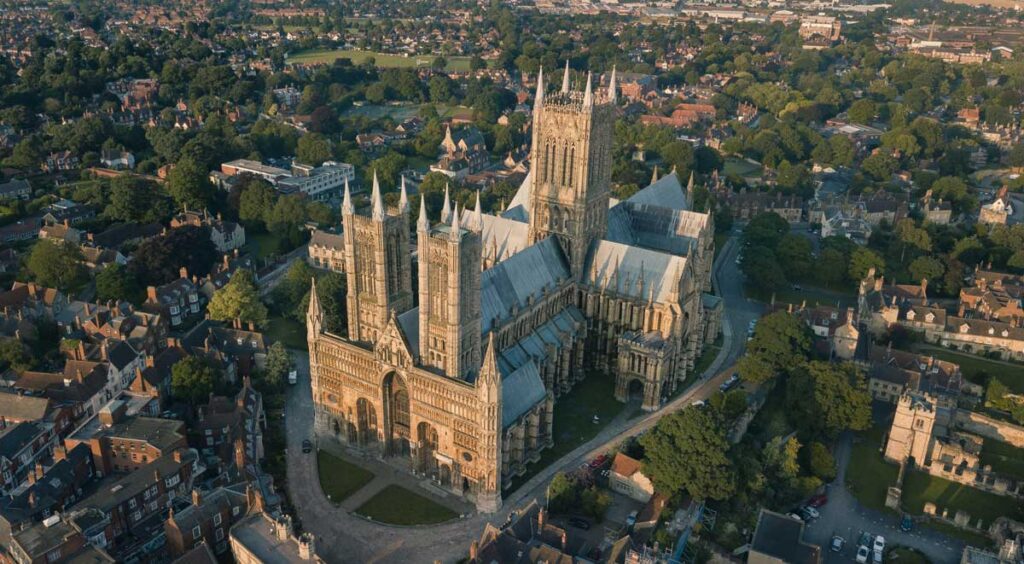
Lincoln Cathedral was, for more than 200 years, the tallest building in the world. The central spire, completed in the early 14th century, rose to 160 metres and held that distinction until it collapsed in a storm in 1549. What remains is still breathtaking — a building set on a hill above the city whose silhouette dominates the Lincolnshire plain for miles in every direction.
The Angel Choir (1256–1280), built to house the shrine of St Hugh of Lincoln, is one of the supreme achievements of English Gothic. Twenty-eight carved angels fill the spandrels of the triforium arcade with an assurance of craftsmanship that has rarely been equalled. Among them hides the Lincoln Imp — a small carved figure of a grinning devil, caught in stone by an angel and now the symbol of the city. The Dean’s Eye and Bishop’s Eye, two magnificent rose windows facing each other across the south transept, contain medieval glass of the first quality.
Lincoln is an independent-visit destination with strong on-site guides. The cathedral runs daily guided tours and rooftop tours in season. The city around it — Roman walls, the castle housing its own copy of Magna Carta, the medieval Steep Hill — rewards a full day’s exploration.
Read a more in-depth guide to Lincoln Cathedral here.
5. Exeter Cathedral, Devon
Exeter Cathedral contains the longest unbroken Gothic vault in the world — 91 metres of continuous ribbed vaulting running the full length of nave and choir without interruption. It was built in the Decorated Gothic style between the 1270s and around 1400, giving the interior a visual consistency that the piecemeal construction of most cathedrals does not allow. From the west end, the effect is of a stone tunnel of extraordinary elegance converging on the east window.
The details reward close attention. The Minstrels’ Gallery (c.1350) on the north wall of the nave is carved with 12 angels playing musical instruments — lute, bagpipes, harp, trumpet, gittern — with a specificity of observation that suggests the carver was working from life. The Bishop’s Throne (1312) is the tallest wooden throne in England, an extraordinary piece of medieval joinery rising to 18 metres. The astronomical clock in the north transept, dating from the early 15th century, is one of the finest in Europe.
Exeter is best reached by train from London‘s Paddington station, roughly two hours. The cathedral offers regular volunteer-led guided tours and audio guides. The surrounding Cathedral Close, with its medieval buildings and lawns, is one of the most pleasant precinct environments in England.
For more detail, I’ve written a guide to visiting Exeter Cathedral.
6. King’s College Chapel, Cambridge
King’s College Chapel is the supreme achievement of Perpendicular Gothic — the distinctively English development of the later medieval period, characterised by vertical emphasis, large windows and the technical virtuosity of fan vaulting. The chapel was begun by Henry VI in 1446 and not completed until 1515 under Henry VIII. That 70-year construction period produced, improbably, a building of almost total visual unity.
The fan vault, completed between 1512 and 1515 by John Wastell, is the largest of its kind in the world. Each half-cone of stone fans out from the wall shafts to meet its opposite number at the ridge, the whole ceiling a continuous surface of carved geometry. Below it, the original 16th-century stained glass survives complete in all 12 side windows and the great east window — one of the very few buildings where the original glazing programme remains intact. At the east end, Rubens’ Adoration of the Magi serves as the altarpiece.
A guided walking tour of Cambridge including King’s College and King’s College Chapel covers the architectural highlights with a student or alumnus guide, with admissions included. Visitors from London can join a Cambridge day trip from London that includes a city tour and access to the university’s historic buildings, with the chapel a centrepiece stop.
7. Wells Cathedral, Somerset
The West Front of Wells Cathedral is the greatest sculptural programme of the English Middle Ages — more than 300 carved figures arranged across the facade in tiers, representing the resurrection of the dead, the apostles, prophets and the Virgin, with Christ in majesty at the apex. Most are 13th-century originals, retaining traces of original paint. It is an astonishing survival.
Inside, the building poses and solves an architectural problem with a solution unlike anything else in the world. When the central tower began to sink under its own weight in the 1330s, the master mason William Joy designed the scissor arches — two interlocking inverted arches spanning the crossing — to redistribute the load. They work. They are also, seen from the nave, one of the most striking architectural inventions in any English building.
The Chapter House (1306), reached by a worn medieval stair whose steps have been shaped by seven centuries of feet, is an octagonal room with a central pier from which the vault fans out in 32 ribs. The effect, particularly in low morning light, is of inhabiting an open palm. Wells is served by bus from Bath and Bristol; the Somerset town around the cathedral is small and amiable.
Again, I’ve written a more detailed guide to visiting Wells Cathedral.
8. Gloucester Cathedral, Gloucestershire
Gloucester Cathedral holds two unique distinctions. The choir, rebuilt after 1337 around the Norman structure of the abbey church, is the first major example of Perpendicular Gothic anywhere — the earliest appearance of what would become the dominant English architectural style for the next 200 years. The great east window, the largest medieval window in England, was inserted into this new framework to commemorate the Battle of Crécy. It still contains most of its original 14th-century glass.
The cloister, built between about 1360 and 1412, contains the first fan vaulting in England — predating even King’s College by a century. It is a more intimate version of the form: the corridor vaults fan out from the walls to meet along a central ridge, the whole thing lit by the original tracery windows of the lavatorium on one side. Walking through the Gloucester cloister is one of the finest Gothic experiences in the country and is entirely free. The tomb of Edward II, murdered at Berkeley Castle in 1327, is one of the finest royal monuments in England.
Gloucester is easily reached by train from London Paddington. The cathedral runs regular guided tours. The surrounding area, including the Severn Vale and the Forest of Dean, rewards a longer stay.
9. Beverley Minster, East Yorkshire
Beverley Minster is the most underrated Gothic building in England. It is not a cathedral — it never had a bishop — but in architectural quality it rivals Westminster Abbey, and it is visited by a tiny fraction of the crowds. The west front, with its two Perpendicular towers, is among the finest in England. The interior, running from early 13th-century Early English in the east to 14th-century Decorated in the nave, gives a survey of English Gothic comparable to any cathedral in the country.
The Percy Canopy (c.1340), a tomb canopy above a memorial to Lady Eleanor Percy, is one of the most complex and beautiful pieces of medieval carved stonework in England — a forest of miniature spires and crocketed arches barely a metre wide. The misericords in the choir stalls include some of the finest medieval carvings in the country. The building is free to enter, the town of Beverley is charming and the East Riding countryside around it is severely underappreciated. York, an easy 30 minutes by train, makes a natural base.
For more detail, read my complete Beverley Minster visitor guide.
10. Glasgow Cathedral, Scotland
Glasgow Cathedral is the only medieval cathedral on the Scottish mainland to survive the Reformation substantially intact — a remarkable accident of civic loyalty, since the townspeople of Glasgow are said to have physically prevented the Protestant reformers from demolishing it in the 1560s. What they preserved is the finest Gothic building in Scotland.
The building is largely 13th century, but the outstanding space is the Lower Church — a vaulted crypt below the choir, not underground but built into the slope of the hill, which serves as the setting for the tomb of St Mungo, the city’s patron saint. The forest of slender columns, the low vaulted bays and the filtered light from the deep-set windows give it a quality of enclosed, reverential space that the upper church, for all its quality, does not quite match. It is one of the finest Gothic interiors in Britain.
A Glasgow city centre walking tour includes the cathedral alongside the Necropolis, the medieval city centre and other architectural landmarks, with a local guide providing context on Glasgow’s evolution from medieval cathedral town to Victorian industrial powerhouse. The cathedral itself admits visitors free of charge; volunteer guides are available inside during opening hours.
My more detailed Glasgow cathedral guide should answer any further questions.
Practical tips for visiting Gothic cathedrals in the UK
Admission and donations
Most English cathedrals charge admission outside service times. Beverley Minster and Glasgow Cathedral are free. Wells, Exeter, Lincoln, York, Salisbury, Canterbury and Gloucester all charge entry fees, though attending a service — evensong is typically daily — allows free access to the building. King’s College Chapel has its own admissions system through the college. Evensong at any of these buildings is one of the finest free cultural experiences in the country and is highly recommended on its own terms.
The three styles explained
Early English Gothic (c.1175–1275) uses pointed arches, narrow lancet windows and clustered columns of dark Purbeck marble. Salisbury and Wells are the best examples. Decorated Gothic (c.1275–1350) is characterised by elaborate window tracery, naturalistic carved foliage and geometric complexity — see Exeter’s nave vault and Lincoln’s Angel Choir. Perpendicular Gothic (c.1350–1540) introduces large windows with vertical mullions, flat arches and, eventually, the fan vault. King’s College Chapel and Gloucester’s cloister are the defining examples. Once you can read these distinctions, visiting any Gothic building in Britain becomes considerably more rewarding.
The best lesser-known stops
Beverley Minster and Wells Cathedral are the two buildings most likely to surprise visitors who do not know them. Both are architecturally exceptional and visited by a fraction of the crowds at York or Canterbury. If you have done the obvious cathedrals and want to go further, start there. Ely Cathedral — with its unique 14th-century Octagon replacing a collapsed Norman tower, and one of the most dramatic interior views in England — is the obvious next stop beyond this list.
More European cathedrals
Other European cathedral guides on Planet Whitley include
- Key information for visiting Winchester Cathedral in Hampshire.
- What to expect when visiting the World Heritage-listed Naumburg Cathedral in Saxony-Anhalt.
- Oviedo Cathedral visitor guide: Opening hours, prices and which day to avoid.
- Visitor guide to St Bavo’s Cathedral in Ghent.
- A practical guide to visiting Nidaros Cathedral in Trondheim.