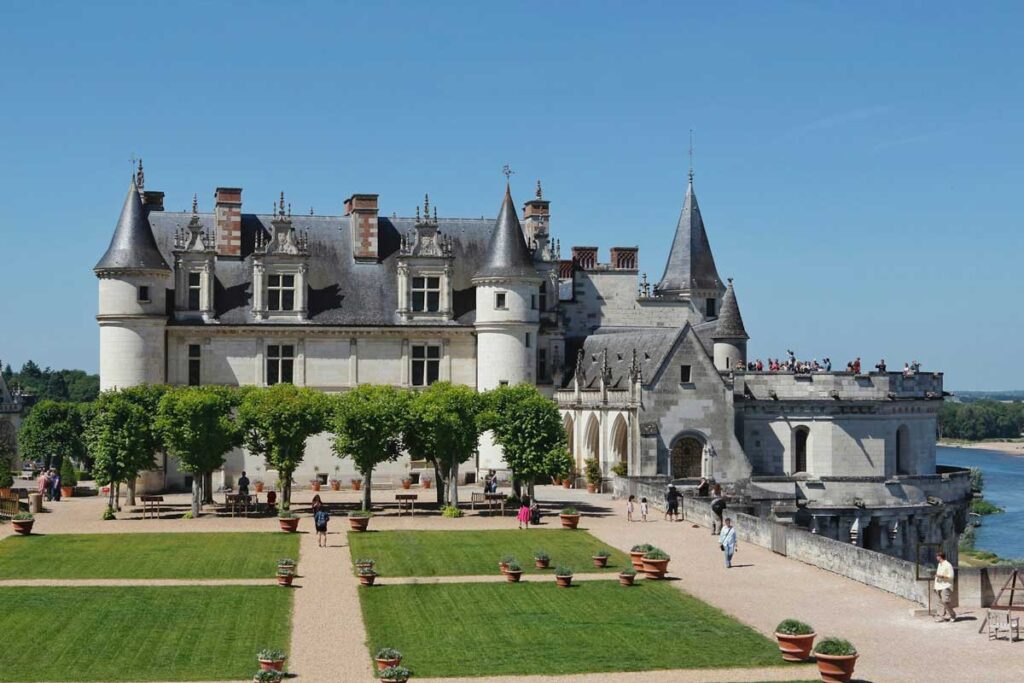
The Château Royal d’Amboise is a historic Renaissance palace and former residence of French kings, situated on a promontory overlooking the Loire River in Amboise, France. This guide covers opening hours, ticket prices, transport, parking, accessibility, and practical visitor tips.
To secure entry on the day you want to visit, book your tickets online.
This comprehensive visitor guide was updated in May 2026 to reflect the latest €17.30 adult admission price, which now fully includes the interactive Histopad tablet.
Quick facts
| Feature | Details |
| Opening hours | Peak summer: 09:00 to 19:00. Winter: 10:00 to 16:30. |
| Ticket prices | Adults: €17.30. Students: €14.40. Children (7 to 18): €11.00. |
| Address | Montée de l’Emir Abd-el-Kader, 37400 Amboise, France. |
| Nearest public transport or parking | Amboise railway station. Municipal parking along the Loire River. |
| Typical time needed to visit | One and a half to two hours. |
Château Royal d’Amboise opening hours
The castle is open to visitors every day of the year, with the exception of Christmas Day and New Year’s Day. During the peak summer months of July and August, the gates open at 09:00 and close at 19:00.
In the winter months, hours are significantly reduced, generally operating from 10:00 to 16:30. A temporary lunch closure is implemented during January and early February. The final admission time is strictly 30 minutes before the scheduled closing hour.
Château Royal d’Amboise ticket prices
Standard adult admission costs €17.30, while students aged 19 to 25 pay a reduced rate of €14.40. Tickets for children between seven and 18 years old cost €11.00. Children under seven enter the site completely free of charge.
Opening hours and ticket prices were checked on the official website and last updated in May 2026.
Every standard admission ticket includes a complimentary Histopad interactive tablet. Tickets can be purchased online.
How to get to the Château Royal d’Amboise
The fortress is located in the heart of Amboise, a town in the Indre-et-Loire department easily accessible by train. Visitors can take a direct two-hour rail journey from Paris Austerlitz. You can also take a 20-minute regional train from Tours directly to the Amboise railway station.
From the train station, it is a flat 2km walk across the river into the historic town centre. The pedestrian entrance to the castle is located on Place Michel Debré. Here, visitors ascend the sloping Emir Abd El-Kader walkway.
Parking at the Château Royal d’Amboise
This French castle does not have its own dedicated private visitor car park on the elevated grounds. Visitors must utilise the municipal car parks located throughout the town of Amboise and along the banks of the Loire River.
Both free and paid parking zones are available down by the riverbank. These are located just a short five-minute walk from the main entrance ramp. During the peak summer season, these central parking lots fill up very rapidly. Arriving early in the morning is essential to secure a spot.
How long to spend at the Château Royal d’Amboise
Visitors typically require between one and a half to two hours to complete a full tour of the grounds and buildings. The interior royal apartments take approximately 45 minutes to explore using the provided interactive tablet guide.
The remainder of your time will be spent outdoors. You can take in the panoramic views over the river, explore the formal gardens, and visit the historic chapel.
Accessibility at the Château Royal d’Amboise
Due to its historic architecture and elevated location, the site presents some accessibility challenges. The ground floor and first floor of the royal apartments are accessible for wheelchair users. Visitors with mobility issues can request a video guide at the ticket office to view the inaccessible second-floor rooms.
The outdoor pathways through the gardens are generally wide and paved. However, several paths feature steep inclines with a gradient of up to 10%. These slopes may require physical assistance to navigate safely.
Inside / what to see at the Château Royal d’Amboise
The primary historical draw of the site is the Chapel of Saint-Hubert. This is a delicate Gothic structure built on the outer defensive walls. This chapel is globally famous for containing the official tomb of Leonardo da Vinci. He spent the final years of his life in Amboise.
Inside the main royal lodge, visitors walk through a sequence of restored residential rooms. These rooms showcase the transition from Gothic to Renaissance architecture. The interior displays a rich collection of authentic 15th and 16th-century furniture. This includes intricately carved canopy beds and massive stone fireplaces.
As you explore the royal apartments, you use the Histopad tablet, which is included with admission. This device provides a 3D augmented reality experience. It shows exactly how the empty rooms looked when fully furnished during the reign of King Francis I.
Outside the buildings, the elevated rock platform houses expansive panoramic gardens laid out in the formal French style. Visitors can explore the Jardin d’Orient, which features Mediterranean plantings and perfectly pruned topiary spheres.
The castle’s high vantage point provides an unobstructed, sweeping view across the slate roofs of Amboise and the wide expanse of the Loire River. The raised cavalry towers are another major architectural highlight. They feature massive internal spiral ramps originally designed for horses.
Practical visitor tips
| Tip category | Advice |
| Timing | Arrive when the gates open at 09:00 to explore the interior rooms before the large coach groups arrive. |
| Crowds | The summer months are extremely busy, so plan your visit for a weekday in May or September. |
| Layout | Collect the free printed visitor guide at the entrance, which is available in 16 different languages. |
| Entry process | You can purchase your admission tickets at the front desk, as online advance booking is not mandatory. |
| On-site logistics | Bring a pair of headphones to plug into your Histopad tablet for a more immersive audio experience. |
Frequently asked questions about the Château Royal d’Amboise
| Question | Answer |
| Is the Château Royal d’Amboise suitable for children? | Yes, children under seven enter for free, and the interactive Histopad tablet features a digital treasure hunt. |
| Do you need to book tickets in advance for the Château Royal d’Amboise? | No, visitors can purchase standard admission tickets at the main entrance gate upon arrival. |
| Is the Château Royal d’Amboise open on Sundays? | Yes, the castle is open every Sunday of the year, closing only on Christmas Day and New Year’s Day. |
| Are bags allowed at the Château Royal d’Amboise? | Standard day backpacks are permitted, but large luggage and oversized suitcases cannot be brought inside. |
| Are dogs allowed at the Château Royal d’Amboise? | Dogs on a lead are permitted in the gardens, and small dogs in a carrier are allowed inside the buildings. |
Things to do near the Château Royal d’Amboise
- Château du Clos Lucé: A nearby historic manor house where Leonardo da Vinci lived, featuring models of his famous inventions.
- Château Gaillard: A restored royal retreat in Amboise boasting some of the earliest Renaissance gardens planted in France.
- Parc des Mini-Châteaux: A family-friendly outdoor park displaying highly detailed miniature scale models of the famous Loire Valley castles.
- Pagoda of Chanteloup: A towering 18th-century Chinese-style monument offering panoramic views from its upper viewing platform.
- Caves Ambacia: Historic riverside wine cellars offering guided underground tours and regional vintage wine tasting sessions.
What to visit tomorrow
- Château de Chenonceau: An iconic Renaissance castle famous for being constructed on a bridge directly spanning the Cher River.
- Château de Chambord: The largest and most elaborate castle in the region, featuring a famous double helix staircase.
- Château de Blois: A grand royal palace located in the city centre of Blois, showcasing four distinct eras of French architecture.
- Château de Cheverny: A highly symmetrical 17th-century estate famous for its lavish interiors and its working pack of hunting hounds.
- Château d’Azay-le-Rideau: An elegant French Renaissance castle constructed on a picturesque island in the middle of the Indre River.
More France travel
Other France travel guides on Planet Whitley include:
- Practical guide to visiting the Palais des Papes in Avignon.
- French castle guides: Foix Castle near Toulouse and Chateau de Castelnaud in the Dordogne.
- Loire Valley castle guides: Chenonceau Castle, the Chateau de Bouges, the Chateau de Saumur and Chambord Castle.
- Important visitor information for Chateau de Compiegne and Chateau de Pierrefonds in Hauts-de-France.
- Visitor guides for National Monuments around Paris: The Chateau de Vincennes, the Chateau de Maisons and Villa Savoye..