Explore Corbridge Roman Town, a key settlement on Hadrian’s Wall in Northumberland. Plan your visit with this practical guide covering ticket prices, opening hours, and visitor tips.
This guide was updated in March 2026 to reflect recent price increases. Other guides may be outdated.
Overview: History, what to expect, and unique features
Corbridge Roman Town (Coria) offers a distinct perspective on life on the northern frontier. Unlike the military forts located directly on Hadrian’s Wall, Corbridge began as a military base but quickly developed into a flourishing civilian town and a vital supply depot for the Wall’s garrisons. It was the place where supplies were stored, troops were paid, and trade took place for nearly three centuries.
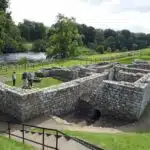
Visitors can expect to explore the foundations of a Roman market town, including visible streets, protective walls, and the remains of storehouses, fountains, and granaries. The site is notable for the survival of the Corbridge Hoard, a remarkable collection of Roman armour and tools found in 1964. The museum on site displays this collection and other significant local finds. Corbridge is managed by English Heritage and offers a gentle, engaging site that is easier to navigate than the dramatic hill forts along the main Wall line.
Corbridge Roman Town opening times
The site and museum at this English Heritage site are open year-round, but specific closing times vary by season. Visitors should confirm the schedule on the English Heritage website.
- Summer season (29 March to 25 October): Open daily from 10:00am to 5:00pm.
- Winter season (26 October to 27 March): Open on weekends and school holidays from 10:00am to 4:00pm.
- Last entry: Last admission to the site is generally one hour before closing (e.g., 4:00pm in summer, 3:00pm in winter).
- Closures: The town and museum are closed on 24, 25, and 26 December.
Five great things to do in Northumberland
- 🏛️ Discover Roman Britain on a full day tour along Hadrian’s Wall.
- 🎬 Visit the filming locations for Vera on a day tour from Newcastle.
- 🌊 Take a guided Pilgrims Path walk across the sands to Holy Island.
- 🏰 Explore Harry Potter’s Hogwarts at Alnwick Castle.
- 👻 Learn about Hexham’s gruesome, dark side on a storytelling tour.
Corbridge Roman Town admission fees and tickets
Admission prices at Corbridge Roman Town are a infuriatingly complicated, as they vary depending on the time of year and day of the week. The prices below are for tickets booked online at least one day in advance, without a Gift Aid donation, and represent a saving of around 15% compared to tickets bought on the day at the entrance.
Super Saver — Fri–Sat, 28 Mar–22 May & 1 Sep–1 Nov; daily from 2 Nov–16 Mar
| Visitor | Price |
|---|---|
| Adult | £9.26 |
| Concession | £8.50 |
| Child | £4.59 |
Saver — Sun–Thu, 28 Mar–22 May & 1 Sep–1 Nov; Fri–Sat, 23 May–31 Aug
| Visitor | Price |
|---|---|
| Adult | £10.79 |
| Concession | £10.03 |
| Child | £5.35 |
Standard — Sun–Thu, 23 May–31 Aug
| Visitor | Price |
|---|---|
| Adult | £12.32 |
| Concession | £11.56 |
| Child | £6.12 |
Concession prices apply to over-65s, students with a valid student ID, and jobseekers with relevant ID. English Heritage members enter free.
Prices checked and updated March 2026.
Is it worth paying for English Heritage membership?
Entry prices for English Heritage sites, including Dover Castle, Stonehenge and Tintagel Castle, can seem extremely expensive. This is clearly a deliberate ploy to push visitors towards taking out annual English Heritage membership.
Membership gives free access to more than 400 sites across the country, and costs £82. That is, unless you get a special deal – there was a 25%-off Black Friday deal in November 2025, for example.
Whether that £82 is worth it depends on how many sites are near you (there are lots in the south of the country, not so many near me in Yorkshire). And, critically, whether you’re going to visit them with children.
Each member can take up to six children with them free of charge. Given the steep one-time entry fees, an adult member with two children is likely to recoup the cost of their membership by visiting just two or three sites within the year.
For an individual without children, I’d say English Heritage membership is worth it only if you’re planning to blitz a few sites in one year. For an individual with children, membership is a smart investment that will likely pay itself back within one school holiday. To me, it’s a no-brainer.
The real question is whether it’s worth renewing English Heritage membership after a year. That’s debatable, as you’re unlikely to go to many of these sites twice. I eventually renewed after I was offered 20% off the price. I’ll probably recoup the membership price visiting two sites in summer next year, even if I’ve ticked off most of the best ones near me.
If you buy membership through this link, I earn a small commission at no extra cost to you.
Accessibility, parking, and the site terrain
Corbridge Roman Town is generally considered more accessible than the military forts along the escarpment of Hadrian’s Wall. However expect uneven or gravel paths.
- Parking: A free car park is available on site for visitors.
- Museum/Shop: The museum and shop are fully accessible with level or ramped access. Accessible toilets are also available.
- Town Ruins: The open site features mainly grass and gravel paths. While the ground is generally level, the terrain can be uneven or soft in wet weather. Access to the full circuit of the ruins may be challenging for some mobility aids, but the main viewing areas are usually manageable.
- Assistance: Visitors are advised to contact the site ahead of time for up-to-date information on ground conditions if mobility is a concern.
Nearby attractions for Corbridge Roman Town
Corbridge’s location makes it an easy stop when exploring the southern and central sections of Hadrian’s Wall:
- Chesters Roman Fort: A short drive north, this former cavalry fort is noted for its well-preserved Roman bath-house. Housesteads Roman Fort is an alternative option.
- Aydon Castle: A fortified medieval manor house, located just a few miles away, offering a contrast to the Roman-era history.
- Hexham: A nearby market town featuring the historic Hexham Abbey, which was originally founded in the Anglo-Saxon period.
- Vindolanda Roman Fort: A major excavation site located west of Corbridge, famous for the preservation of the Roman writing tablets.
FAQs (Frequently Asked Questions)
| Question | Answer |
|---|---|
| Is Corbridge actually on Hadrian’s Wall? | No, it is located about 2.5 miles south of the Wall. It was a crucial supply base and civilian town, not a frontier military fort. |
| Is the site easy to walk around? | Compared to the hill forts, Corbridge is relatively flat and gentle. The paths are grassed or gravel, which can be uneven, but it is generally easier to navigate for most visitors. |
| What is the most important item in the museum? | The museum features the Corbridge Hoard, a remarkable time capsule of Roman armour, tools, and equipment discovered in a chest in 1964. |
| Are dogs allowed at the site? | Dogs are welcome on the grounds of the Roman town, provided they are kept on a lead at all times. They are not permitted inside the museum. |
| How long does a typical visit last? | Most visitors spend between 1.5 and 2 hours exploring both the ruins of the town and the Clayton Museum. |

More Northumberland travel
Other Northumberland travel articles on Planet Whitley include:
- How to get the best out of a visit to Alnwick Castle.
- A practical guide to Dunstanburgh Castle.
- Kielder Observatory visitor guide.
- Seals, saints and stars on a journey around Northumberland.
- A first time visitors’ guide to Bamburgh Castle.