Ehrenbreitstein Fortress is a historic 19th-century Prussian military citadel situated on a high rock plateau overlooking the confluence of the Rhine and Moselle rivers in Koblenz, Germany. This guide covers Ehrenbreitstein Fortress opening hours, exact ticket prices, transport or parking, accessibility, and practical visitor tips to help you efficiently plan your visit.
This guide was updated in May 2026 to reflect the current combined ticketing options that integrate the cross-river cable car journey directly with standard fortress admission.
Quick facts
| Feature | Details |
| Opening hours | Daily 10:00 am – 6:00 pm |
| Ticket prices | €10.00 (Adult); €5.50 (Student); €4.00 (Child 7-17); Free (Child 6 and under) |
| Address | Greiffenklaustraße, 56077 Koblenz, Germany |
| Nearest public transport or parking | Seilbahn Koblenz / Fortress Visitor Car Park |
| Typical time needed to visit | 2 to 3 hours |
Ehrenbreitstein Fortress opening hours
Ehrenbreitstein Fortress operates daily throughout the year, but the access times for the interior exhibitions change depending on the season. During the primary summer season, from late March until early November, the indoor museums and exhibition spaces are open from 10:00 am until 6:00 pm from Monday to Sunday.
While the exhibition buildings close at 6:00 pm, the general outdoor fortress grounds and the associated hospitality venues typically remain open with free access until midnight. During the winter season, running from November to March, the interior exhibitions operate on reduced hours, generally closing at 5:00 pm. The exhibition buildings are closed entirely on Christmas Eve and New Year’s Eve.
Ehrenbreitstein Fortress ticket prices
Opening hours and ticket prices were checked on the official website and last updated in May 2026. General admission for adults visiting only the fortress costs €10.00. Discounted entry is available at €5.50 for students and trainees with valid identification. Children aged seven to 17 pay €4.00, while children aged six and under enter for free.
Ehrenbreitstein Fortress is not currently included in any multi-attraction digital city pass schemes. However, most visitors purchase a combined ticket that includes return travel on the Koblenz Cable Car alongside fortress admission. This specific combined ticket costs €21.90 for an adult. Family tickets covering up to two adults and four children are also available for both fortress-only and combined options.
Why book the Koblenz Cable Car & Ehrenbreitstein Fortress?
- 🚠 Aerial Rhine Crossing: Glide 890 meters across the Rhine River in a panoramic cable car, enjoying spectacular 360-degree views of the UNESCO World Heritage Upper Middle Rhine Valley.
- 🏰 Ehrenbreitstein Fortress: Explore one of the largest preserved fortresses in Europe, standing 118 meters above the river and offering a fascinating journey through Prussian military history and architecture.
- 🗺️ The “German Corner” View: Capture the best vantage point of the *Deutsches Eck*, the iconic confluence where the Moselle River flows into the Rhine, presided over by the monumental statue of Emperor William I.
- 🖼️ Immersive Cultural Exhibits: Gain access to the fortress’s diverse museums, featuring world-class exhibitions on archaeology, the history of photography, and the region’s rich wine-growing heritage.
- ♿ Barrier-Free Exploration: Benefit from a 100% accessible experience, from the modern cable car cabins to the well-maintained paths of the fortress park, ensuring everyone can enjoy the Arctic-like breeze and views.
How to get to Ehrenbreitstein Fortress
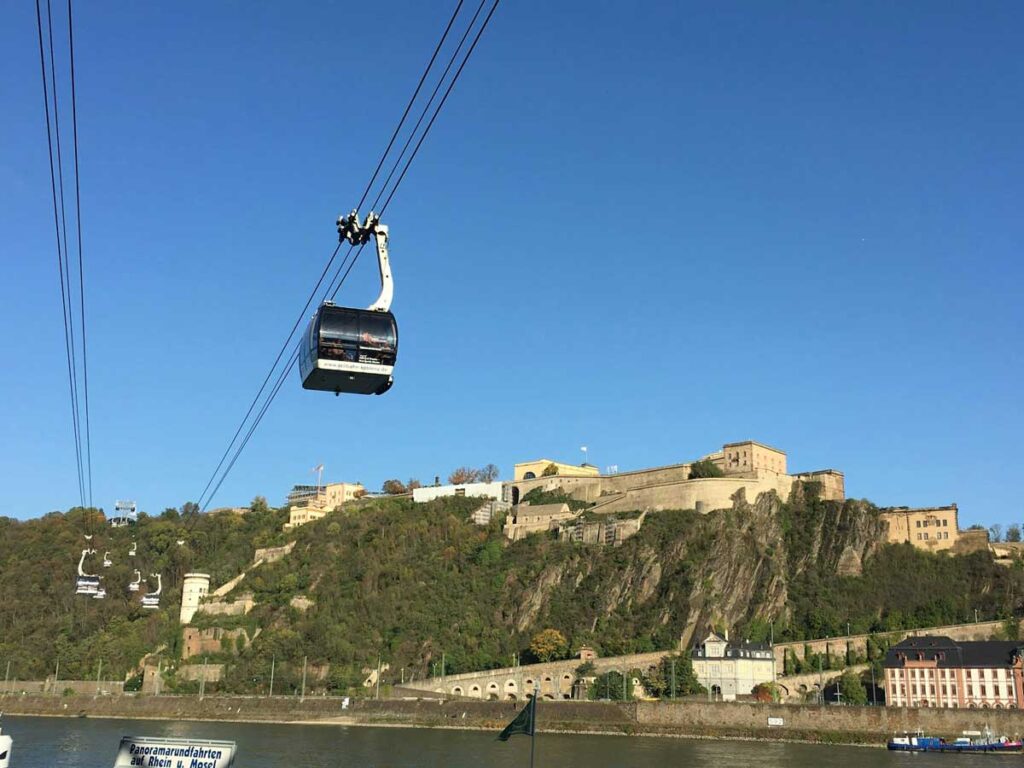
The most direct and popular method to reach Ehrenbreitstein Fortress from central Koblenz is by using the Seilbahn Koblenz. This modern cable car departs from the Konrad-Adenauer-Ufer station situated near the Deutsches Eck. The scenic journey transports passengers directly across the Rhine River to the upper fortress entrance in a few minutes.
Alternatively, visitors approaching from the eastern side of the river can use the Ehrenbreitstein Fortress Lift. This mechanical funicular railway travels directly from the lower Ehrenbreitstein district up to the cultural centre in under three minutes. Traditional public buses also operate scheduled routes serving the upper plateau, and a passenger ferry frequently crosses the river between the city centre and the lower town.
Parking at Ehrenbreitstein Fortress
Drivers visiting Ehrenbreitstein Fortress will find a designated visitor car park located directly next to the main entrance building on the plateau. This official surface lot operates seven days a week and utilises a standard paid tariff system. The parking fee is €2.00 for the first hour and €1.50 for every additional hour, up to a maximum daily rate of €20.00.
Finding a parking space in this upper lot at this German castle can be challenging during peak summer weekends or during major historical festivals. As an alternative, visitors can park in the large municipal car parks or underground garages located in the Koblenz city centre. From these central locations, you can walk to the base station and ascend the hill using the cross-river cable car.
How long to spend at Ehrenbreitstein Fortress
A standard visit to Ehrenbreitstein Fortress typically requires between two and three hours. This duration provides enough time to walk the extensive outdoor defensive perimeter and navigate the central courtyards. It also allows visitors to comfortably view the main permanent exhibitions located inside the historical barrack buildings at a steady walking pace.
If you intend to thoroughly read the detailed archaeological plaques, participate in a guided historical tour, or eat a meal at the on-site restaurant, allocate an additional hour to your itinerary. Visitors who purchase the combined cable car ticket usually spend a full half-day completing the round trip and exploring the surrounding plateau gardens.
Accessibility at Ehrenbreitstein Fortress
Ehrenbreitstein Fortress offers significant infrastructure to accommodate visitors with mobility requirements. Both the Koblenz Cable Car and the Ehrenbreitstein Fortress Lift are fully wheelchair accessible. The cable car cabins can be briefly halted by staff to allow easy, level boarding, and they provide sufficient space to accommodate modern electric wheelchairs.
Inside the fortress grounds, the primary pathways leading to the central courtyards and the main museum entrances are paved and relatively flat. Modern lifts connect the different floor levels within the main exhibition buildings, and wheelchair-accessible public toilets are available on-site. However, some historical outer walls and older defensive tunnels feature uneven terrain and steep steps that restrict access.
Inside / what to see at Ehrenbreitstein Fortress
Upon entering the complex, visitors first encounter the interactive Milestones of Fortress History exhibition. This introductory display is located immediately next to the main entrance and guides you through a chronological timeline of the site. It outlines how the strategic location was utilised for military defence over the centuries, culminating in the construction of the massive 19th-century Prussian citadel.
The site houses the extensive Archaeological Museum, which documents over half a million years of human history across the Middle Rhine and Moselle regions. The permanent galleries display significant regional artefacts spanning from the Stone Age to the Middle Ages. Visitors can view historical tools, Roman pottery, and early medieval weapons recovered from local archaeological excavations.
Directly above the Archaeological Museum, visitors can access the Historical Time Gardens located on the roof. This specific outdoor exhibition reconstructs different horticultural periods using authentic historical planting methods. You can observe how agricultural spaces evolved, comparing a structured Roman subsistence garden directly with a medieval farm layout.
The fortress also features a dedicated exhibition named the House of Indulgence, which focuses entirely on regional wine production. This gallery explores 2,000 years of viticulture within Rhineland-Palatinate, detailing the historical importance of the six local wine-growing areas. Visitors can examine historical pressing equipment and learn about traditional fermentation techniques.
One of the primary highlights is the vast viewing platform situated at the very edge of the fortress walls. This large, paved area provides an unobstructed, panoramic vantage point directly overlooking the Deutsches Eck, where the Moselle River meets the Rhine. It is widely considered the best location for photographing the Koblenz cityscape and the surrounding river valleys.
Practical visitor tips
| Tip Category | Practical Advice |
| Timing | Arrive when the gates open at 10:00 am to secure a space in the upper car park before afternoon visitors arrive. |
| Crowds | Check the official event schedule before your visit, as regular historical festivals frequently restrict general admission to event ticket holders only. |
| Layout | Utilise the free fortress map provided at the entrance to efficiently navigate the complex, unguided network of defensive walls and courtyards. |
| Entry process | Retain your combined cable car ticket throughout your visit, as you will need to scan it again to board the return carriage. |
| On-site logistics | Wear sturdy, flat walking shoes, as the expansive outdoor grounds require significant walking over cobbled and uneven historical surfaces. |
Frequently asked questions about Ehrenbreitstein Fortress
| Question | Answer |
| Is Ehrenbreitstein Fortress suitable for children? | Yes, the site is highly suitable for children and features large outdoor areas to explore alongside specific interactive exhibits in the archaeological museum. |
| Do you need to book tickets in advance for Ehrenbreitstein Fortress? | No, advance booking is not strictly required for general daytime visits, and standard admission tickets can be purchased at the cable car or entrance desks. |
| Is Ehrenbreitstein Fortress open on Mondays? | Yes, the attraction remains open on Mondays throughout the year, maintaining the same operating hours as the rest of the week. |
| Are bags allowed at Ehrenbreitstein Fortress? | Standard day bags and small backpacks are permitted inside the grounds and exhibitions, but large luggage must be left at your hotel. |
| Are dogs allowed at Ehrenbreitstein Fortress? | Dogs are permitted in the outdoor areas of the fortress if kept on a lead, but they are strictly prohibited from entering any indoor exhibition rooms. |
Things to do near Ehrenbreitstein Fortress
- Deutsches Eck: A monumental headland located directly across the river, featuring a massive equestrian statue of Kaiser Wilhelm I marking the confluence of the Rhine and Moselle.
- Stolzenfels Castle: A highly romanticised 19th-century palace situated a short distance south of Koblenz, featuring ornate historical interiors and terraced gardens overlooking the river.
- Basilica of St. Castor: The oldest church in Koblenz, located near the Deutsches Eck, featuring distinct Romanesque architecture and a peaceful enclosed courtyard.
- Rhein-Museum Koblenz: A dedicated cultural museum located in the lower Ehrenbreitstein district, detailing the ecological and historical significance of the Rhine River.
- Electoral Palace: A sprawling 18th-century neoclassical palace located in central Koblenz, featuring meticulously manicured public gardens extending down to the riverbank.
What to visit tomorrow
- Burg Eltz: A highly preserved, fairy-tale medieval castle hidden within a dense forest valley, featuring original historical furnishings and a large armoury collection.
- Marksburg: An entirely intact medieval hill castle located above the town of Braubach, offering guided tours through historical living quarters and defensive structures.
- Cochem Castle: A prominent imperial castle rebuilt in the 19th-century Neo-Gothic style, perched high on a steep hill overlooking the winding Moselle River.
- Rheinfels Castle: A massive, ruined fortress complex located in St. Goar, featuring an extensive network of underground mining tunnels and dark defensive passageways.
- Schloss Drachenburg: A late 19th-century neo-Gothic villa situated on the Drachenfels hill near Bonn, featuring lavish interior decorations and expansive landscaped parks.
More German castles
Other German castle guides on Planet Whitley include:
- How to get into Neuschwanstein Castle when the tickets have sold out.
- Bavarian castle guides: Visiting Trausnitz Castle and planning a trip to Burghausen Castle.
- Plan your visit to Wartburg Castle in Thuringia.
- Practical guiide to visiting Bentheim Castle in Lower Saxony.
- What to know before visiting Lichtenstein Castle in Baden-Württemberg.