Pfalzgrafenstein Castle is a historic medieval toll station situated on the small Falkenau island in the middle of the Rhine River near Kaub. This guide covers opening hours, ticket prices, transport or parking, accessibility, and practical visitor tips to help you efficiently plan your visit.
This guide was updated in May 2026 to reflect the current operating schedule, noting that the castle is now open from Thursday to Sunday during the main season.
Quick facts
| Feature | Details |
| Opening hours | Thu-Sun 10:00 am – 5:00 pm (March to October) |
| Ticket prices | €8.00 (Adult); €4.00 (Child 6-17); Free (Child 5 and under) |
| Address | Insel Falkenau 1, 56349 Kaub, Germany |
| Nearest public transport or parking | Kaub railway station / B42 ferry car park |
| Typical time needed | 1.5 to 2 hours |
Pfalzgrafenstein Castle opening hours
Pfalzgrafenstein Castle operates on a highly seasonal and restricted schedule due to its exposed island location. During the primary visitor season, which runs from mid-March until the end of October, the castle is open four days a week. From Thursday to Sunday, visitors can access the site between 10:00 am and 5:00 pm.
The attraction is completely closed to the public from Monday to Wednesday during the summer. Furthermore, the castle closes entirely for a long winter season from November through to mid-March. Occasional short-notice closures may also occur during the open season if high water levels, strong river currents, or severe weather make the ferry crossing unsafe.
Pfalzgrafenstein Castle ticket prices
Opening hours and ticket prices were checked on the official website and last updated in May 2026. General admission for adults costs exactly €8.00. Discounted entry is available at €7.00 for students, trainees, and pensioners with valid identification. Children aged six to 17 pay €4.00, while children aged five and under enter for free. Family tickets are available at €8.00 for one adult with up to four children, and €16.00 for two adults with up to four children.
Crucially, all listed admission prices directly include the cost of the short passenger ferry ride to and from the island. Pfalzgrafenstein Castle is not currently included in any major digital city pass schemes such as the Frankfurt Card or the Go City pass. Those regional passes typically cover different urban attractions further afield, such as the Städel Museum, the Palmengarten, and the Senckenberg Natural History Museum in Frankfurt.
How to get to Pfalzgrafenstein Castle
Because Pfalzgrafenstein Castle is located on an island in the middle of the Rhine, it is completely inaccessible by bridge. The only way to reach the site is by taking the dedicated foot passenger ferry from the town of Kaub. The designated ferry jetty is situated on the mainland along the B42 road, approximately 1.5 kilometres south of the main Kaub village boundary.
Visitors travelling by public transport can take the regional train to the Kaub railway station. From the station platform, it is a flat, 15-minute walk south along the riverfront to reach the passenger ferry departure point. Long-distance river cruise ships operated by companies like KD travel past the castle daily, but they do not dock at the island itself.
Parking at Pfalzgrafenstein Castle
Drivers visiting Pfalzgrafenstein Castle cannot take their vehicles to the island. You must park your car on the mainland in Kaub before boarding the foot ferry. There are designated public parking spaces situated directly between the B42 main road and the elevated railway embankment, located immediately adjacent to the ferry jetty.
These mainland parking spaces operate on a standard paid tariff system requiring payment at automated machines. Space is relatively limited and can fill up quickly during peak summer weekends. If the primary ferry car park is full, visitors must park in the municipal lots within the Kaub town centre and walk south along the river promenade to the departure jetty.
How long to spend at Pfalzgrafenstein Castle
A standard visit to Pfalzgrafenstein Castle typically requires between one and a half to two hours. This duration includes the time needed to purchase tickets on the mainland, wait for the scheduled passenger ferry, and complete the short river crossing. Once on the island, you need approximately 45 minutes to walk through the small inner courtyard and explore the tower levels.
If you choose to rent the digital audio guide for €1.00, you should allocate the full two hours to ensure you can listen to all the historical information at a steady pace. The total duration of your visit is strictly dictated by the return ferry schedule, which departs the island at regular, fixed intervals to transport visitors back to Kaub.
Accessibility at Pfalzgrafenstein Castle
Pfalzgrafenstein Castle presents severe physical accessibility challenges and is entirely inaccessible to wheelchair users or visitors with significant mobility impairments. The passenger ferry requires stepping over a gap to board, and the island jetty consists of steep, uneven stone steps leading directly up to the main entrance gate.
Inside the defensive walls, the historic architecture remains unaltered. Visitors must navigate narrow, uneven stone floors, low doorways, and steep wooden staircases without modern handrails to access the upper tower levels. Furthermore, there are no public toilets, cafes, or drinking water facilities anywhere on the island. Visitors must use the barrier-free public toilets located at the Pegelhaus car park in Kaub before crossing.
Inside / what to see at Pfalzgrafenstein Castle
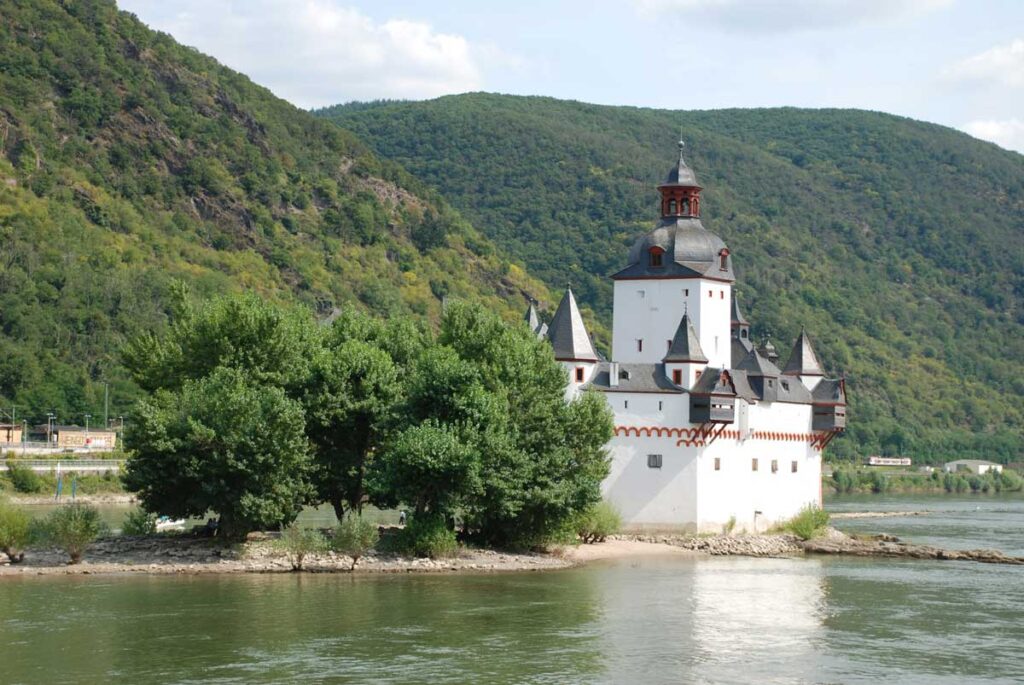
Upon entering through the heavy wooden gates, visitors step into the narrow inner courtyard of the toll station. The focal point of the complex is the central pentagonal tower, originally constructed in 1327 by King Ludwig IV. This six-storey structure was purposefully designed with a wedge-shaped point facing upriver to act as a wave and ice-breaker against the strong Rhine currents.
Surrounding the central tower is a thick, 12-metre-high defensive ring wall built around 1340. Visitors can walk along the elevated wooden galleries mounted on the inside of this wall. These covered walkways feature small viewing slits and defensive loopholes that provide clear, strategic vantage points over both the eastern and western shipping channels of the river.
The exterior architecture is defined by its distinct ship-like appearance, created by a pointed ashlar stone projection added to the southern end during the 17th century. This specific addition was engineered to further protect the foundation from heavy winter ice floes. From the mainland, the combination of the pointed bow and the baroque tower lantern makes the castle resemble a stone ship permanently anchored in the water.
The interior rooms within the tower are relatively small and sparsely furnished, accurately reflecting the utilitarian lifestyle of the toll collectors and small military garrison stationed there. Visitors will find basic historical household items, simple clay pottery, and an original 17th-century pizza and bread oven located on the second floor.
The site also features a preserved historical dungeon used to hold merchants who refused to pay the river tolls. This specific prison consists of a simple wooden raft located at the bottom of a deep internal well. Prisoners were physically lowered down by rope and held in the damp, dark shaft until the required financial ransom was paid to the authorities.
Practical visitor tips
| Tip Category | Practical Advice |
| Timing | Arrive at the Kaub ferry jetty at 10:00 am on a Thursday to explore the small interior rooms before afternoon tourist groups arrive. |
| Crowds | Avoid visiting during German public holidays in the summer, as the small passenger ferry has a strict maximum capacity per crossing. |
| Layout | Wear sturdy, flat walking shoes, as the interior wooden stairs are steep and the stone courtyard floors are highly uneven. |
| Entry process | Purchase your combined admission and ferry ticket directly at the mainland booth in Kaub, as online advance booking is not available. |
| On-site logistics | Bring a refillable water bottle with you, as there are absolutely no food or drink concessions operating on the island. |
Frequently asked questions about Pfalzgrafenstein Castle
| Question | Answer |
| Is Pfalzgrafenstein Castle suitable for children? | Yes, children generally enjoy the short boat ride and the castle architecture, but steep stairs and low walls require close adult supervision. |
| Do you need to book tickets in advance for Pfalzgrafenstein Castle? | No, advance booking is not required or possible; standard admission tickets are purchased upon arrival at the mainland ferry jetty. |
| Is Pfalzgrafenstein Castle open on Mondays? | No, the castle is strictly closed to the public from Monday to Wednesday during the summer, and completely closed throughout the winter. |
| Are bags allowed at Pfalzgrafenstein Castle? | Small day bags are permitted, but large backpacks and heavy travel luggage should not be taken onto the small passenger ferry. |
| Are there toilets at Pfalzgrafenstein Castle? | No, there are no toilet facilities located anywhere on the island; visitors must use the public toilets in Kaub before departing. |
Things to do near Pfalzgrafenstein Castle
- Blücher Museum Kaub: A historical museum located in the town centre detailing the famous 1814 crossing of the Rhine by Prussian General von Blücher.
- Gutenfels Castle: A large 13th-century fortress situated high on the hill directly above Kaub, currently operating as a private hotel but visible from the river.
- Loreley Rock: A massive, steep slate cliff towering over the narrowest point of the Rhine, famous for its mythological siren and panoramic viewing plateau.
- Niederwald Monument: A colossal 19th-century memorial located near Rüdesheim, accessible via a scenic cable car ride over the surrounding vineyards.
- Rheingau Wine Region: The broader surrounding agricultural area, featuring numerous traditional wine taverns and steep terraced vineyards specialising in Riesling production.
What to visit tomorrow
- Marksburg: An entirely intact medieval hill castle located above the town of Braubach, offering guided tours through historical living quarters and armouries.
- Ehrenbreitstein Fortress: A massive 19th-century Prussian military citadel situated in Koblenz, reached by a modern cross-river cable car.
- Burg Eltz: A highly preserved, fairy-tale medieval castle hidden within a dense forest valley, featuring original historical furnishings and treasury collections.
- Cochem Castle: A prominent imperial castle completely rebuilt in the Neo-Gothic style, perched high above the winding Moselle River.
- Rheinfels Castle: An extensive ruined fortress complex located in St. Goar, featuring a large network of underground mining tunnels and defensive passageways.
More German castles
Other German castle guides on Planet Whitley include:
- Practical guiide to visiting Bentheim Castle in Lower Saxony.
- What to know before visiting Lichtenstein Castle in Baden-Württemberg.
- Visitor guide to Schloss Drachenburg in Konigswinter.
- Plan your visit to Wartburg Castle in Thuringia.
- Bavarian castle guides: Trausnitz Castle and Burghausen Castle.