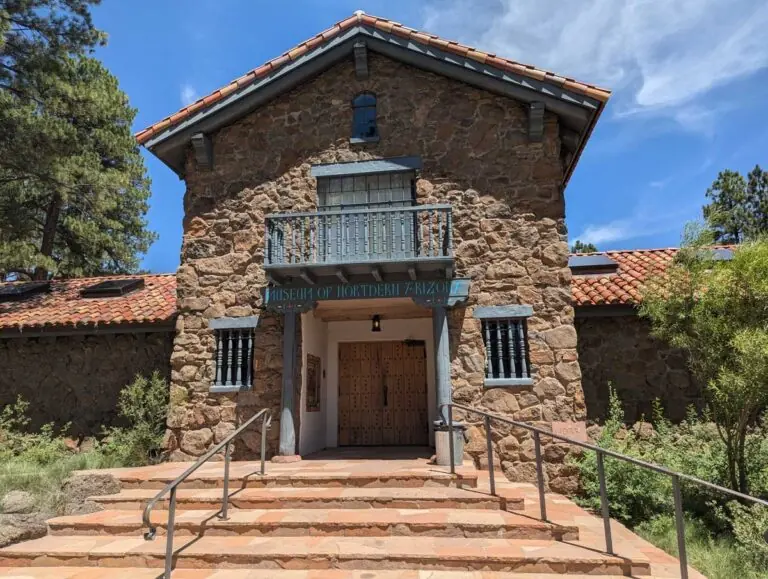
Flagstaff sits at 7,000 feet on the edge of the Colorado Plateau — a university city in a ponderosa pine forest with a character significantly different from the desert cities to its south. It is where Pluto was discovered in 1930, where a Craftsman mansion built by a pair of timber baron brothers still stands in near-original condition, and where three distinct ancestral Native American cultures left traces in the volcanic landscape to the north. The Museum of Northern Arizona is one of the finest regional museums in the Southwest. The Lowell Observatory remains an active research institution more than a century after its founding. And the eastern approach to Flagstaff along Historic Route 66 passes a 50,000-year-old meteor impact crater and a Hopi ancestral site that reward the detour. Flagstaff is also the most practical base for day trips to the Grand Canyon South Rim, 80 miles north. These guides cover the city’s key attractions with practical information on ticket prices, opening hours and what to expect on arrival, alongside road trip guides for the most popular routes through the region.
Flagstaff city attractions
Flagstaff’s city attractions are clustered in and around the downtown historic district and the university area — compact enough to combine two or three in a single day. The Lowell Observatory and Museum of Northern Arizona are the headline institutions; the Riordan Mansion and Arboretum reward those with more time.

- Museum of Northern Arizona, Flagstaff: ticket prices, hours and visitor guide — one of the finest regional museums in the American Southwest, covering the geology, biology, archaeology and living cultures of the Colorado Plateau, with outstanding collections of Hopi, Navajo and Zuni art and a programme of tribal artisan markets that bring the collections to life through direct engagement with Native artists.
- Lowell Observatory, Flagstaff: ticket prices, hours and visitor guide — the historic observatory on Mars Hill where Clyde Tombaugh discovered Pluto in 1930 and where the first evidence for the expanding universe was gathered in the 1910s, still an active research institution with guided tours, daytime solar viewing and evening telescope sessions for visitors.
- Riordan Mansion State Historic Park, Flagstaff: ticket prices, hours and visitor guide — a 13,000-square-foot Arts and Crafts duplex mansion built in 1904 for two timber baron brothers who married two sisters, with the interior preserved remarkably intact and guided tours that cover both the architecture and the family history of the men who shaped early Flagstaff.
- The Arboretum at Flagstaff: practical guide with hours, prices and tips — a 200-acre botanical garden at 7,150 feet elevation, the highest arboretum in the United States, with collections of high-altitude native plants, a raptor free-flight programme and nature trails through the surrounding ponderosa pine forest.
National monuments around Flagstaff: the volcano loop
Three National Park Service monuments lie north of Flagstaff on a route that can be driven as a single half-day or full-day loop — Wupatki, Sunset Crater and Walnut Canyon — each preserving a different aspect of the volcanic and human history of the San Francisco Peaks landscape. The eruption of Sunset Crater Volcano around 1085 AD is the event that connects all three.
- Sunset Crater Volcano National Monument, Flagstaff: ticket prices, hours and visitor guide — the site of a volcanic eruption around 1085 AD that forced the evacuation of surrounding Sinaguan communities and then, paradoxically, drew them back as the volcanic ash improved soil moisture retention, with a lava flow trail through a landscape of cinder cones and solidified basalt.
- Wupatki National Monument, Flagstaff: ticket prices, hours and visitor guide — the remains of a 12th-century pueblo that grew to become one of the largest and most cosmopolitan settlements in the region after the Sunset Crater eruption enriched the soil, with a natural blowhole, a ball court of Mesoamerican influence and views across the Painted Desert.
- Walnut Canyon National Monument, Flagstaff: ticket prices, hours and visitor guide — a series of cliff dwellings built by the Sinagua people into the limestone ledges of a forested canyon eight miles east of Flagstaff, accessed via a steep 240-step trail that descends into the canyon and passes 25 rooms of preserved 12th-century architecture.
The Route 66 corridor: Winslow and Meteor Crater
The drive east from Flagstaff along Historic Route 66 and I-40 passes two of the most unusual attractions in Arizona — one natural, one archaeological — within 60 miles of the city. Both work well as a combined day trip or as stops on an onward journey east toward Albuquerque.
- Meteor Crater, near Winslow, Arizona: practical guide for first-time visitors — the best-preserved meteorite impact crater on earth, nearly a mile wide and 550 feet deep, created approximately 50,000 years ago when a nickel-iron meteorite struck the Colorado Plateau, now privately owned with a visitor centre, guided rim tours and an impressive indoor museum covering both the crater’s science and NASA astronaut training that took place here.
- Homolovi State Park, Winslow: practical guide with hours, prices and tips — an Arizona state park protecting four ancestral Hopi pueblos dating from the 13th and 14th centuries, considered sacred by the Hopi Nation and offering walking trails through the archaeological sites with an interpretive centre covering the history and significance of the settlements.
Road trips to, from and through Flagstaff
Flagstaff’s position at the intersection of I-17, I-40 and US-89 makes it a natural crossroads for Southwest road trips — approached from Phoenix and Tucson to the south, from Albuquerque and Amarillo to the east along the old Route 66 corridor, and from Gallup and the Navajo Nation to the northeast. The drives onward to Williams, Kingman, Santa Fe and the Grand Canyon all start here. These guides cover nine of the most popular routes, with best stops, distances and realistic drive times.
- Phoenix to Flagstaff road trip: best stops, distance and drive time — the drive north on I-17 through the Sonoran Desert and up the Mogollon Rim escarpment, climbing nearly 5,000 feet as the saguaro cactus gives way to ponderosa pine, with Montezuma Castle and the Verde Valley as the most rewarding detours.
- Tucson to Flagstaff road trip: best stops, drive time and distance — the longer drive north through Phoenix or via the more scenic Oracle and Globe route through the Tonto National Forest, connecting southern Arizona’s Sonoran Desert to the Colorado Plateau.
- Albuquerque to Flagstaff road trip: best stops, drive time and distance — the drive west along I-40 through the high desert of New Mexico and into Arizona, following the old Route 66 corridor through Gallup, the Painted Desert and Petrified Forest National Park.
- Amarillo to Flagstaff road trip: best stops, distance and drive time — the classic Route 66 drive west across the Texas Panhandle and through New Mexico, passing Cadillac Ranch, Tucumcari and Albuquerque before the final stretch across the Arizona high desert to Flagstaff.
- Gallup, New Mexico to Flagstaff drive: best stops, distance and drive time — the drive west through the Navajo Nation and the Painted Desert, passing through the Petrified Forest and the geological spectacle of the Painted Desert Rim before descending toward Flagstaff.
- The best route from Flagstaff to the Grand Canyon — the 80-mile drive north along US-180 and AZ-64 to the South Rim, covering the route options, what to see on the way and how to make the most of the drive in either direction.
- Flagstaff to Williams drive: best stops, distance and drive time — the short drive west along Historic Route 66, one of the most intact stretches of the original highway, connecting Flagstaff to the small town that serves as the Grand Canyon Railway terminus.
- Flagstaff to Kingman drive: best stops, distance and drive time — the drive west through Williams and along the old Route 66 corridor, with detours through Seligman — the inspiration for the town of Radiator Springs in the film Cars — and the dramatic descent into the Mojave Desert.
- Flagstaff to Santa Fe road trip: best stops, distance and drive time — the drive northeast across the Colorado Plateau through Winslow, the Petrified Forest and Gallup, crossing the Continental Divide before arriving in New Mexico’s historic capital.
Planning your Flagstaff visit
Flagstaff’s 7,000-foot elevation makes it significantly cooler than Phoenix and Tucson year-round — it receives regular snow in winter and rarely exceeds 27°C in summer, making it a popular cool-weather escape from Arizona’s desert cities. The national monuments north of the city can be combined into a single day loop via the US-89 / Forest Road 545 circuit — Sunset Crater, Wupatki and Walnut Canyon — without needing to backtrack. The Lowell Observatory is best visited for an evening programme when telescopes are available for public use; daytime visits are shorter. The Museum of Northern Arizona is worth two to three hours and is most rewarding when the tribal artisan markets are running — check the museum’s calendar before visiting.
How many days do you need in Flagstaff?
Two full days covers Flagstaff’s main city attractions and the national monument loop. A first day suits the city — the Museum of Northern Arizona in the morning, Riordan Mansion in the afternoon and Lowell Observatory in the evening. A second day works well for the national monument loop — Sunset Crater, Wupatki and Walnut Canyon in sequence. A third day allows the Winslow corridor — Meteor Crater and Homolovi — or a day trip to the Grand Canyon South Rim.
What is Flagstaff best known for?
Flagstaff is best known as the primary gateway to the Grand Canyon South Rim, as the home of Northern Arizona University and as a dark sky community — it was the first city in the world to adopt outdoor lighting ordinances specifically to protect astronomical observation, a status maintained since 1958. Among visitors, it is known for the Lowell Observatory, the San Francisco Peaks and the surrounding national monuments. The historic Route 66 downtown district gives it a character that distinguishes it from the more resort-focused Sedona to the south.