
The Fort Clinch State Park is a 1,400-acre historical military installation and natural coastal preserve located in Fernandina Beach, Florida. This guide covers opening hours, ticket prices, transport and parking, accessibility, and practical visitor tips.
This guide was updated in May 2026 to reflect the current entry fee of $6 per vehicle and the separate $2.50 per person admission charge for entering the historic fort structure itself.
Quick facts about Fort Clinch State Park
| Feature | Details |
| Opening hours | Daily, 08:00 to sunset |
| Ticket prices | $6 per vehicle plus $2.50 fort admission |
| Address | 2601 Atlantic Avenue, Fernandina Beach, FL 32034 |
| Nearest public transport | Limited local Nassau Transit routes |
| Typical time needed | 60 to 120 minutes |
Fort Clinch State Park opening hours
The Fort Clinch State Park opening hours are 08:00 to sunset every day of the week. While the general park grounds remain open until the sun goes down, the specific attractions inside the park operate on different, restricted schedules. The historic fort structure itself opens daily from 09:00 to 17:00, and the main visitor centre operates from 09:00 to 16:30.
These core operating hours apply year-round, meaning there are no seasonal variations to the standard schedule. The exact time the main park gates lock will change depending on the month and the shifting time of sunset. The on-site ranger station is staffed from 10:30 to 17:30 daily, and the park remains open on all state and federal public holidays.
Fort Clinch State Park ticket prices
The main Fort Clinch State Park ticket price is $6 per vehicle for groups of two to eight passengers. Single-occupant vehicles are charged a reduced rate of $4. Opening hours and ticket prices were checked on the official website and last updated in May 2026. Pedestrians and bicyclists pay $2 to enter the park, and there is a mandatory, additional $2.50 fee per person to enter the historic fort.
General park entry is fully included in the Florida State Parks Annual Entrance Pass, a prepaid card designed for frequent visitors. This official state pass provides standard vehicle entry to most state-run parks across Florida for a fixed annual price. Other major attractions included in this pass are Big Talbot Island State Park, Little Talbot Island State Park, and Washington Oaks Gardens State Park.
5 great experiences around Jacksonville to book now
- 🏛️ Discover how Jacksonville’s history was shaped by fire on an architecture tour.
- 🛶 Take a guided kayak tour to see the local wildlife around Amelia Island.
- 🍫 Indulge your sweet tooth on a chocolate and candy factory tour.
- 🚶 Take a Downtown Fernandina historic walking tour – and learn about pirates, war and colourful local characters.
- 🚴 Enjoy Jacksonville’s art and architecture on an ebike tour.
How to get to Fort Clinch State Park
To get to Fort Clinch State Park by private vehicle, visitors should drive north along the Florida A1A highway directly into Fernandina Beach. The main park entrance is located on Atlantic Avenue, situated approximately two miles east of the historic downtown district. The route is clearly marked with brown state park road signs directing traffic towards the gate.
Public transport options are extremely limited on Amelia Island, meaning visitors typically arrive using their own car, a rental vehicle, or a local taxi service. Cyclists can safely access the park via the dedicated paved biking trails that connect directly to the surrounding residential neighbourhoods and nearby beach resorts.
Parking at Fort Clinch State Park
There is ample, regulated parking at Fort Clinch State Park distributed across several designated asphalt lots throughout the vast 1,400-acre property. The primary parking area for history visitors is located directly adjacent to the visitor centre and the main fort entrance, offering straightforward access to the fortifications.
Additional parking lots are situated near the beach access points, the fishing pier, and the Willow Pond trailheads. Parking is completely included in the initial vehicle entry fee paid at the main gate. There are no supplementary parking meters or hourly charges required once you have driven inside the protected state reserve.
How long to spend at Fort Clinch State Park
Most visitors will spend 60 to 120 minutes at Fort Clinch State Park to completely explore the primary historic fortification and the adjacent visitor centre exhibits. This basic timeframe allows enough time to walk through the internal rooms, climb the ramparts, and observe the scenic river views without rushing.
If you plan to hike the nature trails, collect shells on the beach, or utilise the picnic areas, you should allocate three to four hours for your visit. During the first weekend of the month, the volunteer living history demonstrations frequently encourage visitors to stay much longer on the premises.
Accessibility at Fort Clinch State Park
Accessibility at Fort Clinch State Park varies significantly depending on which areas of the large property you intend to visit. The main visitor centre, the museum exhibits, and the modern restroom facilities are fully wheelchair accessible with flat, level, paved pathways connecting the buildings.
Entering the historic fort requires navigating uneven brick pathways, packed dirt surfaces, and slight inclines that may challenge some mobility devices. The upper gun decks and defensive ramparts are only accessible via steep stone staircases. Standard wheelchairs cannot reach the beach areas without traversing soft, deep sand, though specialist beach wheelchairs may be available upon request.
Inside / what to see at Fort Clinch State Park
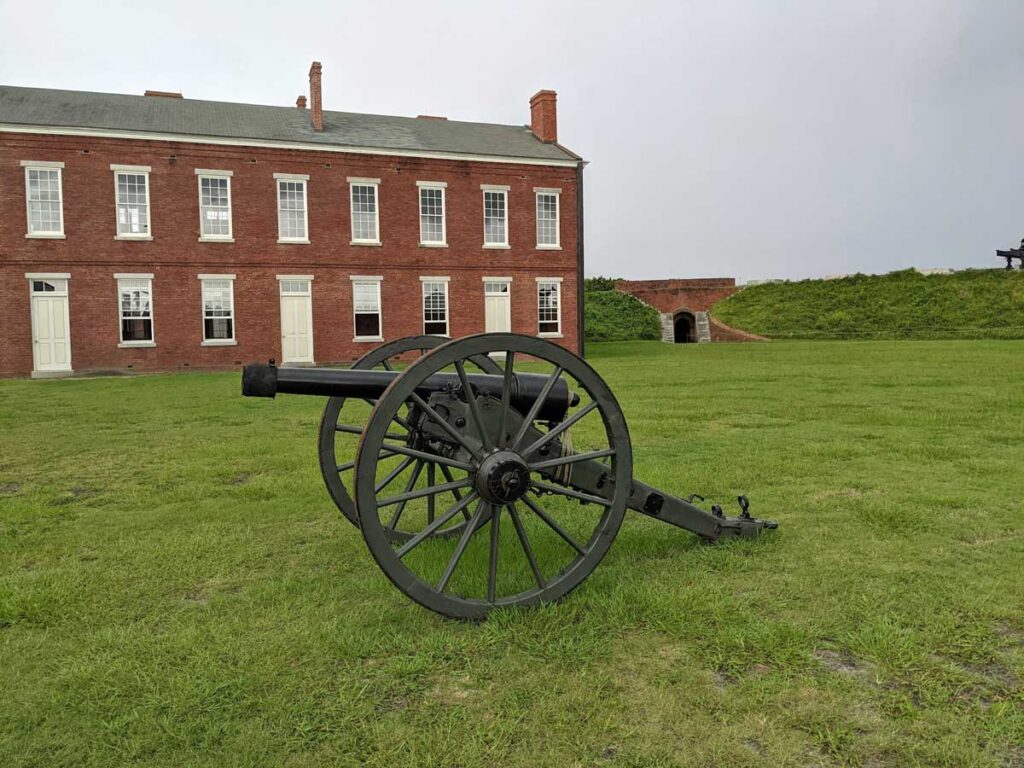
Visitors entering the 19th-century brick fortress can explore a wide variety of restored interior rooms and external defensive structures. The ground floor features furnished officer quarters, soldier barracks, a prison area, and a working blacksmith shop. These spaces are carefully designed to replicate standard military life during the American Civil War era.
The upper levels of the fort provide access to the extensive defensive ramparts and the primary observation gun decks. A row of large, historic cannons remains securely mounted along the outer brick walls. These heavy weapons point directly outward across the calm waters of the St. Mary’s River towards the nearby Georgia coastline.
The main visitor centre functions as a dedicated museum space, displaying authentic military artefacts, historical photographs, and informational plaques. During the first weekend of every month, volunteer reenactors dressed in period Union Army uniforms occupy the site. These historical reenactors fire the cannons and perform authentic battlefield drills inside the central courtyard.
Beyond the fort walls, the surrounding state park encompasses 1,400 acres of protected coastal maritime hammocks. Visitors can observe massive, arching live oak trees draped in Spanish moss while walking along the popular Willow Pond Nature Trail.
The extensive Atlantic shoreline provides multiple opportunities for outdoor recreation and wildlife observation. Visitors frequently walk the sandy beaches to look for local coastal birds, collect washed-up seashells, and hunt for fossilised shark teeth hidden in the sand.
Practical visitor tips
| Tip Category | Visitor Advice |
| Timing | Arrive when the fort opens at 09:00 to avoid the peak midday heat and extreme humidity during the Florida summer. |
| Crowds | The park experiences the highest visitor volume during the first weekend of every month due to the live cannon firing events. |
| Layout | The property is vast, so you must drive your private vehicle between the main entrance gate, the trailheads, and the fort. |
| Entry process | You must pay the initial vehicle entry fee at the main road gate, but the fort admission fee is paid at the visitor centre. |
| On-site logistics | Bring your own drinking water and insect repellent, as the forested trails support dense mosquito populations throughout the warmer months. |
Frequently asked questions about Fort Clinch State Park
| Question | Answer |
| Is Fort Clinch State Park suitable for children? | Yes, the wide open spaces, direct beach access, and historical cannon displays make the park an engaging environment for young visitors. |
| Do you need to book tickets in advance for Fort Clinch State Park? | No, general admission and fort entry tickets can be easily purchased directly at the entrance gate and visitor centre upon arrival. |
| Is Fort Clinch State Park open on Sundays? | Yes, the nature park and the historical fort operate seven days a week, including all Sundays and state public holidays. |
| Are bags allowed at Fort Clinch State Park? | Yes, visitors are officially permitted to carry standard daypacks, camera bags, and cooler boxes throughout the park and inside the fort. |
| Can you bring dogs to Fort Clinch State Park? | Yes, but dogs must remain on a short leash at all times and are completely prohibited from the beaches and inside the fort. |
Things to do near Fort Clinch State Park
- Amelia Island Historic District: A preserved 50-block commercial and residential district featuring Victorian architecture, boutique retail shops, and independent restaurants.
- Amelia Island Museum of History: A local history museum located in a former county jail that details the island’s Native American, Spanish, and pirate heritage.
- Main Beach Park: A public coastal park providing wide sandy beaches, outdoor sports courts, picnic pavilions, and direct lifeguard supervision.
- Egans Creek Greenway: A protected natural marshland featuring unpaved walking paths and extensive opportunities for spotting local birds and alligators.
- Amelia Island Lighthouse: The oldest surviving operational lighthouse in the state of Florida, offering limited guided tours on specific weekdays.
What to visit tomorrow
- Castillo de San Marcos National Monument: A large 17th-century Spanish stone fortress situated on the western shore of Matanzas Bay in St. Augustine.
- Fort Matanzas National Monument: A preserved 1740 Spanish coastal watchtower accessible only via a short passenger ferry ride from Anastasia Island.
- Big Talbot Island State Park: A natural coastal preserve famous for its unique shoreline covered in large, weather-beaten fallen tree trunks.
- Little Talbot Island State Park: An undeveloped barrier island offering five miles of pristine white sand beaches and extensive maritime forest hiking trails.
- Fort Caroline National Memorial: A reconstructed 16th-century French colonial fort located along the wooded banks of the St. Johns River in Jacksonville.
