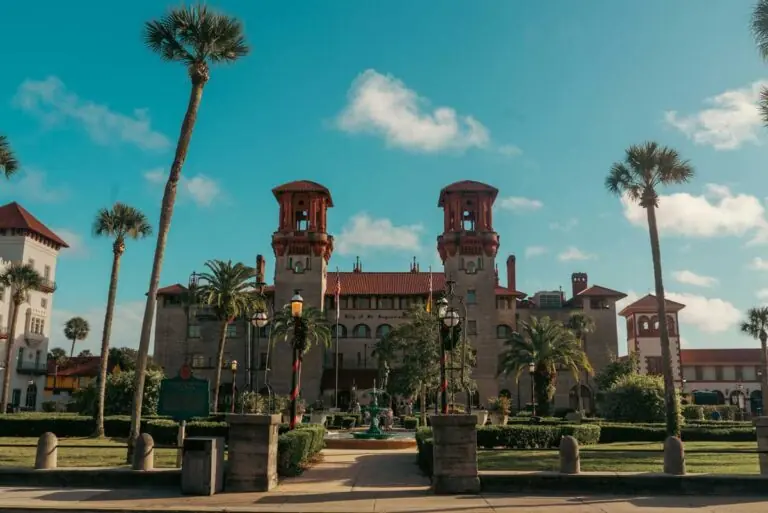
St Augustine is the oldest continuously occupied European settlement in the United States, founded by Spanish colonists in 1565 — more than four decades before the Jamestown colony in Virginia. That history is tangible and unhurried in a way that larger American cities rarely manage: the Castillo de San Marcos is the oldest masonry fort in the country and still defines the waterfront; the Mission Nombre de Dios marks the site of the first permanent mission in North America; and the story of Ponce de León and the Fountain of Youth has been commercially embellished but retains genuine archaeological substance. Beyond the colonial heritage, St Augustine has a cluster of Victorian-era museums, a lighthouse on a barrier island worth climbing for the views, and one of the finest alligator attractions in Florida. These guides cover the city’s key attractions with practical information on ticket prices, opening hours and what to expect on arrival, alongside road trip guides for the most popular approach routes.
Spanish colonial forts, missions and archaeological sites
St Augustine’s Spanish colonial heritage — spanning more than two centuries of continuous occupation — is the reason most historically minded visitors come here. The four sites below form a coherent heritage circuit that can be spread across a full day, with the Castillo as the natural centrepiece and Fort Matanzas as an atmospheric half-day excursion south of the city.
- Castillo de San Marcos, St Augustine: hours, prices and visitor tips — the oldest masonry fort in the continental United States, built by the Spanish between 1672 and 1695 from coquina — a local shellstone that absorbed cannon fire rather than shattering — and still standing virtually intact on the waterfront, with National Park Service rangers and cannon demonstrations.
- Fort Matanzas National Monument, St Augustine: ticket prices, hours and visitor guide — a small but evocative 18th-century Spanish watchtower fort on a tidal island 14 miles south of St Augustine, accessible only by a free National Park Service ferry, where the Spanish massacred nearly 250 French soldiers in 1565 in the event that gave the site its name.
- Mission Nombre de Dios, St Augustine: ticket prices, hours and visitor guide — the site of the first permanent Catholic mission in North America, founded in 1565, with a 208-foot stainless steel cross marking the landing site of the original Spanish settlers, a replica chapel and a peaceful waterfront setting on the Matanzas River.
- Fountain of Youth Archaeological Park, St Augustine: ticket prices, hours and visitor guide — the site where Ponce de León is claimed to have landed in 1513, now a 24-acre archaeological park with a spring visitors can drink from, significant Timucuan burial grounds, a planetarium and peacocks roaming the grounds — more historically substantial than its name might suggest.
Museums and heritage attractions
St Augustine’s museum offer reflects the city’s layered history — from the Gilded Age opulence of the Lightner Museum’s former hotel to the grimmer story told in the Old Jail. The cluster of smaller heritage museums along St George Street and the surrounding blocks can be combined into a single day of exploration, with the Lightner as the standout cultural institution.

- Lightner Museum, St Augustine: ticket prices, hours and visitor guide — the former Hotel Alcazar, built by railway magnate Henry Flagler in 1888 and now housing a remarkable collection of Gilded Age decorative arts, including Tiffany glass, Victorian art and one of the most beautiful indoor swimming pools in America — now converted into a café.
- St Augustine History Museum: ticket prices, hours and visitor guide — a well-curated overview of St Augustine’s 450 years of recorded history, covering the Spanish colonial period, the British interlude, the Civil War and the city’s role in the American civil rights movement through artefacts, maps and multimedia exhibits.
- Old Jail, St Augustine: ticket prices, hours and visitor guide — the 1891 county jail that housed prisoners for 65 years, with guided tours through the sheriff’s quarters, the maximum security cell block and the exercise yard, covering both the mechanics of 19th-century incarceration and the stories of the inmates who passed through.
- St Augustine Pirate and Treasure Museum: ticket prices, hours and visitor guide — a collection of genuine pirate-era artefacts housed in a theatrical setting, with one of the largest collections of authentic pirate memorabilia in the world, covering the Golden Age of Piracy in the Caribbean and the waters off the Florida coast.
- Oldest Store Museum Experience, St Augustine: ticket prices, hours and visitor guide — a replica 19th-century general store stocked with over 100,000 period items, with costumed interpreters demonstrating how goods were sold and used in Victorian-era Florida, a good family-oriented stop that places the city’s commercial history in accessible context.
Outdoor, wildlife and Anastasia Island
Anastasia Island, accessible from the historic district across the Bridge of Lions, holds two of St Augustine’s most rewarding non-museum attractions — a working lighthouse with a significant maritime museum and a state park with one of the finest beaches on Florida’s northeast Atlantic coast. The alligator farm on the island is one of the oldest and most substantial animal attractions in the state.
- Anastasia State Park, St Augustine: ticket prices, hours and visitor guide 2026 — a 1,600-acre state park on Anastasia Island with four miles of undeveloped Atlantic beach, nature trails through ancient coquina rock formations, a salt marsh, kayak and canoe rentals and the best swimming beach within easy reach of the historic district.
- St Augustine Lighthouse and Maritime Museum: ticket prices, hours and visitor guide — a 165-foot working lighthouse on Anastasia Island built in 1874, with a 219-step climb to the lamp room for the finest panoramic views over St Augustine and the surrounding coastline, alongside a serious maritime museum in the restored keeper’s house covering the history of the St Johns River and St Augustine Inlet.
- St Augustine Alligator Farm, Florida: ticket prices, hours and visitor guide — one of Florida’s oldest continuously operating attractions, founded in 1893, housing every species of crocodilian in the world alongside birds, snakes and other reptiles, with a zip line over the alligator enclosures and a rookery where wood storks and roseate spoonbills nest in the trees above the alligators in spring.
- The best places to see alligators in Florida: a complete guide — a guide to the most reliable locations across Florida for close encounters with wild American alligators, covering state parks, wildlife refuges and specific sites within easy reach of St Augustine alongside the major alligator hotspots elsewhere in the state.
Road trips to St Augustine
St Augustine sits on Florida’s northeast Atlantic coast, between Jacksonville to the north and Daytona Beach to the south, and is within comfortable driving distance of several major Florida cities. These guides cover the best stops, distances and realistic drive times for the two most popular approach routes.
- Jacksonville to St Augustine drive: best stops, distance and drive time — the short drive south along the A1A coastal highway or via I-95, passing through the beach communities of Ponte Vedra and Vilano Beach, around 45 minutes on the direct route with the scenic coastal road adding time but considerably more appeal.
- Gainesville to St Augustine drive: best stops, distance and drive time — the drive east from the University of Florida city through the Ocala National Forest and the St Johns River country, around 75 minutes on the direct route with options to detour through Paynes Prairie State Preserve and the springs country.
Planning your St Augustine visit
St Augustine’s historic district is compact and walkable, but Anastasia Island — where the lighthouse, alligator farm and state park are all located — requires crossing the Bridge of Lions and is more easily reached by car or rideshare than on foot. The Fort Matanzas ferry departs from a site 14 miles south of the city and requires a separate trip; combine it with a drive along the A1A coastal highway to make the journey worthwhile. Spring and autumn are the most comfortable visiting seasons; summer is very hot and humid but manageable for those focused on the air-conditioned museums. The historic district becomes extremely busy during the December holiday season when the city’s famous Nights of Lights illuminations draw visitors from across Florida and beyond.
How many days do you need in St Augustine?
Two full days covers St Augustine’s main attractions comfortably. A first day suits the historic