Fort Santiago is a historic military citadel located in the walled city of Intramuros in Manila, established as a formidable symbol of Spanish power in the Far East. This guide covers opening hours, ticket prices, transport or parking, accessibility, and practical visitor tips to help you effectively plan your visit.
This guide was updated in May 2026 to reflect the attraction’s current daily operating schedule, which extends opening hours until 11:00 pm for all visitors without requiring pre-booked late-night tickets.
Quick facts
| Feature | Details |
| Opening hours | Daily 8:00 am – 11:00 pm |
| Ticket prices | PHP 75 (Adult); PHP 50 (Children, students, faculty, senior citizens, PWDs) |
| Address | Santa Clara Street, Intramuros, Manila, 1002 Metro Manila, Philippines |
| Nearest public transport or parking | LRT-1 (Central Terminal station) / Intramuros street parking |
| Typical time needed to visit | 1 to 2 hours |
Fort Santiago opening hours
Fort Santiago operates on a straightforward daily schedule for all visitors throughout the entire week. The site opens its gates to the public at 8:00 am and closes late at 11:00 pm. These consistent hours apply from Monday through to Sunday, providing ample opportunity for both daytime and evening visits.
The attraction maintains these operating hours year-round, with no seasonal variations to consider when planning your itinerary. Visitors do not need to pre-book specific time slots for evening entry, as the extended hours until 11:00 pm are standard for general admission. The late closure allows you to experience the historic defensive walls and plazas illuminated by architectural lighting after sunset.
Fort Santiago ticket prices
Opening hours and ticket prices were checked on the official website and last updated in May 2026. General admission for an adult visitor costs PHP 75. A discounted rate of PHP 50 is available for children, students, faculty members, senior citizens, and persons with disabilities. You must present a valid ID upon entry to secure these concession rates.
How to get to Fort Santiago
Visitors can access Fort Santiago using the primary public transport infrastructure operating across Manila. The most direct train route utilises the LRT-1 line, requiring you to alight at the Central Terminal station. From this station, the walk to the Intramuros district takes approximately 15 minutes. Alternatively, motorised tricycles operate from the station directly to the main gates.
Ride-hailing services such as Grab provide a convenient and direct transport option for reaching the walled city. These vehicles can drop passengers right at the Fort Santiago entrance on Santa Clara Street. Traditional public jeepneys also travel along nearby Bonifacio Drive, requiring a brief walk into the historic district. You can also utilise the Pasig River Ferry Service, disembarking at the Escolta station.
Parking at Fort Santiago
Drivers visiting Fort Santiago will find designated public parking spaces located along the streets within Intramuros. The most convenient parking bays are situated close to the main entrance on Santa Clara Street. These spaces are managed by the local administration and generally operate on a standard fee structure that requires payment to authorised street attendants.
As the walled city is a busy historical district, these street parking spaces often fill up rapidly during peak hours. Arriving early in the morning is the best strategy for securing a parking spot near the attraction. Alternative parking is available near Plaza Roma, a short pedestrian route away from the fort’s main gates.
How long to spend at Fort Santiago
A standard visit to Fort Santiago generally requires between one and two hours to complete comfortably. This duration gives you sufficient time to walk through the main gates and explore the central outdoor plaza. You can easily view the historic walls, read the informational markers, and observe the surrounding colonial architecture at a relaxed pace.
If you possess a deep interest in military history, you should allocate the full two hours to your itinerary. This extended timeframe allows for a more thorough examination of the defensive structures and the interior exhibits. Combining the fort with other Intramuros sites will naturally extend your total visiting time in the district to a half-day excursion.
Accessibility at Fort Santiago
The primary outdoor areas of Fort Santiago feature paved pathways that provide reasonable access for wheelchair users. Visitors with mobility aids can navigate the main Plaza Moriones and approach the central historical monuments without significant difficulty. Accessible restroom facilities are provided within the grounds to support visitors requiring these modern amenities.
However, certain historic sections of the fort present notable physical accessibility barriers due to their age and design. Accessing the elevated defensive walls, such as the Baluartillo de San Francisco Javier, involves climbing steep stone steps without modern lifts. The pathways around the older ruins can feature uneven cobblestones, which may restrict access for some individuals relying on wheeled mobility devices.
Inside / what to see at Fort Santiago
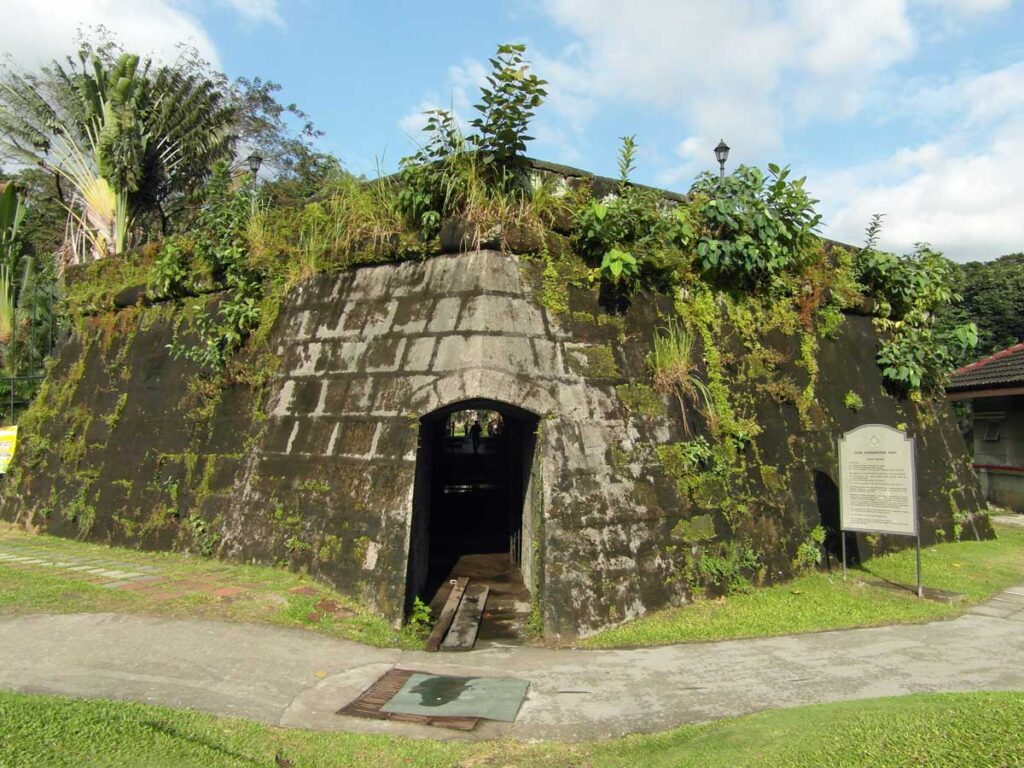
Upon entering Fort Santiago, visitors immediately step into Plaza Moriones, a large open space traditionally used for military reviews, drills, and parades. This landscaped area is flanked by the preserved ruins of former military barracks and colonial storehouses. It provides an excellent vantage point for viewing the intricately carved stone reliefs on the main gate. The present fort, constructed using volcanic tuff known locally as adobe, was built between 1589 and 1592.
Beyond the main gate, the central citadel area contains the reconstructed barracks that now house the Rizal Shrine. This building serves as a museum dedicated to Dr Jose Rizal, displaying his personal artefacts and original manuscripts. You can clearly trace his final footsteps, which are marked by bronze prints embedded in the paving stones, leading from his cell to his execution site.
Visitors can explore the Baluartillo de San Francisco Javier, a thick stone wall constructed in 1663. This fortified structure has been transformed through adaptive reuse to show modern facilities while offering views over the defensive perimeter. Directly associated with this wall is the Reducto de San Francisco Javier, a crescent-shaped high wall built in 1773 to reinforce the primary fortifications against artillery fire.
The site also features the modern Guadalupe Chapel, built in 1981 using traditional construction methods. This small chapel is dedicated to Our Lady of Guadalupe and sits securely within the historic stone redoubts. Throughout the grounds, you will encounter various remnants of Spanish military architecture, including old bronze cannons, brick arches, and the reconstructed moats that once protected the inner citadel.
Practical visitor tips
| Tip Category | Practical Advice |
| Timing | Arrive shortly after the 8:00 am opening time to explore the expansive outdoor grounds before midday temperatures peak. |
| Crowds | Weekday mornings offer the quietest experience, as weekends frequently attract large local family groups and school tours. |
| Layout | Follow the embedded bronze footprints to efficiently navigate the route from the main entrance directly to the Rizal Shrine. |
| Entry process | Ensure you have your valid identification ready at the ticket booth to quickly claim any eligible discounted entry rates. |
| On-site logistics | Bring a refillable water bottle and sun protection, as the open plazas offer very little natural shade during the afternoon. |
Frequently asked questions about Fort Santiago
| Question | Answer |
| Is Fort Santiago suitable for children? | Yes, the historic site is safe and offers large open spaces, though children should be closely supervised near the elevated stone walls. |
| Do you need to book tickets in advance for Fort Santiago? | No, advance booking is not strictly required, and general admission tickets can be purchased directly at the entrance gates upon arrival. |
| Is Fort Santiago open on Sundays? | Yes, the attraction operates on Sundays from 8:00 am until 11:00 pm, maintaining the exact same schedule as regular weekdays. |
| Are bags allowed at Fort Santiago? | Standard day bags and small backpacks are permitted, but large luggage may be subject to security checks at the main gate. |
| Does Fort Santiago have a dress code? | There is no formal dress code, but wearing comfortable walking shoes and breathable clothing is highly recommended for the tropical climate. |
Things to do near Fort Santiago
- Manila Cathedral: A prominent Roman Catholic basilica featuring intricate stained glass windows and a grand Romanesque facade, located a short walk away.
- Casa Manila: A reconstructed Spanish colonial mansion demonstrating the domestic lifestyle and architecture of affluent 19th-century Filipino families.
- San Agustin Church: The oldest stone church in the Philippines, containing an extensive museum of religious artefacts and ecclesiastical history.
- Baluarte de San Diego: A circular stone fort surrounded by landscaped gardens, originally constructed to defend the southern coastal boundaries of Intramuros.
- Museo de Intramuros: A cultural museum housed in a reconstructed colonial building, displaying religious sculptures and antiques from the Spanish era.
What to visit tomorrow
- Fort San Antonio Abad: A triangular Spanish citadel located in Malate, historically used as a defensive garrison against naval attacks and coastal invasions.
- Fort San Felipe: A 17th-century military fortress constructed from heavy granite blocks, situated within the active naval base in nearby Cavite City.
- Corregidor Island (Fort Mills): A historic island fortress in Manila Bay, featuring extensive World War II artillery batteries and ruined military barracks.
- El Fraile Island (Fort Drum): A heavily fortified concrete island situated at the mouth of Manila Bay, historically resembling a concrete battleship.
- Cuartel de Santo Domingo: The preserved stone ruins of an old Spanish military barracks and command structure located in Santa Rosa, Laguna.