Lurie Garden is a five-acre urban botanical garden located at the southern end of Millennium Park in the centre of Chicago, Illinois. This guide covers opening hours, ticket prices, transport or parking, accessibility, and practical visitor tips.
This guide was updated in May 2026 to reflect current park policies, noting that general admission remains completely free and the seasonal guided walking tours have resumed for the summer months.
Quick facts
| Opening hours | Daily 6am to 11pm. |
| Ticket prices | Free admission for all visitors. |
| Address | 220 E Monroe St, Chicago, IL 60601. |
| Nearest public transport | Washington/Wabash CTA station (Brown, Green, Orange, Pink, and Purple lines). |
| Typical time needed | 30 to 45 minutes. |
Lurie Garden opening hours
Lurie Garden is accessible to visitors every day from 6am to 11pm, aligning precisely with the general operating times of the wider Millennium Park. These daily hours remain consistent throughout the year, allowing visitors to walk through the landscaped paths during early mornings or late evenings.
While the garden remains open year-round, the visual experience changes significantly depending on the season. The plant life lies dormant and is intentionally left uncut during the winter months, while the peak blooming period occurs between late May and early autumn.
Lurie Garden ticket prices
Unlike major gardens elsewhere, such as the Mercer Botanic Gardens near Houston and the Rock City Gardens in Chattanooga, general admission to Lurie Garden is completely free of charge for all visitors. Because the site operates as an open-air public botanical space situated within a free city park, you do not need to purchase a ticket or make a reservation.
Opening hours and ticket prices were checked on the official website and last updated in May 2026.
Five great things to do in Chicago
- 🏙️ Marvel at the skyscrapers – on a Chicago River architecture cruise.
- 🖼️ Take an interiors architecture tour – to see stunning glass art and mosaics.
- 🍕 Taste Chicago’s favourite dishes – on a city favourites food tour.
- 🌆 Visit the Willis Tower observation deck – and see the city from above.
- 🕵️ Discover Chicago’s gangster heritage – on a crime and mob tour.
How to get to Lurie Garden
The most straightforward way to get to Lurie Garden using public transport is to take the CTA train system to the Washington/Wabash CTA station. From this station, the garden is located just a five-minute walk east along Madison Street and into the park.
Visitors arriving via the Metra commuter rail network can exit directly into Millennium Park from Millennium Station, which sits immediately beneath the grounds. Multiple CTA bus routes, including the 3, 4, and 147, stop along Michigan Avenue running parallel to the park.
Why book the Big Bus Chicago Hop-On Hop-Off Tour?
- 🚌 Unlimited Hop-On Hop-Off: Explore the Windy City at your own pace with a pass that allows you to join and rejoin the tour at any of the 11+ strategically located stops.
- 🏙️ Iconic Chicago Sightseeing: See the city’s most famous landmarks, including the Navy Pier, Skydeck Chicago (Willis Tower), the Magnificent Mile, and Millennium Park.
- 🎧 Informative Audio Commentary: Learn about Chicago’s rich history, world-class architecture, and vibrant culture through entertaining narration available in multiple languages.
- 📸 Unobstructed Top-Deck Views: Ride on an open-top, double-decker bus to capture perfect photos of the city’s towering skyscrapers and the beautiful Lake Michigan shoreline.
- ⏱️ Flexible Ticket Options: Choose a 24, 48, or 72-hour pass to perfectly fit your travel itinerary, with the freedom to spend as much time as you like at each attraction.
Parking at Lurie Garden
There is no dedicated street-level visitor car park exclusively for Lurie Garden, as the site sits within a pedestrianised park. Visitors travelling by car should use the Millennium Park Garage, which is an underground facility located directly beneath the garden surface.
There are designated accessible parking spaces available for Blue Badge holders or vehicles with state-issued disability placards located within this underground garage. These disabled parking bays operate strictly on a first-come, first-served basis and are positioned near the lifts that rise to the park level.
Why book the Go City Chicago Explorer Pass?
- 🏙️ Skydeck Chicago & 360 CHICAGO: Get high-altitude views of the city from its most famous observation decks, including the glass-bottomed “Ledge” at Willis Tower.
- ⛴️ Architecture River Cruise: Experience Chicago’s world-renowned skyline from the water on a Shoreline Sightseeing cruise, one of the city’s most popular activities.
- 🦕 World-Class Museums: Choose from premier institutions like the Field Museum, the Museum of Science and Industry, the Adler Planetarium, and the Art Institute of Chicago.
- 💰 Save up to 40%: Pay one flat price for your choice of 2 to 7 attractions and enjoy significant savings compared to purchasing individual tickets at each gate.
- 📱 Total Flexibility: You have 60 days to use your pass once it’s activated at your first attraction, and your digital pass is easily managed directly from your smartphone.
How long to spend at Lurie Garden
Most visitors spend between 30 and 45 minutes at Lurie Garden to walk the central boardwalk, read the botanical information panels, and observe the perennial planting beds. Because the garden occupies just five acres, you do not need to budget an extended period to walk the entire perimeter.
If you plan to join one of the free volunteer-led guided tours offered during the summer, you should allow at least an hour. Visitors should also factor in additional time if they wish to sit on the grass and eat a picnic lunch or explore the other art installations within the park.
Accessibility at Lurie Garden
Lurie Garden provides level, step-free access from the surrounding paved promenades of Millennium Park, making it easily navigable for wheelchair users. The internal pathways consist of smooth limestone paving and flat wooden boardwalks, ensuring that the plant beds remain accessible for visitors using mobility devices.
The site is entirely barrier-free and does not require visitors to navigate any staircases or steep gradients. While there are no visitor toilets located directly inside the garden boundaries, fully accessible public facilities are situated nearby at the Jay Pritzker Pavilion.
Inside / what to see at Lurie Garden
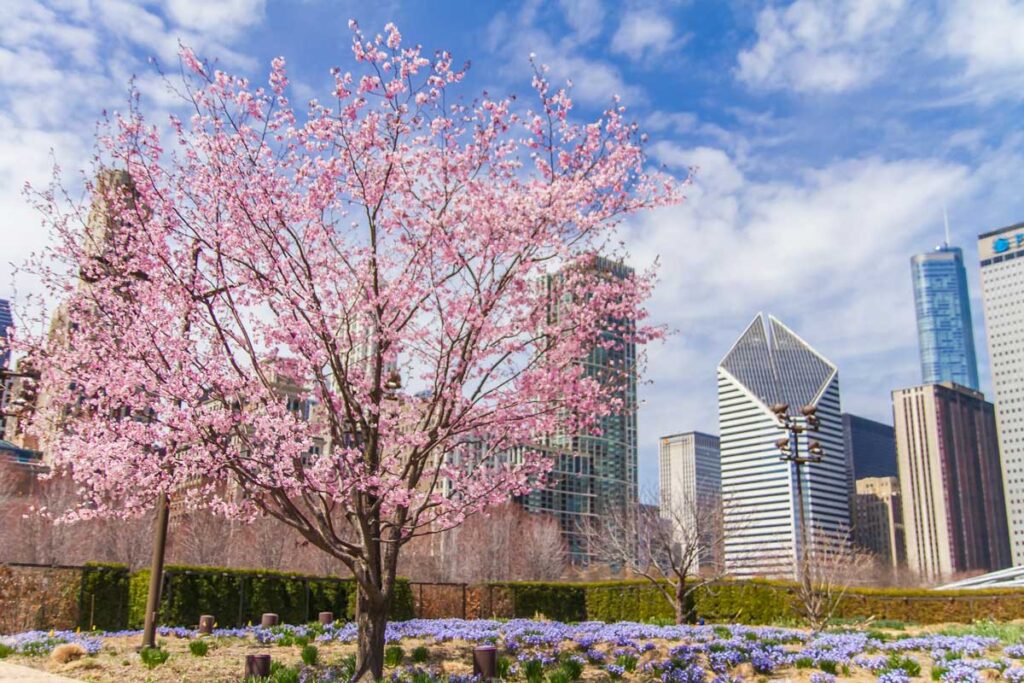
The garden is fundamentally divided into two distinct planting zones, known as the Light Plate and the Dark Plate. The Light Plate features sun-loving perennials that thrive in direct heat, showcasing varied textures and blooming patterns that peak during the summer months.
The Dark Plate represents the historical landscape of Chicago before modern development, featuring shade-tolerant understorey plants and native trees. This section provides a canopy of cherry trees and offers a cooler, shaded environment for visitors during hot summer afternoons.
The Seam is a prominent wooden boardwalk that physically divides the Light Plate and the Dark Plate. This pathway sits directly over a shallow, flowing water channel, referencing the historical reliance of the city on the Chicago River and Lake Michigan.
The Shoulder Hedge is a massive 15-foot structural boundary made of clipped evergreen arborvitae trees that encloses the northern and western edges of the garden. This living wall serves as a physical windbreak and acts as a visual metaphor for Chicago’s historical nickname, the “City of Broad Shoulders”.
The plant selection focuses heavily on native prairie species, featuring over 200 distinct types of perennials, grasses, and shrubs. During May and June, the garden becomes visually dominated by a large river of purple Salvia, which is a major draw for local photographers.
Practical visitor tips
| Tip category | Advice |
| Timing | Arrive early in the morning shortly after 6am to photograph the plants and the city skyline without large crowds. |
| Crowds | The central wooden boardwalk over the water channel can become highly congested during warm weekend afternoons. |
| Layout | Stick strictly to the designated stone pathways and wooden boardwalks to protect the fragile perennial root systems. |
| Entry process | You can walk straight into the garden from the surrounding park promenades without passing through any gates or turnstiles. |
| On-site logistics | Bicycles are strictly prohibited inside the garden, so you must leave them at the racks located on the park perimeter. |
Frequently asked questions about Lurie Garden
| Question | Answer |
| Is Lurie Garden suitable for children? | Yes, the garden is family-friendly and offers an open natural space for children to observe local birds and pollinating insects. |
| Do you need to book tickets in advance for Lurie Garden? | No, the garden is a free public botanical space and does not require any advance booking or tickets. |
| Is Lurie Garden open on Sundays? | Yes, the garden is accessible to visitors every Sunday from 6am to 11pm alongside the rest of Millennium Park. |
| Are bags allowed at Lurie Garden? | Yes, you can carry standard day bags and picnic baskets, but there are no storage lockers available on site. |
| Are dogs allowed inside Lurie Garden? | No, general pet dogs are not permitted anywhere in Millennium Park, but registered assistance dogs are fully welcome. |
Things to do near Lurie Garden
- Art Institute of Chicago: A massive fine art museum situated directly across the pedestrian bridge, housing an extensive collection of global artworks.
- Cloud Gate: A highly polished stainless steel sculpture famously known as “The Bean,” offering distorted reflections of the surrounding skyline.
- Jay Pritzker Pavilion: An outdoor concert venue featuring a prominent stainless steel bandshell and a sweeping great lawn.
- Crown Fountain: An interactive public art installation featuring two 50-foot glass block towers that project videos of local residents.
- Maggie Daley Park: A large recreational park connected via a pedestrian bridge, featuring a climbing wall, play areas, and a skating ribbon.
What to visit tomorrow
- Garfield Park Conservatory: A massive historic glasshouse located on the west side of Chicago, featuring thousands of exotic plant species.
- Lincoln Park Conservatory: A Victorian era glasshouse situated north of the city centre, displaying seasonal flower shows and tropical palms.
- Chicago Botanic Garden: A sprawling 385-acre living plant museum featuring 27 distinct display gardens, located roughly 40 minutes north in Glencoe.
- The Morton Arboretum: A large outdoor tree museum and botanical research centre situated 45 minutes west of Chicago in Lisle.
- Garden of the Phoenix: A traditional Japanese strolling garden situated within Jackson Park on the south side of the city.
More Chicago travel
Other Chicago travel articles on Planet Whitley include:
- A guide to parking at the Field Museum.
- Guides to visiting key Chicago highlights: The Chicago Architecture Center, the Art Institute of Chicago, the Shedd Aquarium and the Griffin Museum of Science and Industry.
- Practical guide to visiting the Chicago Children’s Museum on Navy Pier.
- Meet the room service robots at Hotel EMC2 in Chicago.
- What you need to know before visiting the Chicago History Museum, Lincoln Park Zoo and Peggy Notebaert Nature Museum in Lincoln Park.