The Funivia dell’Etna is the only cable car on the southern flank of Mount Etna — Europe’s highest active volcano and a UNESCO World Heritage Site. It lifts visitors from 1,923 metres to 2,500 metres above sea level on a spectacular 15-minute ascent from Rifugio Sapienza, near Nicolosi in Sicily.
This guide was updated in June 2026. Several widely circulated travel guides and booking aggregators still quote the 2500m cable car ticket in US dollars at around $59, reflecting stale currency conversions; the current official price, confirmed on the site as of 1 June 2026, is €54.00, and the full Tour 3000 — cable car, 4×4 bus and guide — is €82.00. It is also worth noting that the cable car underwent two separate maintenance closures in spring 2026, replaced temporarily by 4×4 buses, confirming that service interruptions do occur. Book through GetYourGuide to secure your ticket before arriving at the mountain.
Quick facts
| Detail | Information |
|---|---|
| Departure station | Piazzale Rifugio Sapienza, Nicolosi, Etna Sud, Sicily |
| Address | SP92, 95030 Nicolosi CT, Italy |
| Daily hours | 8:30 am – 4:45 pm (last descent 5:15 pm) |
| Tour 3000 last entry | 3:15 pm (last descent 5:15 pm) |
| Silvestri Craters hours | 8:30 am – 5:00 pm |
| Closed | Subject to weather and technical conditions — no guaranteed operating days |
| 2500m cable car (round-trip) | €54.00 |
| Tour 3000 (cable car + 4×4 + guide) | €82.00 |
| Silvestri Craters entry | €5.00 |
| Parking | Free on site at Rifugio Sapienza |
| Nearest city | Catania (approx. 35 km, 50–60 min by car) |
| Typical visit (cable car only) | 1.5–2 hours at 2,500m |
| Typical visit (Tour 3000) | 2.5 hours |
Opening hours
The cable car operates every day from 8:30 am to 4:45 pm, with the last descent from the upper station at 5:15 pm. Hours are subject to closure at any time due to weather conditions or technical maintenance — this is not a caveat buried in small print, but a genuine operational reality at 2,500 metres on an active volcano. Cloud, high wind, and eruption-related restrictions have all caused unplanned closures in recent seasons.
The Tour 3000 experience has a slightly earlier last-entry time: the last 4×4 departure from the upper cable car station is at 3:15 pm.
The Silvestri Craters — the separate lower-altitude outdoor experience near the base station — are open every day from 8:30 am to 5:00 pm and are not affected by cable car closures.
No information about seasonal closures or winter schedule changes is published on the official site; the cable car is described as “always available.” Check the official webcam before travelling on days when cloud cover is visible over the summit.
Ticket prices
All prices are inclusive of Italian VAT and are confirmed from the official site as of 1 June 2026. Online booking includes a Fast Track benefit, allowing you to skip the queue at the ticket office and go directly to boarding.
| Experience | Price |
|---|---|
| 2500m cable car — round-trip | €54.00 |
| Tour 3000 (cable car + 4×4 bus + guide, ~2.5 hrs) | €82.00 |
| Silvestri Craters entry | €5.00 |
No child discount or senior rate is listed on the official site. Equipment rental — windbreaker, hiking boots, and poles — is available at the upper station for visitors not equipped with suitable clothing; prices are not published but rental is confirmed available.
The official site does not publish a separate gate price, so the Fast Track benefit of skipping the queue is the primary incentive to book online rather than a price saving. Book through GetYourGuide to benefit from Fast Track access and confirm your place on busy summer days.
Why visit Funivia dell’Etna?
- 🏛️ The only cable car on Etna’s south side: Funivia dell’Etna holds the sole concession for mechanised ascent on the southern flank — there is no alternative route to 2,500 metres without it.
- 🎟️ 100 km of coastline from a single viewpoint: The upper station at 2,500m offers panoramic views stretching from the summit craters above to the Ionian Sea and the coastline as far as Syracuse on a clear day.
- 🌿 Wheelchair-friendly 4×4 buses to nearly 3,000m: The Tour 3000 experience is specifically designed for families, seniors and visitors with disabilities — the 4×4 buses are wheelchair accessible and the routes avoid strenuous terrain.
- 📜 Europe’s most active volcano, under continuous monitoring: Etna is watched 24/7 by Italy’s INGV volcanological institute; the constant low-level activity that makes it dramatic also makes it one of the safest volcanoes to visit, with eruptions moving slowly enough to allow safe guided access.
- 💰 Fast Track included with online booking: Every online ticket — whether bought through the official site or GetYourGuide — includes Fast Track, bypassing the ticket-office queue that can extend significantly on summer mornings.
How to get there
By car (recommended): The cable car station is at Piazzale Rifugio Sapienza on the SP92 provincial road, about 35 km from Catania. The drive takes approximately 50–60 minutes. From Catania, follow signs for Nicolosi and then for Rifugio Sapienza / Etna Sud. The road climbs steadily through lava fields and pine forest. From Taormina, the drive is around 55 km and takes approximately one hour, joining the SP92 via the A18 motorway towards Catania.
By public bus from Catania: The AST (Azienda Siciliana Trasporti) bus departs daily from Piazza Papa Giovanni XXIII, in front of Catania Centrale station, at 8:15 am and arrives at Rifugio Sapienza at around 10:15 am. The return bus leaves Rifugio Sapienza at 4:30 pm. The round-trip fare is approximately €6.60 — tickets are purchased on board in cash. There is no online booking and no reserved seating. The schedule is subject to change; verify current times before travelling.
By organised transfer from Catania: Several operators run shuttle buses from central Catania to Rifugio Sapienza, often marketed as “Crater Express” services, departing around 9:00 am from Piazza San Placido and returning around 1:30 pm. These are faster and more convenient than the AST bus but come at an added cost. Payment is typically by card only, on the morning of travel.
From Taormina: There is no direct public bus from Taormina to Rifugio Sapienza. Options are a rental car, an organised tour departing from Taormina, or a train to Catania Centrale followed by the AST bus.
Parking
Parking at Piazzale Rifugio Sapienza is free and ample. The car park is large enough to accommodate coaches and camper vans. On busy summer days, particularly in July and August, the lower sections of the approach road can fill early — arriving before 9:00 am is advisable.
How long to spend
The cable car ride itself takes approximately 15 minutes each way. Visitors on the 2500m ticket typically spend 60 to 90 minutes at the upper station — walking the accessible paths, visiting the terrace, eating or drinking at the on-site restaurant, and taking photographs of the summit craters above and the coastline below. Combined with travel time, allow a half-day from Catania.
The Tour 3000 experience runs approximately 2.5 hours from the upper cable car station — add the cable car transit time for around three hours total on the mountain. The Silvestri Craters walk at the base takes around 30 minutes. A visitor doing the full sequence — Silvestri Craters, cable car to 2,500m, Tour 3000 — should budget a full day.
Accessibility
Funivia dell’Etna has made specific provision for visitors with disabilities, which is unusual given the extreme terrain. The 4×4 buses used in the Tour 3000 are wheelchair accessible. Stairlifts are installed at the ticket office. The cable cars themselves accommodate wheelchairs.
At the 2,500m upper station, the paths described as “gentle” are paved and suitable for most visitors, though the high altitude, volcanic sand, and exposure to wind present challenges for anyone with respiratory or cardiac conditions. The official site explicitly states that the cable car and Tour 3000 are not recommended for people with heart or respiratory conditions, high blood pressure, or pregnant women.
The Silvestri Craters at the base are accessible from the provincial road, including for visitors with disabilities, and the rim path has benches at intervals.
What to see
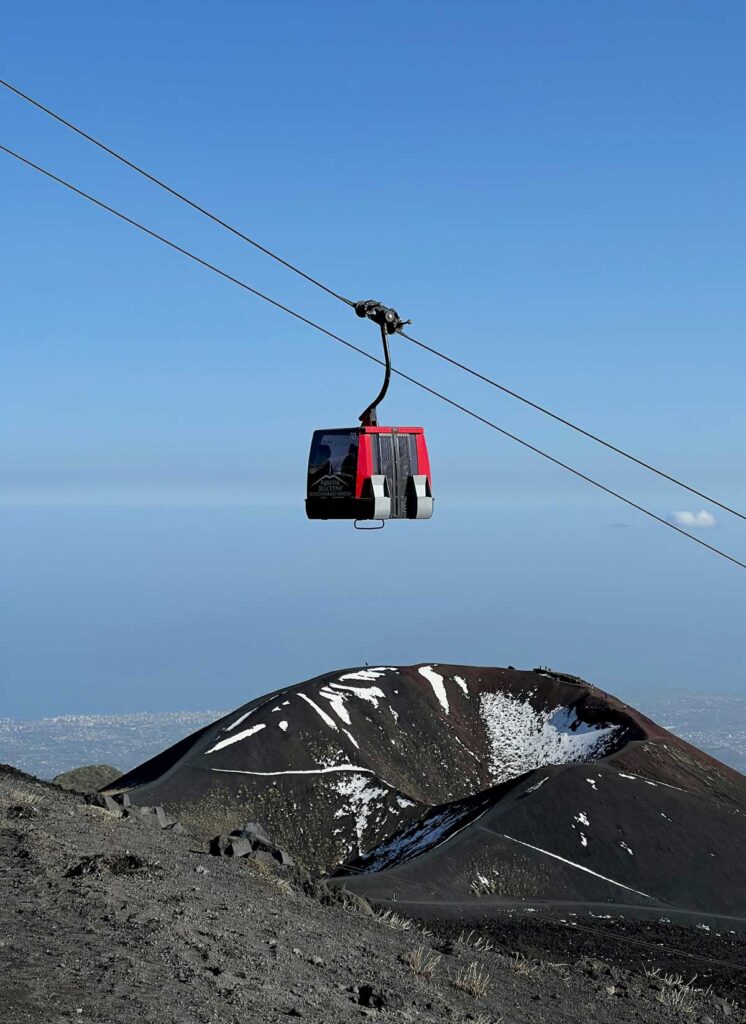
The cable car ascent is itself the defining experience — 15 minutes of rising above the treeline, over ancient lava flows and the Silvestri Craters, with the summit cone growing overhead and the Ionian Sea opening below. The new-generation gondolas offer unobstructed views on all sides. Arriving at 2,500 metres, the landscape shifts abruptly to a moonlike plateau of volcanic ash and black basalt.
The upper station at 2,500m has a terrace café serving Sicilian specialities — arancini, local wine, and coffee — with a direct sightline to the summit craters on one side and the Ionian coastline on the other. The contrast between the hot island coast below and the cold, wind-scoured summit environment above is one of the visit’s most striking aspects. Equipment rental (boots, windbreaker, poles) is available here.
The Tour 3000 extends the experience significantly. From the 2,500m station, specially converted 4×4 buses climb along an access road exclusive to the Funivia dell’Etna to around 2,850m — the maximum altitude currently permitted by authorities. From there, certified alpine and volcanological guides lead small groups on foot to approximately 3,000m, passing the Torre del Filosofo site, the craters formed in the 2002 eruption, and approaching the active summit craters. Guides speak Italian, English, and French. The trek is graded easy and takes about 90 minutes at altitude.
The summit craters visible from the upper sections of Tour 3000 are Etna’s most dramatic feature. The volcano has grown from a single Central Crater to multiple active craters over the past century, including the Southeast Crater, which has been among the most active in recent decades, producing some of the tallest lava fountains ever recorded. The current summit height fluctuates with eruptive episodes — Etna stands at approximately 3,403 metres but loses and gains material regularly.
The Silvestri Craters at the base offer an entirely different, free-roaming experience. The Upper Silvestri (1,986m) and Lower Silvestri (1,886m) erupted in 1892 over 173 days of lava fountains. Today the rim path is easy and open, with benches along the route, 360-degree views towards the coast, and visible lava-field ecology including the endemic Genista aetnensis (Etna broom), pale lichens, and the rare Etna subspecies of the Scotch argus butterfly.
Practical visitor tips
| Tip | Detail |
|---|---|
| Check the webcam before leaving | The official site has a live webcam. If the upper station is cloud-covered, your views at 2,500m will be severely limited. Choose a clear morning — the mountain typically clouds over in the afternoon in summer. |
| Dress for alpine conditions regardless of season | Even in July, temperatures at 2,500m can be 10–15°C cooler than at sea level, with strong wind. A windbreaker is essential; boots are strongly advisable. Rental is available at the upper station but book in advance if possible. |
| Book online for Fast Track | Summer queues at the ticket office can be substantial. Online booking includes Fast Track access — a dedicated line that bypasses the main queue entirely. Book in advance through GetYourGuide. |
| The Tour 3000 last entry is 3:15 pm, not 4:45 pm | Many visitors assume all tickets share the same closing time. The 4×4 bus to 3,000m stops accepting passengers at 3:15 pm — arrive by midday to guarantee a Tour 3000 slot in peak season. |
| Closures happen without warning | The cable car was suspended twice in spring 2026 for maintenance. Volcanic activity, high wind, and technical issues can close the service at any time. Have a fallback plan, and avoid building your entire Sicily itinerary around a single cable car day. |
FAQ
| Question | Answer |
|---|---|
| What is Fast Track and do I need it? | Fast Track allows online ticket holders to bypass the ticket-office queue and go directly to boarding. It is included automatically with any online purchase — from the official site or from GetYourGuide — at no extra cost. In summer it is effectively essential. |
| Can the cable car be closed on the day? | Yes. Weather, volcanic activity, and maintenance can close the service at any time. The webcam on the official site gives a real-time view of conditions. There is no published cancellation policy for weather closures — ask at the ticket office on arrival. |
| What is the difference between the 2500m ticket and Tour 3000? | The 2500m ticket covers the round-trip cable car only — you arrive at the upper station, explore independently, and return. Tour 3000 adds a 4×4 bus ride to approximately 2,850m and a guided 90-minute walk to around 3,000m with a volcanic guide. |
| Is the experience suitable for children and older visitors? | The 2500m cable car is suitable for most ages and abilities. The Tour 3000 is graded easy and is explicitly designed for families and seniors. Neither is recommended for people with heart or respiratory conditions, high blood pressure, or during pregnancy. |
| Do I need to hire a guide to go above 2,500m? | Above approximately 2,900m, access to the summit crater zone requires a licensed volcanic guide by law. The Tour 3000 product includes this guide. Independent visitors reaching 2,500m by cable car may walk freely around the upper station but cannot continue to the summit craters unaccompanied. |
Things to do nearby
Rifugio Sapienza is the historic mountain shelter at the cable car base and is the natural staging point for any Etna visit. The refuge has a restaurant, bar, and basic accommodation — it is the place to eat and warm up before or after the ascent, and sits next to the Silvestri Craters.
Nicolosi is the small town at the foot of the south-facing slope, about 10 km below Rifugio Sapienza, with a handful of restaurants and the Museo dell’Etna, a small but well-presented geological museum covering the volcano’s eruptive history.
Catania is 35 km from the cable car and serves as the natural base for an Etna visit. Sicily’s second city has a baroque city centre designated a UNESCO World Heritage Site, including the Piazza del Duomo with its famous lava-stone elephant fountain, and a thriving street-food scene centred on the Mercato di Ballarò and Via Etnea.
Taormina is about 55 km from Rifugio Sapienza and is one of the most dramatic hilltop towns in Sicily, built on a cliff above the Ionian Sea with a Greek theatre that frames Etna perfectly on clear days. It is a natural complement to an Etna visit, combining ancient ruins, boutique shopping, and sea views.
Alcantara Gorge (Gole dell’Alcantara) is about 40 km from Rifugio Sapienza, between Etna and Taormina, where the Alcantara river has carved a narrow basalt canyon — the lava rock is part of the same geological system as Etna. It can be visited by guided descent into the gorge or from walkways above.
What to visit tomorrow
If cable cars and active volcanoes are your focus, Sicily and southern Italy offer compelling alternatives within a few hours. These are all cable car or volcano experiences rather than general Sicilian tourism.
Funivia dell’Etna Nord (Piano Provenzana, Etna North) is the cable car serving the northern flank of Etna, offering a different perspective on the same volcano through older, forested lava fields. It is around 90 minutes from Rifugio Sapienza via the SP7 road. The northern side is quieter and gives access to a different set of craters and terrain.
Stromboli (Aeolian Islands) is accessible by ferry from Milazzo (about 2 hours from Catania) and is one of the most continuously active volcanoes on earth, erupting reliably every 15–20 minutes from its Sciara del Fuoco vent. Guided summit treks to 400m are available nightly; daytime boat tours give close views of the lava-flow channel.
Vulcano (Aeolian Islands) is the island whose name gave all volcanoes their word. It is accessible from Milazzo and features the Gran Cratere — a walkable active fumarolic crater at 391m — plus natural mud pools and thermal beaches. The summit hike takes about 90 minutes and requires no guide.
Vesuvius (Naples) is approximately 4 hours from Catania by air or ferry and train. Italy’s other iconic active volcano is accessible by shuttle bus from Ercolano to the crater rim at 1,000m — no cable car, but a short guided walk to the edge of the summit crater. The combination of Pompeii and Vesuvius makes it the most visited volcano site in Europe.
Campi Flegrei (Pozzuoli, near Naples) is less visited than Vesuvius but geologically more active — a supervolcanic caldera with fumaroles, craters, and a visitor trail through the Solfatara zone. It is within 40 minutes of Naples by metro and represents a very different volcanic landscape from Etna’s tall cone.