
The Jewish Museum Berlin is an expansive museum dedicated to German-Jewish history and culture, located at Lindenstraße 9–14 in the Kreuzberg district of Berlin. This 2026 visitor guide covers opening hours, ticket prices, public transport routes, parking options, accessibility features, and practical visitor tips.
This guide was last updated in March 2026 to reflect the newly introduced operational schedule, which notes that the museum is now closed to the public on Mondays.
Quick facts about the Jewish Museum Berlin
| Feature | Details |
| Opening hours | Tue–Sun 10:00 AM – 6:00 PM; Mon Closed |
| Ticket prices | Core exhibition Free; Temporary exhibitions Adults €10, Concessions €4 |
| Address | Lindenstraße 9–14, 10969 Berlin, Germany |
| Nearest public transport or parking | Hallesches Tor U-Bahn station; no dedicated on-site car park |
| Typical time needed | 2 to 3 hours |
Jewish Museum Berlin opening hours
The Jewish Museum Berlin is open from 10:00 AM to 6:00 PM from Tuesday to Sunday, with the last admission at 5:00 PM. The museum is closed on Mondays and on specific Jewish high holidays, including Rosh Hashanah and Yom Kippur.
5 Berlin experiences worth booking
- 🏛️ Dive into Berlin’s history on a Third Reich and Cold War walking tour.
- 🚲 Take a three hour bike tour and cram in more Berlin highlights.
- 🍽️ Discover Berlin’s food scene on a multi-stop food tour.
- 🕊️ Visit Sachsenhausen concentration camp to understand the horrors of the Third Reich.
- 🎵 Discover David Bowie’s Berlin haunts on a specialised small group music tour.
Jewish Museum Berlin ticket prices
Admission to the core exhibition and the ANOHA children’s world is entirely free for all visitors. General admission tickets for the temporary exhibitions in the Old Building cost €10 for adults and €4 for concessions, such as university students and severely disabled visitors, while children under the age of 18 enter for free.
Opening hours and ticket prices were checked on the official website and last updated in March 2026. The museum is included in the Museum Pass Berlin scheme, alongside other paid attractions such as the Altes Museum, the Neues Museum, and the Museum für Naturkunde.
Why book the Berlin WelcomeCard with pocket travel guide?
- Unlimited public transport in Berlin: Use buses, trams and trains across Berlin (fare zones ABC including Potsdam and BER Airport) for the duration of your card.
- Discounts at 170+ attractions: Save between about 25% and 50% at museums, tours, restaurants and leisure activities throughout the city.
- Travel guide included: Receive an English-language pocket travel guide with tips, maps and suggestions to help plan your visit.
- Flexible validity: Choose a card valid from 2 to 6 days so you can tailor it to how long you’re exploring Berlin.
- Saved time and money: Skip buying individual transport tickets and get reduced rates for city tours, museums and sights with one pass.
How to get to the Jewish Museum Berlin
The museum is highly accessible via the Berlin U-Bahn network. Visitors can take lines U1, U3, or U6 to the Hallesches Tor station, or take line U6 to the Kochstraße station, both of which are a short walk from the entrance.
For those using local bus services, the M29 route stops at Lindenstraße/Oranienstraße, and the 248 route stops directly outside at the Jüdisches Museum bus stop.
Parking at the Jewish Museum Berlin
The museum does not operate a dedicated parking garage for visitors, and free street parking in the immediate vicinity is extremely limited. Visitors are strongly advised to use public transport to reach the site.
There are two designated parking spaces for visitors with disabilities located near the main entrance on Lindenstraße.
How long to spend at the Jewish Museum Berlin
Most visitors spend between two and three hours exploring the main architectural spaces and the core historical exhibition.
Those who plan to view the temporary exhibitions or engage deeply with the interactive terminals and video testimonies typically extend their visit to three and a half hours.
Accessibility at the Jewish Museum Berlin
All exhibition areas, the museum garden, and the café are fully accessible to wheelchair users via ramps and spacious lifts. Accessible toilets are available on the lower ground floor, and complimentary wheelchairs or folding stools can be borrowed from the cloakroom.
Visitors holding a severely disabled pass are entitled to a reduced ticket rate for temporary exhibitions, and their registered companion receives free admission to the paid areas.
Inside / what to see at the Jewish Museum Berlin
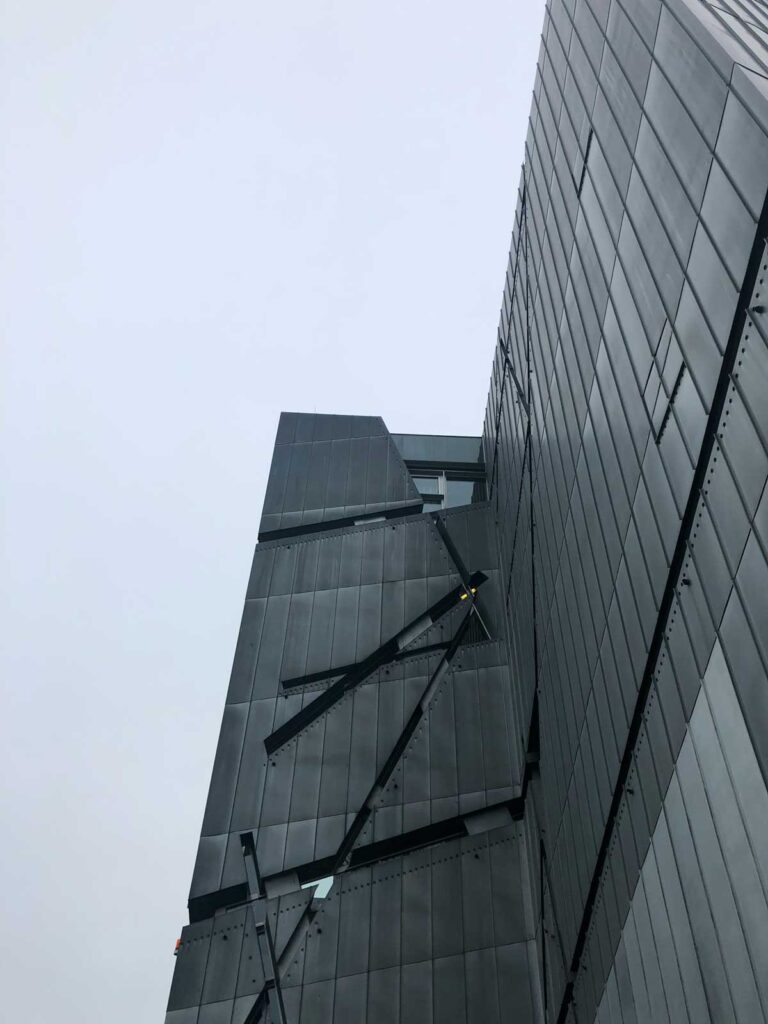
The museum complex comprises a baroque Old Building and the iconic zinc-clad Libeskind Building, which was designed by architect Daniel Libeskind. The contemporary structure features intersecting underground axes, angled walls, and void spaces that symbolise the absence left by the Holocaust.
The core exhibition spans Jewish history in Germany from the Middle Ages to the present day. It focuses on cultural achievements, religious practices, and the devastating impact of the National Socialist era, using historical artifacts, art, and personal testimonies.
A major highlight is the Memory Void, which houses the installation ‘Shalekhet’ (Fallen Leaves) by Menashe Kadishman, featuring over 10,000 heavy iron faces spread across the floor.
Visitors also explore the Holocaust Tower, a tall, unheated concrete silo lit only by a narrow slit at the top, and the Garden of Exile, an outdoor installation of 49 tilted concrete pillars that creates a sense of disorientation.
Practical visitor tips
| Tip Category | Advice |
| Timing | Book advance timed tickets online to secure entry, particularly if you plan to visit the ANOHA children’s world, which frequently sells out. |
| Crowds | Visit on weekday mornings at 10:00 AM for the quietest experience in the narrow corridors of the Libeskind Building. |
| Layout | Download the free JMB app onto your smartphone before arriving to access the complimentary audio guide and interactive map. |
| Entry process | Allow extra time for entry, as all visitors must pass through airport-style security screening and metal detectors. |
| On-site logistics | Store any large bags, backpacks, and heavy coats in the mandatory cloakroom or lockers before proceeding to the galleries. |
Frequently asked questions about the Jewish Museum Berlin
| Question | Answer |
| Is the Jewish Museum Berlin suitable for children? | Yes, children are welcome, and the museum operates the separate ANOHA children’s world across the street. |
| Do you need to book tickets in advance for the Jewish Museum Berlin? | Advance time-slot tickets are strongly encouraged, especially for temporary exhibitions and ANOHA. |
| Is the Jewish Museum Berlin open on Sundays? | Yes, the museum is open from 10:00 AM to 6:00 PM on Sundays. |
| Are bags allowed at the Jewish Museum Berlin? | Small day bags are permitted after a security scan, but larger backpacks must be checked into the cloakroom. |
Things to do near the Jewish Museum Berlin
The museum’s location in Kreuzberg places it close to several other significant historical and cultural attractions:
- Berlinische Galerie: A museum of modern art, photography, and architecture located just a five-minute walk away.
- Checkpoint Charlie Museum (Haus am Checkpoint Charlie): A historical museum documenting escape attempts during the Cold War, situated a short walk north.
- Asisi Panorama Berlin: An immersive visual experience depicting a typical autumn day in divided Berlin during the 1980s, located near Checkpoint Charlie.
More Berlin travel
Other Berlin travel articles on Planet Whitley include:
- Guide to Berlin Cathedral ticket prices.
- 8 ways to improve your Berlin city break.
- What to expect at the Alte Nationalgalerie in Berlin.
- Visitor guide to the Berlin TV Tower.
- Plan your visit to the Deutsches Technikmuseum in Berlin.
