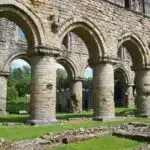
A visitor guide to Kirkstall Abbey, Leeds. Find essential information on opening hours, prices, and accessibility for exploring this medieval Cistercian ruin.
This guide was update in March 2026 to confirm opening hours and lack of admission fee.
Overview: History, what to expect, and unique features of Kirkstall Abbey
Kirkstall Abbey is one of the most complete and well-preserved examples of a medieval Cistercian abbey in Britain. Founded in 1152, the abbey quickly grew into a prosperous and self-sufficient monastic settlement, thanks to its strategic location on the banks of the River Aire. Unlike many other ruined abbeys in England, Kirkstall’s structures, including the church, cloister, chapter house, and refectory, survived the Dissolution of the Monasteries in 1539 largely intact, despite losing their roofs.
Visitors can expect an expansive, evocative experience walking through the large, atmospheric ruins. The abbey’s architecture is primarily Romanesque and early Gothic, showcasing beautiful, unadorned stone vaulting and rounded arches typical of the Cistercian order. Its unusual location within the city of Leeds makes it easily accessible, offering a tranquil, green space right in the urban environment. Leeds City Council manages the site, which often hosts large community events, festivals, and farmers’ markets within the historic grounds.

Planning your visit to Kirkstall Abbey: opening times and access
Kirkstall Abbey is managed by Leeds Museums and Galleries and operates on fairly consistent hours throughout the year, with free access to the main ruins.
- Summer hours (April to September): The abbey is generally open Tuesday to Sunday from 10:00 a.m. to 4:30 p.m.
- Winter hours (October to March): Hours shorten slightly – it’s now Tuesday to Sunday from 10:00 a.m. to 4:00 p.m.
- Closures: The site closes every Monday and observes closures on major bank holidays, including Christmas Day and New Year’s Day.
- Recommended time: Allow approximately one to two hours to explore the extensive abbey complex, including the church and claustral buildings.
Kirkstall Abbey admission and parking fees
Access to the main abbey ruins and grounds is free, though a charge may apply for special events and parking.
| Fee type | Price (checked March 2026) | Notes |
|---|---|---|
| Abbey Admission | Free | Leeds City Council operates the site with free entry to the ruins and grounds. A donation of £5 is suggested. |
| Parking Fee | Free | Free car parking is available on site, though spaces are limited during events. |
| Visitor Centre/Museum | Free | Access to the small on-site museum, located in the former abbot’s lodging, is also free. |
Event note: While general admission is free, the abbey regularly hosts large events, such as farmers’ markets and open-air cinema, which may require a separate entrance fee or affect site access.
Accessibility, safety, and amenities
As an urban heritage site, Kirkstall Abbey offers good, though not perfect, accessibility.
- Accessibility: The visitor centre is fully accessible for wheelchair users. Most of the grounds are accessible too, although there’s the occasional uneven surface, as you’d expect for a heritage site. The slope from the car park, however, is steep, so try to get one of the four Blue Badge spaces on Abbey Walk.
- Facilities: The Visitor Centre contains accessible toilets, a gift shop, and a small museum detailing the abbey’s history and the lives of the monks. A café provides refreshments near the entrance area.
- Safety: Visitors must observe standard safety precautions, staying clear of exposed stone walls and climbing structures.
- Dogs: Dogs are welcome in the abbey ruins and grounds but must remain on a lead at all times.
Nearby attractions to Kirkstall Abbey
The abbey is a key historical attraction near the heart of Leeds, positioning it close to other urban and historical sites:
- Kirkstall Forge Train Station: The abbey is easily accessible via this nearby station, offering quick travel links to Leeds city centre.
- Abbey House Museum: Located across the road from the abbey, this museum provides a fascinating look at Victorian life in Leeds, including reconstructed streets, shops, and houses.
- Leeds City Museum: Located in the city centre, this museum holds extensive collections covering local history, archaeology, and natural sciences.
- Royal Armouries Museum: Situated near the Leeds Docks, this museum showcases the national collection of arms and armour, offering a modern cultural contrast.
- Other attractions for overseas visitors to Leeds include Roundhay Park.
FAQs (Frequently Asked Questions) about Kirkstall Abbey
| Question | Answer |
|---|---|
| Is there a charge to visit the abbey? | No, access to the abbey ruins and grounds is entirely free of charge, as Leeds City Council manages the site. |
| Is Kirkstall Abbey connected to the River Aire? | Yes, the abbey’s history and prosperity relied on the River Aire, which provided water, power for mills, and transport. The river flows close to the site. |
| Can I walk from Leeds city centre to the abbey? | While possible (about a 3-mile walk), visitors typically use the train to Kirkstall Forge Station, take a bus, or drive. |
| How complete are the ruins? | Kirkstall is notable for being one of the most complete Cistercian ruins in Britain, with the walls and structures of the entire monastic complex standing, though without their original roofs. |
| Does the abbey host events? | Yes, the abbey often hosts community events, large festivals, and markets in its grounds, particularly during the summer months. |
More Yorkshire travel
Other Yorkshire travel articles on Planet Whitley include:
- The short walk to Top Withens – inspiration for Wuthering Heights.
- A practical guide to visiting Pontefract Castle.
- A practical guide to visiting the Yorkshire Wildlife Park.
- What to see at the RHS Garden Harlow Carr in Harrogate.
- Top tips for visiting York Castle Museum.