Parque del Drago in Icod de los Vinos is a three-hectare botanical park centred on the Drago Milenario — the oldest and largest dragon tree (Dracaena draco) in the Canary Islands. The tree is officially dated at around 800 years old, though it is widely marketed as “1,000 years old” and many guides repeat this figure.
This guide was updated in June 2026: A key planning point: the tree is partially visible for free from the Plaza de la Constitución outside the park, where the perimeter wall has been deliberately lowered for this purpose — something most guides and aggregators omit entirely. You can book in advance through GetYourGuide if you want the full park experience.
Quick facts
| Detail | Information |
|---|---|
| Address | Plaza de la Constitución, 1, 38430 Icod de los Vinos, Tenerife, Spain. |
| Summer hours (April–September) | 09:00–20:00 daily |
| Winter hours (October–March) | 10:00–18:00 daily |
| Adult ticket | €5 |
| Students and pensioners | €3 |
| Children under 8 | €2.50 |
| Icod de los Vinos residents | Free |
| Parking | Parking del Drago, Av. de Canarias 2 (paid, first hour free, ~€1.80/hr thereafter, 6 floors) |
| Nearest bus stop | Estación Icod (TITSA lines 108, 325, 354, 363) — 5-minute walk |
| Typical visit | 30–60 minutes |
Parque del Drago opening hours
The park is open daily throughout the year with two seasonal schedules. From April to September, opening hours are 09:00 to 20:00. From October to March, the park opens at 10:00 and closes at 18:00.
There is no confirmed closure day. However, hours may be adjusted for local public holidays and town events — it is worth checking ahead if visiting around the Icod town fiesta in September or other Canarian public holidays. No last-admission time is stated on the official Tenerife Tourism listing.
Parque del Drago admission prices
Prices are confirmed on the official Tenerife Tourism page. They are straightforward and have been consistent for several years.
| Category | Price |
|---|---|
| Adults | €5 |
| Students and pensioners | €3 |
| Children under 8 | €2.50 |
| Icod de los Vinos residents | Free |
All prices include VAT. There is no combined ticket with the Mariposario del Drago (butterfly park), though both are in the same area. You can book your Parque del Drago ticket in advance through GetYourGuide.
Why visit Parque del Drago?
- 🌳 The oldest dragon tree in the Canary Islands: The Drago Milenario stands over 16 metres tall, with a base circumference of roughly 20 metres. Nothing else like it exists anywhere in the archipelago.
- 🎟️ Children under 8 pay only €2.50: The park is one of the most affordable family attractions in northern Tenerife, with a full adult ticket at just €5.
- 🌿 Endemic Canarian plant collection: The park surrounds the dragon tree with dozens of species found only in the Canary Islands — cardones, tabaibas, verodes, and smaller drago specimens — with labelled walks.
- 📜 Ancient cave and historic bodega: The visit includes a walk through a volcanic lava cave used in Guanche ritual and an old wine cellar — two features absent from most guides’ descriptions of the park.
- 💰 Free partial view from outside: The perimeter wall on the Plaza de la Constitución has been lowered deliberately so anyone can see the crown of the tree without paying admission — useful if you only want a photograph.
How to get to Parque del Drago
By car, Icod de los Vinos sits on the TF-5 motorway running along the north coast of Tenerife between Puerto de la Cruz and Los Realejos. Exit at Icod de los Vinos and follow signs to the town centre and the Drago. The park entrance is on the Plaza de la Constitución beside the Church of San Marcos.
By bus (TITSA), several lines serve the Estación Icod stop, including lines 108, 325, 354, and 363. The bus station is around a 5-minute walk downhill from the park entrance. Journey times from Puerto de la Cruz are around 30 minutes; from Santa Cruz de Tenerife around 1.5 hours.
On foot from the town centre, the park entrance on Plaza de la Constitución is reached via the pedestrianised streets of the historic quarter, a walk of under 10 minutes from most parts of central Icod.
Parking at Parque del Drago
The nearest car park is Parking del Drago at Avenida de Canarias 2, a six-floor covered facility around 250 metres from the park entrance. The first hour is free; subsequent hours cost approximately €1.80 per hour. The car park is open 24 hours and includes WC facilities. It also features internal murals depicting local history and culture. On-street parking in the town centre is limited and difficult to find during peak visitor hours — the car park is the most reliable option.
How long to spend at Parque del Drago
Allow 30 to 60 minutes for a complete visit. The self-guided route includes the main botanical gardens, close-up views of the Drago Milenario, a volcanic lava cave, and an old bodega. Visitors who linger in the endemic plant sections and read the information boards will need the full hour. Combining the visit with the adjacent Mariposario del Drago (butterfly park) adds 45–60 minutes and converts the trip into a comfortable half-day in Icod.
Accessibility at Parque del Drago
The park paths are not wheelchair accessible in their entirety — several sections involve uneven ground and steep inclines typical of the terrain around the dragon tree. The ticket office and initial entry area are reachable, but the full circuit is not suitable for wheelchairs or pushchairs. Visitors with mobility limitations can see the Drago Milenario from the free viewpoint on Plaza de la Constitución without entering the park. No hearing loop or audio guide provision is confirmed.
What to see at Parque del Drago
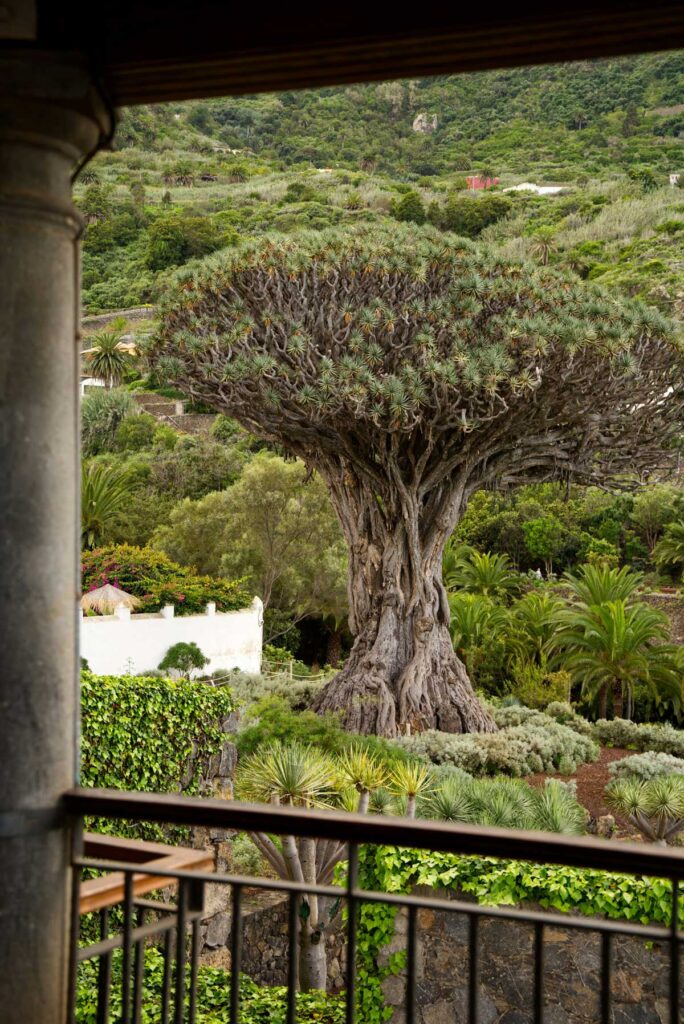
The Drago Milenario is the park’s centrepiece. Its massive multi-branched crown spreads up to 18 metres across, and the bark shows the characteristic scarring and regrowth of centuries of growth. The tree is the official symbol of the Canary Islands and its red resin — known as dragon’s blood — was historically prized for varnish, medicine, and ritual. Close-up views from inside the park are significantly better than the free external viewpoint.
The endemic plant garden surrounds the dragon tree and is labelled throughout in Spanish and English. Species include cardón (Euphorbia canariensis), tabaiba (Euphorbia balsamifera), younger drago specimens, and a variety of succulents and shrubs found only in Macaronesia. Slow lizards (lagarto tizón) are regularly spotted basking on the rocks.
The volcanic lava cave is a short, accessible tunnel running beneath the gardens, connected to the island’s volcanic geology. Historically the cave was used by the Guanche people — the pre-Hispanic indigenous population — for ritual and storage purposes.
The old bodega (wine cellar) reflects Icod de los Vinos’ long wine-making tradition. The town’s name — literally “Icod of the Wines” — derives from its historic role as a wine-producing centre, and the bodega display contextualises the park’s botanical focus within the town’s agricultural history.
Views of Mount Teide are visible from various points within the park on clear days, with the dragon tree and the Church of San Marcos in the foreground.
Practical tips for visiting Parque del Drago
| Tip | Detail |
|---|---|
| Free view from the plaza | The wall on Plaza de la Constitución is deliberately lowered to give a free partial view of the Drago’s crown — useful for a quick photograph without paying the €5 admission. |
| Combine with Mariposario del Drago | The butterfly park is directly adjacent and makes a natural same-day pairing. Tickets are separate; check its own opening times and prices before visiting. |
| Use Parking del Drago | Street parking in Icod is very limited. The Parking del Drago on Avenida de Canarias is the best option — first hour free, well-signed from the TF-5. |
| Arrive early in summer | Summer closing is 20:00, but tour coaches and cruise passengers tend to arrive mid-morning. Early morning or late afternoon is considerably quieter. |
| The tree is 800, not 1,000 years old | The park and official Tenerife Tourism materials both state the tree is officially around 800 years old — the “Drago Milenario” name is traditional, not scientific. It’s worth knowing before conversations with guides. |
Parque del Drago FAQ
| Question | Answer |
|---|---|
| Can I see the Drago Milenario without paying? | Yes. The perimeter wall on Plaza de la Constitución is lowered at one point to allow a free view of the tree’s upper crown. You cannot get close without a ticket. |
| How old is the Drago Milenario? | Officially around 800 years, according to the park’s own materials. It is marketed as the “thousand-year dragon” but the scientific estimate is lower. |
| Is the park wheelchair accessible? | No. The terrain is steep and uneven in places. Visitors with mobility limitations are better served by the free external viewpoint on the plaza. |
| Is there parking? | Yes — Parking del Drago at Av. de Canarias 2 is 250 metres away. First hour is free; approximately €1.80/hr thereafter. |
| Can I book in advance? | Yes. Booking through GetYourGuide allows you to pre-purchase your entry and skip the ticket counter queue. |
Things to do near Parque del Drago
Mariposario del Drago is directly beside the park entrance and is one of the largest butterfly houses in the Canary Islands. It holds over 1,500 live tropical butterflies across a humid glasshouse, as well as exhibits on insectivorous plants and stick insects. Separate admission applies.
Casa del Plátano is a 5-minute walk into the residential streets of Icod — a restored hacienda with a working banana plantation and the only visitor centre in Europe dedicated exclusively to the Canary Islands banana.
The Church of San Marcos (Iglesia de San Marcos) occupies the square adjacent to the park entrance and dates from the 16th century. Its silver cross is one of the most important pieces of religious silverwork on the island. The church interior is free to enter during opening hours.
Garachico is around 10 km west along the coast road and is one of the best-preserved historic towns in Tenerife, rebuilt after a volcanic eruption in 1706 destroyed much of the original town. The natural rock pools (El Caletón) are excellent for swimming.
The wine route of Icod de los Vinos (Museo de la Malvasía) is in the town centre and explores the local wine-making history that gives the town its name. The Malvasía wine museum is worth a stop in combination with a visit to the park.
Similar parks and gardens to visit in Tenerife
La Orotava Botanical Garden (Jardín de Aclimatación), Puerto de la Cruz is one of the oldest botanical gardens in Spain, established by royal decree in 1788. Its collection focuses on tropical and subtropical species brought from the Americas. Around 30 minutes east of Icod by car.
Sitio Litre Orchid Garden, Puerto de la Cruz holds the oldest garden in Tenerife, dating from 1730. The private hacienda contains one of the largest collections of orchids in the Canary Islands. Around 30 minutes east of Icod.
Pirámides de Güímar, Güímar is a landscaped park surrounding a set of pre-Hispanic step pyramids whose origins remain debated. The ethnographic park has botanical gardens developed in collaboration with the University of La Laguna and a museum. Around 1.5 hours south-east.
Hamilton Gardens, Tacoronte is a lesser-visited private garden in the municipality of Tacoronte, created in the style of an English garden on a volcanic hillside. Around 40 minutes east of Icod.
Anaga Country Park (Parque Rural de Anaga), north-east Tenerife is a UNESCO Biosphere Reserve covering the Anaga peninsula with laurisilva forest that has survived since the Tertiary period. Around 1.5 hours east — better for hikers than garden-seekers, but an exceptional example of Canarian endemic nature.