Peñíscola Castle (Castillo de Peñíscola) is a medieval Templar fortress and former papal residence located on a rocky peninsula in Peñíscola, Castellón, Spain. This guide covers opening hours, ticket prices, transport or parking, accessibility, and practical visitor tips.
This guide was updated in May 2026 to reflect the current €5.00 general admission price and the confirmed public holiday closure dates for the year.
Quick facts about Peñíscola Castle
| Feature | Details |
| Opening hours | Opens daily at 10:30 am in winter and 9:30 am in summer. |
| Ticket prices | General admission costs €5.00, with reductions available. |
| Address | Calle del Castillo s/n, 12598 Peñíscola, Castellón, Spain. |
| Nearest public transport or parking | Puerto de Peñíscola car park is located at the base of the old town. |
| Typical time needed | One to two hours for a standard visit. |
Peñíscola Castle opening hours
Peñíscola Castle opening hours change according to the season, dictating when visitors can access the interior courtyards and the roof. During the winter season, which runs from 16 October until Palm Sunday, the castle opens from 10:30 am to 5:30 pm.
During the summer season, which begins on Palm Sunday and ends on 15 October, the operating hours are extended from 9:30 am to 9:30 pm. The castle closes completely on five specific public holidays throughout the year: 1 January, 6 January, 9 September, 9 October, and 25 December.
Peñíscola Castle ticket prices
Peñíscola Castle ticket prices are currently set at €5.00 for a standard adult entry ticket. Opening hours and ticket prices were checked on the official website and last updated in May 2026.
Children aged between 9 and 16, students, unemployed individuals, and visitors over the age of 60 can purchase reduced tickets for €3.50, provided they show valid proof at the entrance. Children aged eight and under enter for free.
How to get to Peñíscola Castle
To get to Peñíscola Castle, drivers should take the AP-7 motorway or the N-340 road along the Mediterranean coast, taking the exit signposted for Peñíscola. Once in the town, follow signs towards the old town (Casco Antiguo) and the port area, as the castle sits at the highest point of the peninsula.
For public transport users, the nearest railway station is Benicarló-Peñíscola, located roughly four miles inland. From the station, you can take a local bus service or a taxi for the short onward journey to the seafront, followed by a steep walk up the cobbled streets to the attraction entrance.
Parking at Peñíscola Castle
Parking at Peñíscola Castle is not possible directly on site, as the fortress is located within a pedestrianised medieval old town with restricted vehicular access. Visitors must park their cars in the modern town below and walk up the hill to the attraction.
The most convenient parking area is the large pay-and-display car park located near the port (Parking Puerto), which sits directly at the base of the historic walls. During the peak summer months, this area fills up quickly, so visitors may need to use municipal street parking further along the North Beach promenade.
How long to spend at Peñíscola Castle
You should plan to spend one to two hours at Peñíscola Castle to complete a standard visit of the interior rooms and the exterior grounds. This timeframe allows you to explore the main fortress levels, view the papal rooms, and take photographs from the highest battlements.
If you intend to explore the surrounding Artillery Park (Parque de Artillería) or stop to read all the historical exhibition panels detailing the Knights Templar, you should allocate two to three hours. Visitors must also factor in the steep 15-minute walk from the lower town to the castle entrance.
Accessibility at Peñíscola Castle
Accessibility at Peñíscola Castle is highly restricted due to the building’s medieval architecture, steep inclines, and uneven stone surfaces. The approach through the old town involves navigating steep, cobbled streets that are difficult for wheelchairs and pushchairs.
Inside the castle, there are multiple flights of narrow stone steps connecting the various floors, courtyards, and battlements, with no elevators available to bypass them. While visitors with documented disabilities can enter free of charge, they will only be able to access the ground floor courtyard areas.
Inside / what to see at Peñíscola Castle
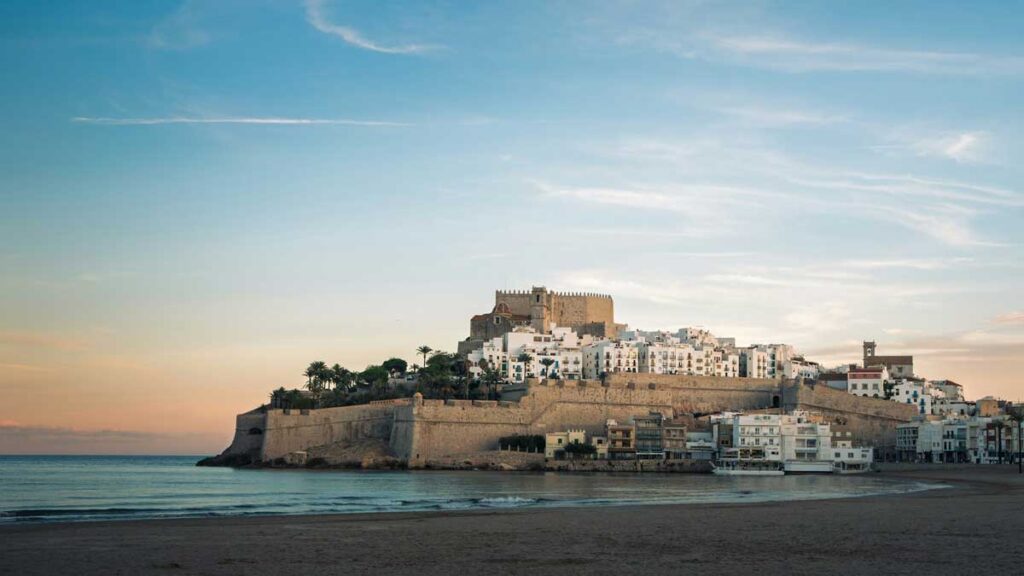
When visiting Peñíscola Castle, the primary attraction is the robust medieval architecture initially constructed by the Knights Templar between 1294 and 1307. The fortress is built from carved stone and features stark, unadorned walls characteristic of Templar military design.
The castle is most famous for serving as the papal residence of Pope Benedict XIII, historically known as Papa Luna, during the Western Schism in the 15th century. Visitors can walk through his former private chambers, the papal library, and the Conclave Hall, where his successor was elected.
The Stables feature an impressive, pointed barrel-vaulted ceiling that highlights the engineering capabilities of the Templar builders. This vast, austere room was historically used to house livestock and military equipment during sieges.
The upper terraces and the roof of the castle provide panoramic viewpoints overlooking the Mediterranean Sea and the golden sands of the North Beach. These high vantage points offer clear visibility of the modern town and the surrounding coastal geography.
Adjacent to the main fortress is the Artillery Park, a botanical garden area set within the lower defensive walls built during the 16th century. This area features restored cannons, military ramps, and manicured walkways surrounded by palm trees and native coastal flora.
Practical visitor tips
| Tip Category | Practical Advice |
| Timing | Arrive when the doors open at 9:30 am during the summer to avoid the midday heat and the large tour groups. |
| Crowds | Visit during the winter months to experience the castle and the old town with significantly fewer tourists. |
| Layout | Wear comfortable, flat walking shoes with good grip, as the cobbled streets and stone steps are often slippery. |
| Entry process | Bring physical identification if you intend to claim a reduced or free ticket, as the staff will ask for verification. |
| On-site logistics | Carry a bottle of water during your visit, as the steep walk up to the castle can be tiring in warm weather. |
Frequently asked questions about Peñíscola Castle
| Frequently Asked Question | Answer |
| Is Peñíscola Castle suitable for children? | Yes, children enjoy the fortress setting, but pushchairs cannot be used on the steep internal staircases. |
| Do you need to book tickets in advance for Peñíscola Castle? | No, you can purchase tickets directly at the entrance, though advance booking is available during peak summer. |
| Is Peñíscola Castle open on Sundays? | Yes, the castle is open on Sundays throughout the year, switching between winter and summer operating hours. |
| Are bags allowed at Peñíscola Castle? | Yes, standard backpacks and bags are permitted, but you must carry them with you at all times. |
| Are dogs allowed at Peñíscola Castle? | No, dogs are not permitted inside the castle or the Artillery Park, with the exception of registered assistance dogs. |
Things to do near Peñíscola Castle
- Peñíscola Old Town: This walled medieval settlement features narrow cobbled streets, whitewashed houses, and traditional Spanish seafood restaurants.
- Playa Norte: This expansive sandy beach stretches for miles along the coastline, offering calm waters and a vibrant seaside promenade.
- Sierra de Irta Natural Park: This protected coastal mountain range features rugged cliffs, hidden coves, and extensive hiking trails located just south of the town.
- Museo del Mar: This small maritime museum highlights the local fishing heritage and displays traditional nautical equipment and model ships.
- Casa de las Conchas: This prominent local building features a striking facade completely covered in native seashells, situated within the historic old town walls.
What to visit tomorrow
- Morella Castle: This imposing medieval fortress sits atop a rocky hill in the Maestrazgo mountains, towering over an ancient walled town.
- Sagunto Castle: This vast, sprawling Roman and Moorish citadel stretches across a long ridge overlooking the Valencian coastline.
- Xàtiva Castle: This twin-peaked historic fortress features extensive defensive walls and offers sweeping views across the surrounding agricultural plains.
- Onda Castle: Known as the Castle of the 300 Towers, this historic Islamic fortification contains an archaeological museum and restored defensive walls.
- Cullera Castle: This renovated 13th-century fortress sits on a coastal mountain above the town of Cullera, featuring an internal sanctuary and a museum.
More Spanish castles
Other Spanish castle guides on Planet Whitley include:
- Visitor guide to the Alcazaba in Almeria.
- First-time visitors’ guide to Montjuic Castle in Barcelona.
- Guide to visiting Gibralfaro Castle in Malaga.
- How to visit the Castillo de Coca near Segovia.
- Practical visitor guide to Trujillo Castle in Extremadura.