Atlatl Rock is a petroglyph site located in Valley of Fire State Park, Nevada, featuring ancient rock carvings created by the Basketmaker and Early Pueblo cultures approximately 2,500 to 4,000 years ago. This guide covers access hours, park entrance fees, how to get there, parking, facilities, what to see, and practical tips for planning your visit.
The petroglyphs are carved on a sandstone boulder approximately 50 feet above ground level, accessible via a metal staircase. The site is named after the atlatl, a spear-throwing tool depicted in several of the rock carvings. Valley of Fire State Park, Nevada’s oldest and largest state park, encompasses 45,000 acres of bright red Aztec sandstone formations in the Mojave Desert. Atlatl Rock is located on Scenic Loop Road near the park’s western entrance, adjacent to Atlatl Rock Campground and picnic area.
For many, it’s the highlight of a small group Valley of Fire tour from Las Vegas.
Quick facts
| Detail | Information |
|---|---|
| Access hours | Open year-round, sunrise to sunset |
| Park entrance fee | Nevada residents: $10 per vehicle | Non-Nevada residents: $15 per vehicle |
| Location | Scenic Loop Road, Valley of Fire State Park, 1.8 miles from west entrance |
| Distance from Las Vegas | Approximately 55 miles northeast (1-hour drive) |
| Trail distance | 0.1 miles round trip (approximately 250 feet) |
| Time needed | 15 to 30 minutes for viewing petroglyphs |
Atlatl Rock access hours
Atlatl Rock is accessible year-round from sunrise to sunset daily. Valley of Fire State Park is open throughout the year, though summer temperatures frequently exceed 100 degrees Fahrenheit (38 degrees Celsius). The best time to visit is October through April when temperatures are cooler, typically ranging from freezing to 75 degrees Fahrenheit (24 degrees Celsius). Summer visits should be planned for early morning to avoid extreme midday heat.
Valley of Fire State Park entrance fees
Day-use entrance fees for Valley of Fire State Park are $10 per vehicle for Nevada residents and $15 per vehicle for non-Nevada residents. Fees are collected at entrance stations on Valley of Fire Highway at the west and east park entrances. The park does not accept advance online payment for day-use entry. Bicyclists pay $2 per bike.
Nevada State Parks annual passes are available for $100 and provide unlimited entry to all Nevada state parks for 12 months. Senior passes and other discounts may be available; check the Nevada State Parks website for current pass options. Federal passes including America the Beautiful passes are not valid at Valley of Fire State Park, which is operated by Nevada State Parks, not the National Park Service.
If you enter on a Valley of Fire tour from Las Vegas, the entrance fees are included in the tour price.
Entrance fees and information were checked and updated in January 2026.
Why book the Small-Group Valley of Fire half-day hiking tour from Las Vegas?
- Discover Valley of Fire State Park: Explore Nevada’s oldest state park, known for its vivid red sandstone formations and dramatic desert scenery.
- Guided hiking experience: Enjoy led walks with a local guide who shares insight into the geology, wildlife and history of the area.
- Small-group format: Limited group size keeps the experience personal and relaxed, with plenty of time to ask questions and enjoy the landscape.
- Photo opportunities: Visit iconic spots like the Fire Wave, Elephant Rock and scenic overlooks perfect for striking photos.
- Easy half-day adventure: A compact outing ideal if you’re short on time but still want to experience Nevada’s spectacular desert landscapes without self-drive stress.
How to get to Atlatl Rock
From Las Vegas, take Interstate 15 north for approximately 35 miles to exit 75, signed for Valley of Fire State Park and Lake Mead National Recreation Area. At the end of the off-ramp, continue southeast on Valley of Fire Highway. The park’s west entrance is reached after 14.5 miles. Drive another 1.8 miles and turn left onto Scenic Loop Road (also called Campground Road), the first paved road on the left, directly across from a gravel road to Petrified Logs Loop.
Drive 0.5 miles on Scenic Loop Road, passing the entrance to Atlatl Rock Campground. Turn left into the Atlatl Rock parking area, located below the rock formation. The metal staircase to the petroglyphs is visible from the parking area. The nearest major airport is Harry Reid International Airport in Las Vegas, approximately 60 miles southwest.
Parking at Atlatl Rock
The Atlatl Rock Picnic Area parking lot accommodates cars, motorcycles, and recreational vehicles. Parking is free with valid park entrance. The lot provides ample space for day visitors, though it can fill during peak season (October through April weekends and holidays). Overflow parking is available along Scenic Loop Road. The parking area also serves the adjacent picnic area with tables, shade canopies, and vault toilets.
How long to spend at Atlatl Rock
Most visitors spend 15 to 30 minutes at Atlatl Rock. The walk to the base of the staircase is approximately 50 yards, and the metal staircase has approximately 60 to 70 steps to the viewing platform. Time at the platform viewing the petroglyphs typically ranges from 5 to 15 minutes. Visitors combining Atlatl Rock with the adjacent picnic area may spend 1 to 2 hours. The site is a quick stop often combined with other Valley of Fire attractions including Arch Rock (0.5 miles away), Mouse’s Tank, Fire Wave, and White Domes.
Accessibility at Atlatl Rock
The trail to the base of the metal staircase is relatively flat and unpaved, suitable for most mobility levels. The metal staircase to the petroglyph viewing platform has approximately 60 to 70 steps and is not wheelchair-accessible. Handrails are provided on both sides of the staircase. Visitors unable to climb stairs can view the sandstone formation and surrounding landscape from the base, though the petroglyphs are not visible from ground level.
The adjacent Atlatl Rock Picnic Area features accessible picnic tables with extended tops, shade canopies, barbecue grills, and vault toilets. Drinking water is available from spigots in the picnic area. The nearest flush toilets are at Atlatl Rock Campground, adjacent to the picnic area.
Dogs are allowed at Atlatl Rock and must be kept on a leash. Dogs are permitted in developed areas including picnic areas, campgrounds, and along roadways but are not allowed on most trails in Valley of Fire State Park.
What to see at Atlatl Rock
The petroglyphs on Atlatl Rock were created by the Basketmaker culture approximately 2,500 years ago and later by the Early Pueblo culture. The rock carvings are etched into desert varnish and sandstone on a boulder face approximately 50 feet above the ground. The viewing platform at the top of the metal staircase provides close access to the petroglyphs without touching the fragile ancient carvings.
The site is named after the atlatl, a spear-throwing tool depicted in several petroglyphs. An atlatl is a wooden stick approximately two feet long with a handhold on one end and a hook on the other end. Ancient hunters used the device to launch spears with greater force and accuracy than throwing by hand alone. The tool predated the bow and arrow in the Americas.
The petroglyphs depict various symbols including human figures, bighorn sheep, geometric patterns, and the atlatl hunting tool. The exact meanings of most petroglyphs remain unknown, though they reflect the past and lifestyles of Native American cultures. Interpretive panels at the base of the staircase provide information about the atlatl and petroglyph preservation.
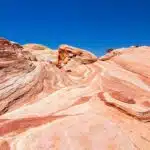
A dinosaur footprint is visible in the rock approximately six feet in front of the base of the metal staircase. The surrounding red Aztec sandstone formations date to the Jurassic period and are remnants of ancient sand dunes left behind after inland seas subsided approximately 150 million years ago. The bright red colour results from iron oxide in the sandstone.
Arch Rock, a natural arch in a sandstone formation, is visible from Scenic Loop Road approximately 0.5 miles from Atlatl Rock. The arch is accessible from the roadside without hiking. The surrounding landscape features dramatic red rock formations, desert vegetation including creosote bush and barrel cactus, and views of distant mountains.
Practical visitor tips
| Tip |
|---|
| Visit between October and April for cooler temperatures; summer temperatures frequently exceed 100 degrees Fahrenheit. |
| Arrive early morning during summer months to avoid extreme midday heat and afternoon thunderstorms. |
| Do not touch, walk on, or deface the petroglyphs; oils from hands damage the ancient rock art. |
| Bring adequate drinking water, as the desert landscape offers little shade and the climate is extremely dry. |
| Wear sturdy shoes with good traction for the metal staircase, which can be slippery. |
| The staircase is not suitable for visitors with mobility limitations; petroglyphs are not visible from ground level. |
| Combine Atlatl Rock with nearby Arch Rock (0.5 miles away on Scenic Loop Road) for an easy two-stop visit. |
| Check weather forecasts before visiting; thunderstorms can develop quickly in summer, creating lightning hazards. |
Frequently asked questions
| Question | Answer |
|---|---|
| Is Atlatl Rock suitable for children? | Yes, children can climb the metal staircase with supervision. The stairs have handrails, and the viewing platform is secure. Count approximately 60 to 70 steps. |
| Do you need to book in advance? | No advance booking is required. Park entrance fees are paid at entrance stations on arrival. |
| Is Atlatl Rock accessible in winter? | Yes, the site is open year-round. Winter offers cooler temperatures (freezing to 75 degrees Fahrenheit) and is the best season for comfortable visits. |
| Are restrooms available? | Yes, vault toilets are located in the adjacent picnic area. Flush toilets are available at the nearby Atlatl Rock Campground. |
| How long does a visit take? | Most visitors spend 15 to 30 minutes at Atlatl Rock, including the walk and staircase climb to view the petroglyphs. |
| Is there wheelchair access? | No, the metal staircase to the petroglyphs is not wheelchair-accessible. The base trail is relatively flat, but petroglyphs are not visible from ground level. |
Things to do near Atlatl Rock
Arch Rock, located 0.5 miles from Atlatl Rock on Scenic Loop Road, is a natural arch in a red sandstone formation visible from the roadside. No hiking is required to view the arch. Atlatl Rock Campground, adjacent to the picnic area, has 44 campsites with tables, grills, water, and restrooms. Some sites have electrical and water hookups. Camping is first-come, first-served and not reservable.
Mouse’s Tank Trail, located near the park visitor centre, is a 0.7-mile round-trip hike along a canyon to a natural rock basin where rainwater collects. Prehistoric petroglyphs line the trail. Fire Wave, one of Valley of Fire’s most photographed locations, features swirling red and white sandstone striations. The hike is 1.5 miles round trip from the trailhead on White Domes Road.
The White Domes Trail, a 1.1-mile loop beginning on White Domes Road, passes through slot canyons, colorful sandstone formations, and areas used for filming. Elephant Rock, located near the park’s east entrance, is a sandstone formation resembling an elephant, visible from the roadside. The Valley of Fire Visitor Center, located on Valley of Fire Highway, provides exhibits on park geology, ecology, prehistory, and history. The visitor centre is open daily.
Other Valley of Fire highlights include the Seven Sisters, the Beehives and Rainbow Vista.
More Nevada travel
Other Nevada travel articles on Planet Whitley include:
- The best stops on the Kingman to Las Vegas drive.
- The best route from Las Vegas to Lake Havasu City.
- The quirky tour of the Techatticup Gold Mine.
- How to see Hoover Dam from the water.
- A practical guide to visiting Rhyolite, Nevada’s most spectacular ghost town.