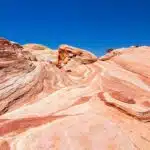
The Beehives are distinctive sandstone formations resembling beehives in Valley of Fire State Park, Nevada. They’re located along Valley of Fire Highway near the park’s east entrance. This 2026 visitor guide covers access hours, park entrance fees, how to get there, parking, what to see, and practical tips for planning your visit.
The Beehives are usually the first stop on small group Valley of Fire tours from Las Vegas.
Quick facts
| Detail | Information |
|---|---|
| Access hours | Open year-round, sunrise to sunset |
| Park entrance fee | Nevada residents: $10 per vehicle | Non-Nevada residents: $15 per vehicle |
| Location | Valley of Fire Highway, near east entrance |
| Distance from Las Vegas | Approximately 55 miles northeast (1-hour drive) |
| Walking distance | Short unpaved path (approximately 0.1 to 0.2 miles) |
| Time needed | 10 to 20 minutes for viewing |
Beehives access hours
The Beehives are accessible year-round from sunrise to sunset daily. Valley of Fire State Park is open throughout the year, though summer temperatures frequently exceed 100 degrees Fahrenheit (38 degrees Celsius). The best time to visit is October through April when temperatures are cooler, typically ranging from freezing to 75 degrees Fahrenheit (24 degrees Celsius). Summer visits should be planned for early morning to avoid extreme midday heat.
Valley of Fire State Park entrance fees
Day-use entrance fees for Valley of Fire State Park are $10 per vehicle for Nevada residents and $15 per vehicle for non-Nevada residents. Fees are collected at entrance stations on Valley of Fire Highway at the west and east park entrances. The park does not accept advance online payment for day-use entry. Cyclists pay $2 per bike.
Nevada State Parks annual passes are available for $100 and provide unlimited entry to all Nevada state parks for 12 months. Federal passes including America the Beautiful passes are not valid at Valley of Fire State Park, which is operated by Nevada State Parks, not the National Park Service.
Entrance fees and information were checked and updated in January 2026.
Why book the Small-Group Valley of Fire half-day hiking tour from Las Vegas?
- Discover Valley of Fire State Park: Explore Nevada’s oldest state park, known for its vivid red sandstone formations and dramatic desert scenery.
- Guided hiking experience: Enjoy led walks with a local guide who shares insight into the geology, wildlife and history of the area.
- Small-group format: Limited group size keeps the experience personal and relaxed, with plenty of time to ask questions and enjoy the landscape.
- Photo opportunities: Visit iconic spots like the Fire Wave, Elephant Rock and scenic overlooks perfect for striking photos.
- Easy half-day adventure: A compact outing ideal if you’re short on time but still want to experience Nevada’s spectacular desert landscapes without self-drive stress.
How to get to the Beehives
From Las Vegas, take Interstate 15 north for approximately 35 miles to exit 75, signed for Valley of Fire State Park and Lake Mead National Recreation Area. At the end of the off-ramp, turn left and continue southeast on Valley of Fire Highway. Enter the park at either the west entrance (14.5 miles from the interstate) or the east entrance (20 miles from the interstate).
From the west entrance, drive approximately 9 miles east on Valley of Fire Highway. The Beehives parking area is on the right (south) side of the highway, immediately before reaching the east entrance station. From the east entrance, the Beehives parking area is immediately on the left (south) side after passing through the entrance station. The formations are visible from the parking area and from Valley of Fire Highway. The nearest major airport is Harry Reid International Airport in Las Vegas, approximately 60 miles southwest.
If you don’t have your own vehicle, booking a Valley of Fire tour from Las Vegas is the most practical option.

Parking at the Beehives
A gravel parking area is located directly adjacent to the Beehives on the south side of Valley of Fire Highway. The lot accommodates cars, motorcycles, and recreational vehicles. Parking is free with valid park entrance. The parking area provides ample space and rarely fills, as most visitors spend only 10 to 20 minutes viewing the formations. The Beehives are visible from the parking area, and a short unpaved path leads to the base of the formations.
How long to spend at the Beehives
Most visitors spend 10 to 20 minutes at the Beehives. The formations are visible from the parking area, and a short unpaved path (approximately 0.1 to 0.2 miles) winds through rocky dunes to the base of the structures. The Beehives serve as a quick roadside stop often combined with other Valley of Fire attractions including the Petrified Logs (immediately west), Elephant Rock (near the east entrance), Atlatl Rock, Fire Wave, and the White Domes Trail. Visitors sometimes climb to higher points on the formations for panoramic views of the Valley of Fire landscape, which extends visit time.
Accessibility at the Beehives
The Beehives are visible from the parking area without walking, though the best views and closest access require following the short unpaved path. The path is not wheelchair-accessible due to sandy and uneven terrain. Visitors with mobility limitations can view the formations from the parking area and roadside without significant difficulty.
No facilities are available at the Beehives. The nearest restrooms are at the east entrance station (approximately 0.2 miles east) or at the Visitor Center (approximately 10 miles west). The nearest drinking water is at the Visitor Center or at picnic areas within the park. Visitors should bring water, particularly during warmer months.
Dogs are allowed at the Beehives and must be kept on a leash up to 6 feet long. The sandy and rocky terrain can be hot and uncomfortable for dogs’ paws during warmer months. Bring water for dogs and avoid midday heat.
What to see at the Beehives
The Beehives are large sandstone formations with rounded, dome-like shapes resembling giant beehives. The formations display prominent cross-bedding patterns—diagonal layers visible on the rock surfaces that indicate the angle at which wind or water deposited sand during the Jurassic period approximately 150 million years ago. Cross-bedding is common in ancient sand dunes, beach deposits, and river sediments. The visible layers show how the dunes shifted and changed direction over time.
The formations are composed of red Aztec sandstone, the same material that gives Valley of Fire its distinctive colour. The bright red colour results from iron oxide in the sandstone. The Beehives sit among rocky dunes with hills of the Muddy Mountains visible in the distance to the south and east. The surrounding landscape features dramatic red rock formations, desert vegetation including creosote bush and barrel cactus, and expansive desert vistas.
Visitors can walk around and between the formations, and some climb to higher points on the structures for panoramic views over the Valley of Fire landscape. From elevated positions, views extend across the park’s red sandstone formations, valleys, and distant mountains. The short unpaved path winds through the rocky dunes, allowing exploration of the formations from various angles.
Petrified Logs, located immediately west of the Beehives across Valley of Fire Highway, are accessible via a short trail. Approximately 225 million years ago, trees from an ancient forest washed into the valley. The logs have been infiltrated by minerals and fossilised over time. Four petrified logs are protected with small gates along the quarter-mile trail.
Practical visitor tips
| Tip |
|---|
| Visit between October and April for cooler temperatures; summer temperatures frequently exceed 100 degrees Fahrenheit. |
| The Beehives are visible from the parking area, making this an accessible stop for visitors unable to walk on uneven terrain. |
| Combine the Beehives with nearby Petrified Logs (directly across the highway) for a 15 to 30-minute two-stop visit. |
| Bring adequate drinking water, as no facilities or water sources are available at the Beehives. |
| Visitors can climb on the formations for panoramic views, though care should be taken on uneven surfaces. |
| The short visit time (10 to 20 minutes) makes the Beehives suitable for quick roadside stops when travelling between park attractions. |
| Early morning or late afternoon provides the best lighting for photography, with low sun angles highlighting the cross-bedding patterns. |
| Check weather forecasts before visiting; thunderstorms can develop quickly in summer, creating lightning hazards. |
Frequently asked questions
| Question | Answer |
|---|---|
| Are the Beehives suitable for children? | Yes, children can easily view and explore the formations from the parking area and short unpaved path. Supervise children if climbing on the rocks. |
| Do you need to book in advance? | No advance booking is required. Park entrance fees are paid at entrance stations on arrival. |
| Are the Beehives accessible in winter? | Yes, the formations are accessible year-round. Winter offers cooler temperatures (freezing to 75 degrees Fahrenheit) and is the best season for comfortable visits. |
| Are restrooms available? | No restrooms are available at the Beehives. The nearest facilities are at the east entrance station (0.2 miles away) or the Visitor Center (10 miles away). |
| How long does a visit take? | Most visitors spend 10 to 20 minutes at the Beehives, viewing the formations from the parking area and walking the short path. |
| Is there wheelchair access? | The formations are visible from the parking area without walking. The unpaved path to the base is not wheelchair-accessible due to sandy and uneven terrain. |
Things to do near the Beehives
The Petrified Logs, located directly across Valley of Fire Highway from the Beehives, are accessible via a quarter-mile trail. Four fossilised logs from an ancient forest that existed approximately 225 million years ago are protected with gates along the trail. Elephant Rock, located near the park’s east entrance, is a sandstone formation resembling an elephant. The formation is visible from the roadside and accessible via a short trail from the entrance area.
The Seven Sisters, a series of seven rock formations jutting from the landscape, are located along Valley of Fire Highway approximately 3 miles west of the Beehives. The formations are visible from the roadside. Scenic Loop Road, accessed from Valley of Fire Highway approximately 6 miles west of the Beehives, provides access to Atlatl Rock (ancient petroglyphs accessible via metal staircase) and Arch Rock (small natural arch visible from the road).
The Valley of Fire Visitor Center, located on Valley of Fire Highway approximately 10 miles west of the Beehives, provides exhibits on park geology, ecology, prehistory, and history. The visitor centre is open daily from 09:00 to 16:00. White Domes Road (also called Mouse’s Tank Road), accessible from the Visitor Center, leads to Fire Wave, Mouse’s Tank, the White Domes Trail, and other popular park attractions.
Other Valley of Fire highlights include Rainbow Vista.
More Nevada travel
Other Nevada travel articles on Planet Whitley include:
- Is it worth visiting Seven Magic Mountains from Las Vegas?
- Why an ebike tour is the best way to explore Red Rock Canyon.
- The best stops on the drive from Las Vegas to Williams, Arizona.
- The best stops on the Kingman to Las Vegas drive.
- A practical guide to visiting Rhyolite, Nevada’s most spectacular ghost town.