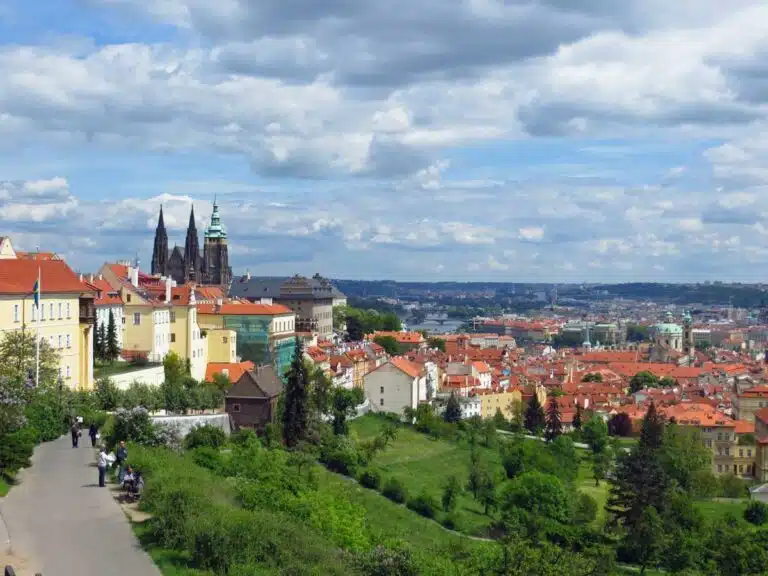
Prague is Central Europe’s most photogenic capital — Gothic spires and Baroque facades lining the Vltava River, with Prague Castle dominating the skyline from its hilltop above the city. But the postcard-perfect Old Town is only the start: Malá Strana’s bohemian streets, the riverside reinvention of Karlín, the elegant residential calm of Vinohrady and the haunting history of the Josefov Jewish Quarter each reveal a different version of the city. Beyond the neighbourhoods, Prague has one of Europe’s most significant Art Nouveau legacies in Alphonse Mucha, a contemporary art scene defined by the provocations of David Černý, and a recent history under Communist rule that the city addresses directly rather than glossing over. These guides cover Prague’s neighbourhoods, landmarks, museums and day trip options with practical information on ticket prices, opening hours and local insight on avoiding the city’s tourist traps.
Prague’s neighbourhoods
Prague’s character changes sharply from district to district — the bohemian charm of Malá Strana, the post-industrial creative energy of Karlín, the elegant calm of Vinohrady and the sombre weight of Josefov’s Jewish heritage are each distinct enough to merit dedicated exploration beyond a single pass through the Old Town.
- Malá Strana, Prague: a guide to the ‘Lesser Town’ — the bohemian district beneath Prague Castle, with cobbled lanes, Baroque churches and a creative atmosphere that includes the Franz Kafka Museum, the Karel Zeman Museum and the hidden Waldstein Garden.
- Franz Kafka Museum, Prague: prices, times and what it’s actually like — a deliberately unsettling exhibition exploring Kafka’s life and the Prague that shaped him, with theatrical lighting and sound design that puts visitors inside his psychological world rather than presenting a conventional biographical museum.
- Karel Zeman Museum, Prague: planning guide and visitor tips — a museum dedicated to the pioneering Czech filmmaker whose special effects techniques influenced Tim Burton and Terry Gilliam, with hands-on exhibits that let visitors try the trick photography and animation methods for themselves.
- Waldstein Garden, Prague: visiting hours, access and best times to visit — a hidden Baroque garden behind the Czech Senate building, with an artificial stalactite wall, peacocks roaming the grounds and a tranquillity that contrasts sharply with the crowds a few streets away.
- Karlín, Prague: the riverside comeback story — a former industrial district along the Vltava that has reinvented itself as one of Prague’s most creative neighbourhoods, with the twin-towered Church of Saints Cyril and Methodius standing as the area’s most striking landmark.
- The twin-towered church in Prague’s Karlín district: what is it? — the story behind the Church of Saints Cyril and Methodius, the neo-Romanesque landmark that dominates Karlín’s skyline and gives the regenerated district its most recognisable silhouette.
- Vinohrady: exploring Prague’s most elegant neighbourhood — a guide to the leafy streets, grand Art Nouveau apartment buildings and strong local food scene of this sophisticated residential district, popular with Prague’s expat community and largely overlooked by tourists.
- Josefov: the history of Prague’s Jewish Quarter — a practical guide to one of Europe’s best-preserved Jewish districts, with synagogues spanning several centuries and the deeply moving Old Jewish Cemetery, where graves are stacked in layers up to twelve deep.
Prague Castle and historic landmarks
Prague Castle is the largest ancient castle complex in the world, and its individual spaces — a Gothic chapel, a coronation hall, a colourful row of historic cottages — each warrant their own visitor guide. The Old Town Hall Tower, away from the castle, offers the definitive view over Old Town Square.
- St Wenceslas Chapel, Prague: visiting hours, tickets and planning tips — the jewel of St Vitus Cathedral, a 14th-century chapel decorated with semi-precious stones and medieval frescoes, housing the tomb of St Wenceslas and, on rare occasions, the Bohemian crown jewels themselves.
- Vladislav Hall, Prague: visiting hours, access and tickets — the late-Gothic heart of the Royal Palace within Prague Castle, famous for its extraordinary ribbed vaulted ceiling and a history that includes coronation banquets and, at one point, indoor jousting tournaments.
- Golden Lane, Prague Castle: a guide to the most colourful street — a row of tiny, brightly painted historic houses built into the castle fortifications, once home to castle guards, goldsmiths and — according to local legend — alchemists working under Rudolf II.
- Old Town Hall Tower, Prague: hours, tickets and tips for the best view of the Astronomical Clock — a climb to the top of the Old Town Hall for panoramic views across Old Town Square and the rooftops of historic Prague, with the famous Astronomical Clock visible from directly below.
Art, museums and culture
Prague’s cultural offer ranges from the high Art Nouveau of Alphonse Mucha to the deliberately provocative public sculpture of David Černý, by way of a sobering museum addressing the city’s Communist-era history and a wall of graffiti that has become an enduring symbol of peaceful resistance.
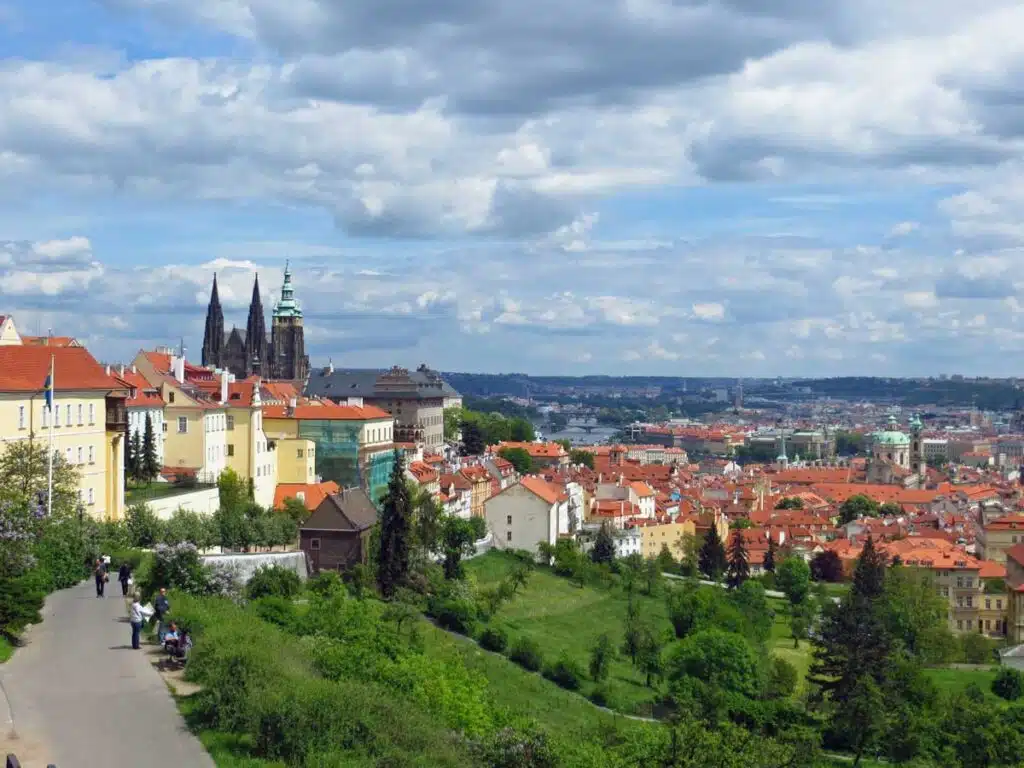
- Mucha Museum, Prague: visitor guide with ticket prices, hours and must-know tips — the world’s only museum dedicated to Alphonse Mucha, the Czech artist whose flowing, decorative style became synonymous with Art Nouveau, with original posters, paintings and a video on his life and influences.
- David Černý in Prague: where to find the ‘Peeing Statues’ — a guide to the city’s most provocative contemporary public art, including the animatronic figures urinating into a pool shaped like the Czech Republic, with directions to several other Černý works scattered across the city.
- David Černý’s giant crawling babies: where to see them in Prague — the faceless bronze infants that crawl up the Žižkov Television Tower and recline in Kampa Park, among the most photographed pieces of public art in the city.
- Museum of Communism, Prague: ticket prices, hours and top tips — a poignant museum exploring life under the post-WWII Communist regime in Czechoslovakia, covering propaganda, surveillance, the planned economy and the eventual collapse of the system in the 1989 Velvet Revolution.
- The Lennon Wall, Prague: opening hours, location and what it represents — an ever-changing wall of graffiti and Beatles-inspired lyrics that became a symbol of peaceful resistance under Communist rule and remains a living, constantly repainted monument to free expression.
- Prague Zoo: ticket prices, opening hours and visitor tips — consistently ranked among the best zoos in Europe, with a dramatic hillside setting above the Vltava, strong conservation programmes and a notable Przewalski’s horse breeding success story.
- Museum of Bricks, Prague: practical guide for first-time visitors — an unofficial LEGO museum with thousands of models and an enormous brick collection, a low-key but genuinely engaging stop for families and brick enthusiasts of any age.
- Kingdom of Railways, Prague: practical guide for first-time visitors — an extensive model railway exhibition recreating Czech landscapes and stations in miniature, with running trains and a level of detail that appeals well beyond the usual model railway audience.
- Story of Prague: practical guide for first-time visitors — a multimedia exhibition condensing 1,000 years of Prague’s history into an accessible narrative format, useful as an orientation point before exploring the city’s older sights in depth.
- Signal Space, Prague: practical guide for first-time visitors — an immersive digital art and light installation space, part of the wave of experiential attractions that have opened in Prague over recent years, reviewed for what it actually delivers.
Where to eat and drink in Prague
Prague’s Old Town Square is notorious for inflated tourist prices on indifferent Czech beer and food. These guides point toward where locals actually go.
- Where to drink in Prague: avoiding the tourist traps — where to find authentic Czech beer at honest prices, away from the inflated bars surrounding Old Town Square, with recommendations rooted in where Prague residents actually go.
- Four great places to eat and drink in Prague — a shortlist of genuinely recommended restaurants and bars across the city, selected for quality and value rather than proximity to the main tourist sights.
Day trips from Prague by train
Prague’s rail connections make several day trips genuinely viable, though some require more careful planning than others. These guides give an honest assessment of journey times and whether each trip is realistic within a single day.
- Prague to Olomouc by train: times, ticket prices and is it a feasible day trip? — logistics for visiting Moravia’s historic university city by rail, with an honest verdict on whether the round trip leaves enough time to do Olomouc justice.
- Prague to Český Krumlov: is there a direct train? — practical advice for reaching the Czech Republic’s most famous fairytale town from the capital, including the realistic connection options given the lack of a direct rail line.
- Berlin to Prague by train: is a day trip realistic? — a realistic assessment of the cross-border rail journey for travellers based in Berlin wondering whether Prague can be seen properly within a single day.
Planning your Prague visit
Prague’s historic centre is compact and walkable, though the cobblestones and hills around the castle are worth bearing in mind for those with mobility concerns. The Prague Card can offer good value for visitors planning to see several paid attractions, including parts of the castle complex. Old Town Square and the area immediately around the Charles Bridge carry significantly inflated prices for food and drink — venturing even a few streets away, into Vinohrady or Karlín, brings both better value and a more genuine sense of the city. Spring and autumn offer the most comfortable temperatures and noticeably smaller crowds than the peak summer months.
How many days do you need in Prague?
Three to four days covers Prague’s main neighbourhoods and the castle without rushing. A first day suits the Old Town and the Old Town Hall Tower. A second day works well for Prague Castle in the morning and Malá Strana in the afternoon. A third day suits Josefov and Vinohrady or Karlín, depending on which neighbourhood character appeals more. A fourth day allows a day trip to Český Krumlov or Olomouc for those who want to see beyond the capital.
Is Prague worth visiting beyond the Old Town?
Emphatically yes. The Old Town is beautiful but increasingly overwhelmed by tourism, and neighbourhoods like Vinohrady, Karlín and Žižkov offer a more genuine sense of how Prague actually lives, eats and drinks. Visitors who venture beyond the main sights consistently report a richer experience and significantly better value for money.