
Raglan Castle is a late-medieval fortress-palace crowning a ridge near the village of Raglan in Monmouthshire, Wales. This guide covers opening hours, ticket prices, transport or parking, accessibility, and practical visitor tips.
This guide was last updated in September 2026. Cadw’s Women Through the Ages campaign currently spotlights Gwladys ferch Dafydd Gam, known as the Lady of Raglan Castle, with new content added to the site in August 2026.
Current admission, valid from 1 September 2026 to 31 March 2027, costs £10.40 for an adult. Booking online saves a further 5%.
Quick facts
| Detail | Information |
|---|---|
| Opening hours | Daily 9.30am–5pm (1 September–31 October 2026); last admission 30 minutes before closing |
| Ticket price | Adult £10.40; under 5s free; Cadw members free |
| Address | Castle Rd, Raglan, Usk NP15 2BT |
| Nearest transport | Bus route 60 (Newport–Monmouth) stops in Raglan village |
| Typical time needed | 1.5 to 2 hours |
Raglan Castle opening hours
The castle is open daily, with hours changing through the year. From 1 September to 31 October 2026, it is open 9.30am to 5pm, with last admission 30 minutes before closing.
Hours extend to 9.30am–6pm in July and August, and shorten to 10am–4pm from November to February. The castle closes only on 24, 25, and 26 December, and on 1 January.
Raglan Castle ticket prices
From 1 September 2026 to 31 March 2027, standard adult admission costs £10.40. A family ticket for two adults and up to three children costs £33.30, or £22.90 for one adult and up to three children.
Seniors aged 65 and over pay £9.30, and juniors aged 5 to 17 or students with photo ID pay £7.20. Disabled visitors and one companion enter free, as do Cadw members and children under 5.
Ticket prices were checked against the official Cadw website, last updated in September 2026. Booking online saves an extra 5%, and visitors on Universal Credit or other named benefits can buy a £1 ticket.
Blue Light Card holders and serving or veteran members of HM Armed Forces receive 10% off individual admission, though this discount is not available online. Raglan Castle is covered by Cadw’s Explorer Pass, which gives access to sites across Wales for 3 or 7 consecutive days.
School groups can arrange a free, self-led educational visit through Cadw’s dedicated bookings page. As a Cadw site, Raglan Castle is not part of English Heritage or National Trust membership schemes.
How to get to Raglan Castle
By road, the castle is reached via the A40, and is well signposted from the village of Raglan. The nearest railway station is Newport, about 30km or 19 miles away, on the Cardiff to Bristol, Birmingham, London, and Manchester lines.
Bus route 60, running between Newport and Monmouth roughly every two hours, stops in Raglan village. Cyclists can use National Cycle Network Route 423, which passes within 1km of the castle.
Visitors travelling from Cardiff or Bristol can reach Raglan in well under an hour by car via the M4 and A40. Traveline Cymru can help plan connecting bus journeys from Newport or Monmouth.
Parking at Raglan Castle
A grassed car park within the castle grounds holds around 120 cars, though there is no dedicated accessible parking. Two Type 2 electric vehicle charging points are available, with charges applying for their use.
A café serving the castle stands about 300 metres, or a 5-minute walk, away. This café is independently run rather than operated by Cadw, so opening times should be checked directly with them.
Free public WiFi is available across the castle grounds, useful for checking the café’s current hours or looking up bus times on arrival.
How long to spend at Raglan Castle
Most visitors spend 1.5 to 2 hours exploring the Great Tower, gatehouse, and surviving garden terraces. History enthusiasts keen to see every corner may want to allow closer to three hours.
Picnic tables on site make it easy to combine a visit with lunch in the castle grounds. Many visitors pair Raglan with a trip to nearby White Castle or Monmouth Castle on the same day.
Accessibility at Raglan Castle
Cadw rates the terrain at Raglan as Level 3, or moderate difficulty, with lawns, gravel, and cobbled areas inside the monument. Steps throughout the castle mean wheelchair access is limited.
A portable induction loop is available, and one accessible toilet is located at the rear of the visitor centre. Mobility scooter users should check that their equipment suits rough or uneven ground before visiting.
Low walls around the moat and bowling green carry a fall risk, and supervised children should be kept away from these edges. Visitors with specific access questions can contact the castle team by phone or email before travelling.
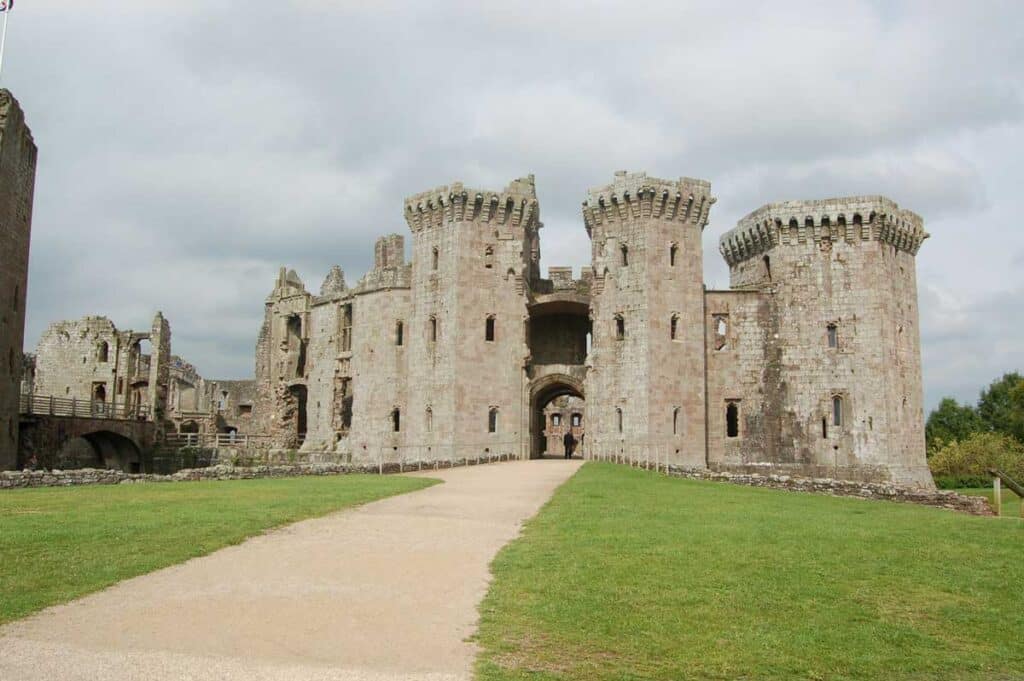
Inside Raglan Castle
Sir William ap Thomas, known as the ‘blue knight of Gwent’, began Raglan’s moated Great Tower in 1435. His son, Sir William Herbert, Earl of Pembroke, later added the castle’s gatehouse, with its distinctive flared machicolations designed to let defenders drop missiles on attackers below.
Raglan was built around 150 years after the height of castle-building in Wales, so it was designed to impress as much as to defend. Under successive Earls of Worcester, the castle grew into a fashionable country seat, with a long gallery and one of the finest Renaissance gardens in Britain.
During the Civil War, this Welsh castle held out under a garrison of 800 men in one of the conflict’s longest sieges. It ultimately fell to Parliamentary forces, who deliberately slighted the castle to prevent further military use.
A rare survival from this period is a piece of Tudor wooden panelling, looted during the siege and later rescued from a cow shed in the 1950s. It is now proudly displayed in the visitor centre.
Cadw’s Women Through the Ages campaign currently highlights Gwladys ferch Dafydd Gam, known as the Lady of Raglan Castle, whose story is woven through Welsh medieval history and folklore. New interpretation panels and online content explore her connection to the castle.
Beyond the main towers, visitors can still trace the remains of formal garden terraces at the rear of the castle. These hint at the scale of the Renaissance-style grounds that once surrounded the fortress-palace.
Practical visitor tips
| Tip | Detail |
|---|---|
| Timing | Visit on a weekday morning for the quietest experience, especially outside school holidays. |
| Crowds | Weekends and school holidays bring the largest number of visitors to the site. |
| Layout | Start at the Great Tower before exploring the gatehouse, hall, and garden terraces. |
| Entry process | Buy tickets on arrival or book online in advance to save 5%. |
| On-site logistics | Wear sturdy shoes, since paths to the rear of the castle can be muddy and involve several steps. |
Frequently asked questions about Raglan Castle
| Question | Answer |
|---|---|
| Is Raglan Castle free to visit? | No, standard adult admission costs £10.40, though several groups qualify for free entry. |
| Do you need to book tickets in advance for Raglan Castle? | No, though booking online saves 5% on the ticket price. |
| Is Raglan Castle open every day? | Yes, except 24, 25, and 26 December and 1 January. |
| Are dogs allowed at Raglan Castle? | Yes, on short leads, on the ground floor levels of the site. |
| Is Raglan Castle suitable for children? | Yes, with family tickets available and picnic tables on site. |
Things to do near Raglan Castle
- Raglan village: a small Monmouthshire village with shops and pubs close to the castle.
- Hen Gwrt Medieval Moated Site: a well-preserved moat protecting a vanished manor, a short drive away.
- Clytha Park and Arch: an 18th-century landscaped park with a striking mock-medieval arch.
- Usk: a market town on the River Usk with a ruined castle and priory church.
- The Kymin: a hilltop landscape with a Naval Temple and Round House, near Monmouth.
Alternative attractions
- White Castle: one of the best-preserved of the Three Castles, about a 15-minute drive away.
- Monmouth Castle: the birthplace of King Henry V, roughly an 18-minute drive away.
- Skenfrith Castle: a substantial medieval fortress with a central round tower, around a 20-minute drive away.
- Chepstow Castle: Britain’s earliest surviving Norman stone castle, about a 22-minute drive away.
- Tintern Abbey: a roofless Cistercian abbey beside the River Wye, roughly a 25-minute drive away.
More Wales travel
Other Wales travel guides on Planet Whitley include:
- Cardiff Castle: what first-time visitors should expect.
- Key information for visiting Llandaff Cathedral in Cardiff.
- Getting the most out of Caerphilly Castle – the second biggest castle in Britain.
- What to expect at the Meadows Wildlife Park in Caerphilly.
- How to get the best out of a visit to Pembroke Castle.

