Rotterdam is a city that looks forward rather than back, with bold architecture replacing what was lost in wartime bombing. This guide explores its most striking buildings, waterfront developments and creative urban spaces.
Arrival at Rotterdam Centraal and first impressions of the city
Stepping out of Rotterdam Centraal station feels like exiting the Netherlands. Gone are the low-rise medieval town centres, windmill-specked fields and red brick houses, to be replaced by something that reaches for the future rather than the past.
To the left, the mirrored glass of the Delftse Poort building reflects the fluffy white clouds. Behind, the gleaming metal, distorted chevron roof of the station brings to mind a sportswear logo. It’s somewhere between the Speedo emblem and an upturned Nike swoosh.
After nigh-on a decade of construction, the new-look Rotterdam Centraal is more in fitting with a city skyline that has embraced the new, the inventive and often the downright weird.
Hester Poortinga, an architect who runs cycling tours for Urban Guides in her spare time, says the point of the roof is very deliberately placed. “It points towards the city,” she says.
Why Rotterdam looks so modern after World War II
While Amsterdam has always had its sleeves rolled up to paint, Rotterdam has had them up in the interests of hard work. “The saying has always been that you make it in Rotterdam, then sell it in Amsterdam,” says Hester.
Unfortunately, being so industrious made it a prime target for the Germans in World War II, and the city was brutally blitzed on May 14th, 1940.
The merciless bombing campaign left around 85,000 people homeless and almost entirely destroyed the historic city centre. In the 70 years since, Rotterdam has had the choice to rebuild as-was or do something new – and it has repeatedly come out in favour of the latter.
The second factor in the city’s look is the port – Rotterdam’s is the largest in Europe. But the port operations are no longer in the city centre – they’ve had to move around 40km away in order to accommodate huge, modern container ships. This, again, created huge holes to fill and massive spaces to reinvent.
Modern architecture highlights along the Rotterdam waterfront
Cycling towards the waterfront, it’s telling that Hester doesn’t think it worth mentioning Calypso, an apartment building with exterior panels alternating in different directions to make the whole edifice look like it’s rippling water. It owes a lot to Frank Gehry’s Dancing Building in Prague, although it is the work of English architect Will Alsop. Anywhere else, this would be a massive talking point. Here, it’s merely one of a herd.
Many of the big name additions to the skyline are clustered on the Wilheminapier, historically the departure point for European migrants heading for a new life in America. They left from what is now the Cruise Terminal, which has been smartened up considerably. The port trappings that were once alongside it, however, have given way to limelight-seeking towers from the likes of Sir Norman Foster and Renzo Piano.
Piano’s is the most interesting, with its leaning glass façade designed to lean at the same angle as the Erasmus Bridge that it stands next to. The bridge, with cables sprouting forth from its elegantly slender, white support pylon, has been nicknamed “The Swan” and gleefully adopted as symbol of the city.
A new addition is De Rotterdam, a collection of offices, apartments and restaurants finished in 2013 by local firm OMA. “They wanted to prove it’s possible to do high rise without it being narrow,” says Hester.
Like so many of Rotterdam’s buildings, it rewards those taking the time to look at it from different angles. At first glance, it seems like a somewhat top-heavy amorphous blob. But keep going along the water front and it becomes obvious that it’s a collection of three towers, all with blocky bulges pointing in different directions. It’s delightfully Tetris-y.
Cube houses and Overblaak architecture in Rotterdam
But if it’s bizarre blockiness, you’re after, the Overblaak development is the place to head to. “In the 1980s, the authorities wanted to connect the Old Harbour to the city centre, and a major road was in the way,” explains Hester.
So Piet Blom, who had worked on a couple of smaller projects elsewhere in the country, was called in. And, partially inspired by the Ponte Vecchio in Venice, he set to work making a bridge with houses on it.
Those houses weren’t exactly conventional though. The bridge ended up dotted with a series of 38 large cubes, rotated at an angle of 53.5 degrees, seemingly standing on top of poles. It’s something of an illusion – one of the cubes has been turned into the Kijk-Kubus Museum, where it becomes quickly apparent that they’re actually three-sided pyramids inside. But you’d struggle to find a home that’s more strikingly odd.
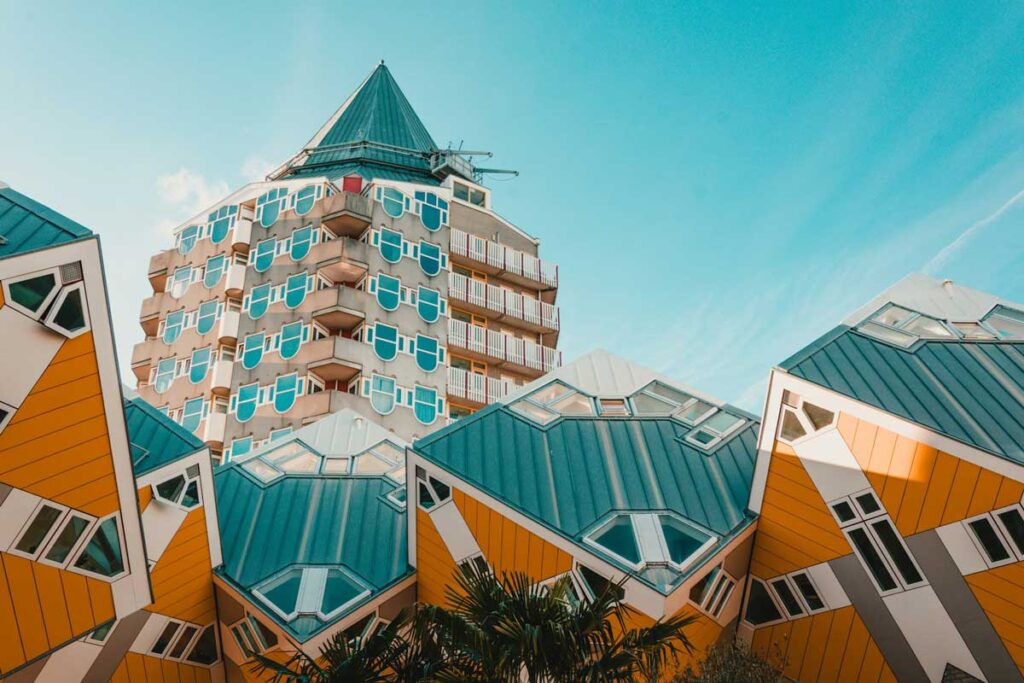
Next to the Cube Houses is another of Piet Blom’s creations, The Blaaktower – although it is known as The Pencil tue to its stubby body and sharpened tip. And opposite is Rotterdam’s new baby.
Market hall Rotterdam architecture and interior artwork
The new Market Hall opened in October 2014, and it has the appearance of a gigantic horseshoe-shaped tube. Some see a sharpener for The Pencil, others an apple-corer, others one of those cylindrical liquorice allsorts.
An ultra-clear glass has been used for the facades, while apartments have been built in the curve around the market itself. Each has a window looking over the stalls.
Most remarkable is the defiantly populist interior decoration. Arno Coenen’s shamelessly bold, colourful 11,000 square metre artwork covers the walls and ceiling. It’s uncomplicated in the detail – just supersized, somewhat psychedelic images of fruit and animals. The lack of subtlety is rather glorious.
Urban regeneration and the Luchtsingel bridge project
But for all the obvious stand-outs, perhaps Rotterdam’s most admirable piece of new architecture is something that would be very easy to miss. The Hofplein roundabout to the east of Centraal Station isn’t exactly a place of unbridled loveliness. Big main roads converge, brutalist buildings surround, and railway lines run behind. But local urban landscaping firm ZUS decided the area shouldn’t be a write-off.
The Urban Guides building is inside an ugly old building that has been rebranded as Test Site Rotterdam. Small creative businesses, dance schools and clubs have moved in, and the permanently buzzing Rotterdam Biergarten – all benches and shipping containers – has set up outside.
On the other side of the train tracks, some of the city’s coolest restaurants have set up in the old railway arches.
To join all of this together, ZUS has built a sprawling, multi-tentacled wooden bridge that goes through buildings and drops down in all the spots that would otherwise require a significant detour.
“What makes it so remarkable,” says Hester, “is that they didn’t have a client. The architects looked for a solution to a problem, then worked out how to fund it rather than waiting to be asked.”
The source of that funding becomes clear looking at the thousands of wooden planks forming the sides of the bridge. Each has the name of a company or individual on it – the engraving purchased at the cost of 25 euros each.
And for all the gleaming towers and double-take inducing architectural statements, thousands of crowdfunded planks of wood end up being the defining figurehead of Rotterdam’s red-hot rebuild.
Nearby attractions in Rotterdam
- Erasmus Bridge: The city’s best-known modern landmark, linking the northern and southern districts with striking design.
- Markthal Rotterdam: A combined food hall and residential building with a vast interior artwork ceiling.
- Cube Houses Museum: One of the tilted cube homes open to visitors, showing the unusual interior layout.
- Old Harbour (Oude Haven): A historic waterfront area surrounded by bars, restaurants and historic ships.
- Wilhelminapier: A redeveloped docklands area packed with contemporary architecture and skyline views.
Rotterdam architecture FAQ
Why is Rotterdam so modern?
The city centre was largely destroyed during World War II bombing in 1940, leading to widespread redevelopment with modern architecture rather than historical reconstruction.
What are the Cube Houses in Rotterdam?
The Cube Houses are tilted residential buildings designed by architect Piet Blom, built in the 1980s as part of a bridge-like development over a road.
What is the Market Hall in Rotterdam?
The Market Hall is a large indoor food market combined with apartments, known for its arched structure and colourful interior artwork.
Where is the best area to see modern architecture in Rotterdam?
The Wilhelminapier and waterfront areas offer clusters of contemporary buildings, including towers by leading international architects.
What is the wooden bridge in Rotterdam?
The Luchtsingel is a crowdfunded pedestrian bridge designed to reconnect parts of the city and support urban regeneration.
More Netherlands travel
Other Netherlands travel articles on Planet Whitley include:
- Three Dutch cities worth visiting beyond Amsterdam and Rotterdam.
- How to see Vermeer’s The Girl With the Pearl Earring at the Mauritshuis in Den Haag.
- First-time visitor’s guide to the Maritime Museum in Rotterdam.
- See the finest castle near Amsterdam – Muiderslot in Muiden.
- Discover the history of smoking and tobacco culture at the Amsterdam Pipe Museum.