The Smithsonian National Museum of Natural History is a large scientific and cultural facility located on the National Mall in Washington DC. This guide covers opening hours, ticket prices, transport or parking, accessibility, and practical visitor tips.
The information in this guide was updated in May 2026 to coincide with the opening of the new “Bison: Standing Strong” permanent exhibition, confirming that the museum still does not require timed entry passes for general admission.
Quick facts
| Feature | Details |
| Opening hours | Open daily from 10:00 AM to 5:30 PM. |
| Ticket prices | Free entry (£0 / $0). |
| Address | 10th Street and Constitution Avenue NW, Washington, DC 20560. |
| Nearest public transport or parking | Federal Triangle Metro station or Smithsonian Metro station. |
| Typical time needed to visit | 3 to 4 hours. |
Smithsonian National Museum of Natural History opening hours
The Smithsonian National Museum of Natural History is open to the public daily from 10:00 AM to 5:30 PM. Visitors can access all permanent exhibition halls during these standard hours throughout the entire year. The facility operates on this consistent schedule with only one closure date, which is Christmas Day on the 25th of December.
5 Washington DC experiences worth booking
- 🏛️ Take a behind-the-scenes tour of the US Capitol Building, with the Library of Congress or Supreme Court included.
- 🏡 Combine George Washington’s Mount Vernon with Old Town Alexandria on a history-packed day tour.
- 🕊️ Take a guided walking tour of Arlington National Cemetery, including the Changing of the Guard.
- 🚲 Visit the monuments and memorials of the National Mall on a bike tour that gets you closer than the bus routes.
- 🍽️ Go on a tasting tour of Georgetown’s top foodie highlights.
Smithsonian National Museum of Natural History ticket prices
There is no cost to enter the building, as Smithsonian National Museum of Natural History ticket prices are entirely free for all visitors. You do not need to purchase a ticket or reserve a timed entry pass to gain general admission. Opening hours and ticket prices were checked on the official website and last updated in May 2026.
How to get to the Smithsonian National Museum of Natural History
The most reliable way to reach the museum is by taking the Metrorail network to either the Federal Triangle or Smithsonian stations. The Federal Triangle station serves the Blue, Orange, and Silver lines and is located a short walk from the Constitution Avenue entrance. The Smithsonian station serves the same lines and provides direct access to the National Mall entrance.
Visitors can also arrive using the District of Columbia Circulator bus. The National Mall route stops directly outside the Constitution Avenue entrance on its continuous loop. Rideshare vehicles can safely drop passengers off along Constitution Avenue, but stopping on the National Mall side is heavily restricted.
Why book the Washington, D.C. Hop-On Hop-Off Trolley Tour?
- 🏛️ Over 15 Strategic Stops: Explore the nation’s capital at your own pace with a route that covers all the essentials, including the White House, the U.S. Capitol, and the Smithsonian museums.
- 🎤 Expert Live Narration: Skip the pre-recorded tracks and enjoy colorful, live commentary from professional guides who share the history, politics, and hidden secrets of D.C.
- 🎖️ Arlington National Cemetery Shuttle: Benefit from a seamless connection to the Arlington National Cemetery tour, making it easy to pay respects at the Tomb of the Unknown Soldier and JFK’s gravesite.
- 📸 Prime Memorial Access: Get dropped off directly near the Lincoln, FDR, and Martin Luther King Jr. Memorials, saving you miles of walking between the sprawling sites of the National Mall.
- 🕒 1 or 2-Day Flexibility: Choose a pass that fits your schedule, allowing you to linger at your favorite exhibits and simply catch the next trolley when you’re ready to move on.
Parking at the Smithsonian National Museum of Natural History
Parking at the Smithsonian National Museum of Natural History is extremely limited as the facility does not operate a dedicated visitor car park. Visitors arriving by car must rely on public metered street parking located along Constitution Avenue, Madison Drive, and Jefferson Drive. These on-street spaces are strictly enforced, generally restricted to two hours, and fill up rapidly.
For longer visits, the most practical solution is to use commercial parking garages located several blocks north in the Penn Quarter neighbourhood. Visitors can use digital parking applications to find and reserve paid spaces in private garages ahead of their journey.
How long to spend at the Smithsonian National Museum of Natural History
A typical visit to explore the major highlights of the museum takes between three and four hours. This timeframe allows visitors to walk through the central rotunda, navigate the extensive fossil halls, and view the major gem collections without rushing. Families with young children often find that three hours is a comfortable limit.
Visitors with a deep interest in natural sciences could easily spend a full day inside the building. There are no mandatory guided routes, allowing visitors to skip sections or linger in specific halls according to their own schedule.
Accessibility at the Smithsonian National Museum of Natural History
The facility is fully accessible to wheelchair users and those with mobility requirements via graded, sloped walkways at the National Mall entrance. Accessibility at the Smithsonian National Museum of Natural History includes step-free access to all public exhibition floors via numerous spacious elevators. The museum provides manual wheelchairs for visitors to borrow free of charge on a first-come, first-served basis.
Service animals are permitted throughout the entire building. The museum also offers visual descriptions, tactile exhibits, and induction loops in certain theatres. Fully accessible public restrooms are located on every floor of the building.
What to see at the Smithsonian National Museum of Natural History
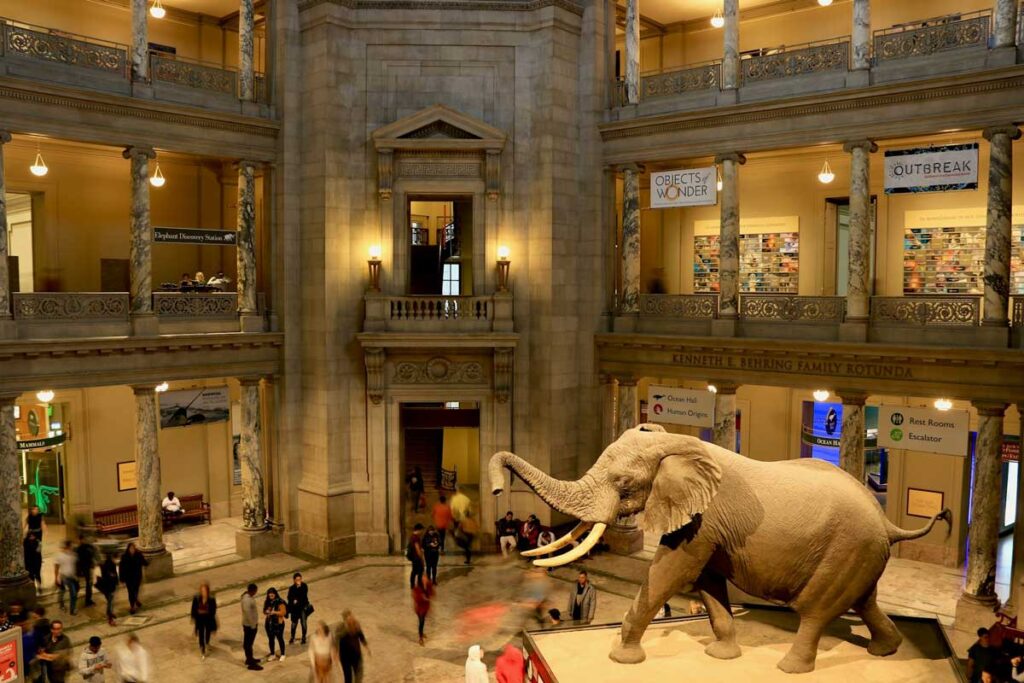
The visual centrepiece of the museum is the massive Rotunda on the main floor. This circular hall features a famous taxidermy African bush elephant named Henry standing on a raised platform. The rotunda serves as the primary navigation hub, connecting the various ground floor exhibition wings.
The David H. Koch Hall of Fossils explores the history of life on Earth. The gallery culminates in a dramatic display of a Tyrannosaurus rex posed as if consuming a Triceratops. This massive hall contains hundreds of authentic dinosaur skeletons, ancient marine reptiles, and early mammal fossils arranged in active poses.
The Janet Annenberg Hooker Hall of Geology, Gems, and Minerals houses an extensive collection of rare stones and meteorites. The most prominent object in this gallery is the Hope Diamond. This massive deep-blue diamond is displayed inside a rotating, secure glass vault for optimal viewing.
The Sant Ocean Hall features a highly detailed, 45-foot-long model of a North Atlantic right whale suspended from the ceiling. Visitors can view giant squid specimens preserved in fluid and explore exhibits detailing the complex ecosystems of the world’s oceans.
Opened in May 2026, the “Bison: Standing Strong” exhibition details the ecological history of the American mammal. The gallery traces the animal’s story from ancient times through its near-extinction. It concludes by highlighting modern conservation efforts restoring herds to the American prairie.
Practical visitor tips
| Category | Practical visitor tip |
| Timing | Arrive exactly at 10:00 AM when the doors open to experience the popular fossil halls before the large afternoon crowds arrive. |
| Crowds | Expect the highest concentration of visitors and school groups during the spring months and on rainy summer afternoons. |
| Layout | Pick up a free printed map at the information desks to help navigate the complex, multi-floor layout of the various halls. |
| Entry process | Use the Constitution Avenue entrance to access the building, as the security screening queues there are often shorter than those on the National Mall side. |
| On-site logistics | Bring a refillable water bottle to use at the drinking fountains, as outside food and beverages are not permitted in the exhibition halls. |
Frequently asked questions about the Smithsonian National Museum of Natural History
| Question | Answer |
| Is the Smithsonian National Museum of Natural History suitable for children? | Yes, the museum is highly suitable for children and features numerous interactive exhibits specifically designed for younger visitors. |
| Do you need to book tickets in advance for the Smithsonian National Museum of Natural History? | No, advance booking is not required because general admission is completely free and timed entry passes are not used. |
| Is the Smithsonian National Museum of Natural History open on Sundays? | Yes, the museum is open from 10:00 AM to 5:30 PM on Sundays and every other day of the week. |
| Are bags allowed at the Smithsonian National Museum of Natural History? | Yes, visitors can bring day bags inside, but they will be subject to a security search upon entry and there are no storage lockers. |
| Is food allowed inside the Smithsonian National Museum of Natural History? | No outside food is permitted in the galleries, but visitors can purchase meals at the cafes located on the lower level. |
Things to do near the Smithsonian National Museum of Natural History
- National Museum of American History: A massive museum located next door that houses cultural artefacts ranging from the original Star-Spangled Banner to pop culture memorabilia.
- National Gallery of Art: A comprehensive art museum located just across the mall, featuring extensive collections of European and American paintings, sculptures, and decorative arts.
- Washington Monument: A towering 555-foot stone obelisk located centrally on the mall that offers a ticketed observation deck with extensive city views.
- National Museum of African American History and Culture: A striking bronze-tiered building offering profound and comprehensive exhibits detailing the African American experience.
- United States Capitol: The historic meeting place of the United States Congress, located at the eastern end of the mall, offering free guided historical tours.
What to visit tomorrow
- National Air and Space Museum: A heavily renovated facility located further down the mall featuring historic aircraft, spacecraft, and extensive exhibits on aviation history.
- Steven F. Udvar-Hazy Center: A massive hangar facility located in Virginia housing thousands of aviation artefacts, including the Space Shuttle Discovery and an SR-71 Blackbird.
- National Museum of the American Indian: A curvilinear stone building on the mall dedicated to the culture, arts, and history of the native peoples of the Western Hemisphere.
- Maryland Science Center: A large interactive science museum located around an hour’s drive away in Baltimore‘s Inner Harbor, featuring a planetarium and dinosaur exhibits.
- National Aquarium: A major aquatic facility also located in Baltimore, housing thousands of marine animals in detailed habitats including a multi-story shark tank.
More Washington DC travel
Other Washington DC travel guides on Planet Whitley include:
- The most impressive memorials on the National Mall – including the Dr Martin Luther King Jr Memorial, Thomas Jefferson Memorial, Franklin D Roosevelt Memorial and Vietnam Veterans Memorial.
- Plan your visit to the United States Holocaust Memorial Museum.
- Guide to the National Building Museum in Washington DC.
- National Mall bus tour vs bike tour: What’s the best way to see Washington DC’s monuments and memorials?
- Plan your visit to Washington DC’s quirkiest sight – the National Capital Columns.