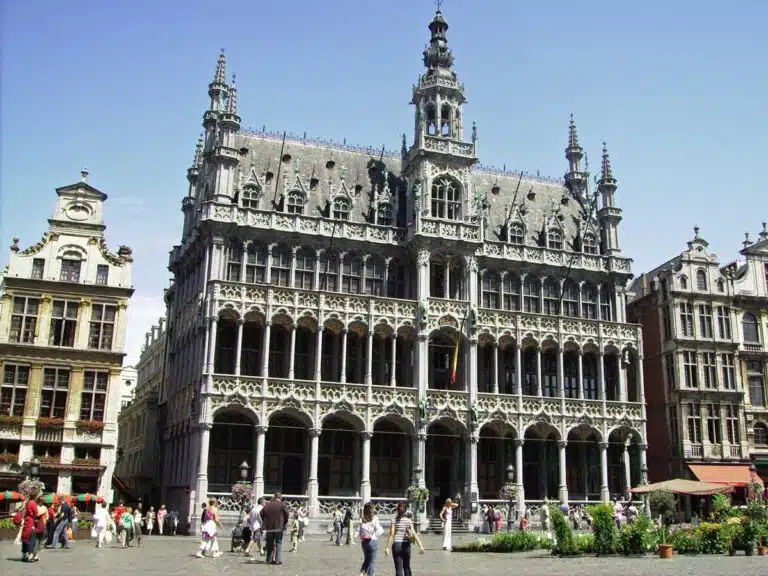
Belgium rewards visitors who look past the chocolate-and-beer reputation — though both are excellent reasons to go.
In a country smaller than Wales, you can move between a multilingual federal capital with Art Nouveau masterpieces and a comic strip heritage, a fashion-forward port city with one of the finest migration museums in Europe, a medieval Flemish city of guildhalls and an extraordinary altarpiece, and a coastal region that gives way inland to some of the most significant First and Second World War battlefields on the continent.
The trains between Belgian cities are fast and frequent, most Belgians speak excellent English, and the country’s museums tend toward substance over spectacle. These guides cover Brussels and Antwerp extensively, with dedicated articles on Ghent, Bruges, Liège and the battlefield museums of Flanders and the Ardennes.
Brussels: art nouveau, comic strips and Belgian identity
Brussels is one of Europe’s most underrated capitals — a city that functions simultaneously as the administrative heart of the EU and as a genuinely idiosyncratic Belgian city with its own Art Nouveau heritage, comic strip culture and culinary identity. These guides cover the city’s major attractions and experiences, from the Atomium to the Horta Museum to the best chocolatiers in the city.

- Brussels travel guide: is this Europe’s most underrated capital? — a comprehensive introduction to the city covering neighbourhoods, what to do, how to get around and why Brussels consistently surprises visitors who arrive with low expectations.
- Horta Museum Brussels: ticket prices, hours and visitor guide — the former home and studio of Victor Horta, the architect who defined Belgian Art Nouveau, preserved exactly as he left it and one of the most beautiful interiors in Europe, with sinuous ironwork, stained glass and mosaic floors throughout.
- Magritte Museum Brussels: ticket prices, opening hours and visitor guide 2026 — the world’s largest collection of work by René Magritte, in the neoclassical Place Royale, covering the full arc of the surrealist painter’s career across three floors of a building he knew well.
- Atomium Brussels: what first-time visitors should expect — the giant iron crystal structure built for the 1958 World’s Fair, with exhibition spaces in the spheres, panoramic views from the top and a design that remains one of the most distinctive pieces of 20th-century architecture in Europe.
- BELvue Museum Brussels: opening hours, ticket prices and accessibility guide — the museum of Belgian history in a former hotel adjacent to the Royal Palace, covering the country’s complex story from independence in 1830 to the present day, with strong exhibitions on the Congo and Belgium’s colonial legacy.
- Autoworld Brussels: what first-time visitors should expect — a collection of over 250 historic vehicles in the spectacular Palais du Cinquantenaire, covering the full history of the automobile from the 1880s to the present day in one of Brussels’ grandest exhibition spaces.
- The Tintin trail in Brussels: following Belgium’s most beloved comic strip hero — how to find the murals, the museum connections and the Hergé-related locations scattered across the city, as part of Brussels’ broader comic strip heritage that covers dozens of characters across the city’s walls.
- Manneken Pis, Brussels: a guide to visiting the city’s famous statue — what the small bronze boy actually looks like, why visitors are often surprised, what costumes he wears and when, and the broader context of a symbol that Belgians treat with a mixture of genuine pride and knowing self-deprecation.
- How to find the best chocolates in Brussels — the difference between Belgian praline traditions and tourist-trap chocolate shops, with guidance on the chocolatiers worth seeking out and the streets and galleries where the best of them are concentrated.
- AfricaMuseum, Tervuren: A practical guide with times and prices: Why it’s worth taking the tram out of Brussels to explore Belgium’s dark colonial heritage.
Antwerp: diamonds, migration stories and Flemish masters
Antwerp is Belgium’s second city and arguably its most stylish — a port city that was the commercial capital of the world in the 16th century, reinvented itself as a global diamond trading hub, and has more recently become one of Europe’s leading fashion cities. Its museums include the Red Star Line, which tells the story of the millions of emigrants who left Europe through Antwerp for America, and the Plantin-Moretus, a UNESCO World Heritage printing house that operated continuously for three centuries. These guides cover Antwerp’s major attractions, planning advice and transport connections.
- Why Antwerp is one of the most underrated cities in Europe — the case for Antwerp as a destination in its own right rather than a Brussels day trip, covering what makes it distinctive and why it consistently rewards visitors more than they expect.
- How to spend the perfect weekend in Antwerp — a two-day itinerary covering the cathedral, the Red Star Line Museum, the fashion district, the MAS rooftop and the best of the city’s restaurant and bar scene.
- Red Star Line Museum, Antwerp: the migration stories that shaped the modern world — the museum in the original Red Star Line warehouses where over two million emigrants were processed before boarding ships to America between 1873 and 1934, with family search tools and an emotionally powerful permanent exhibition.
- Plantin-Moretus Museum, Antwerp: visitor guide with hours and prices — a UNESCO World Heritage printing house and publishing dynasty, operating from the same Antwerp building from 1576 to 1876, with the world’s two oldest surviving printing presses and a library of extraordinary historic books.
- MAS Antwerp: prices, opening hours, what to see and transport guide — the Museum aan de Stroom on the edge of the old port district, with a free rooftop panorama over the Scheldt and the city, and wide-ranging permanent collections on Antwerp’s history as a global trading city.
- Antwerp Cathedral: what to see and when to visit — the largest Gothic church in the Low Countries, containing four major Rubens altarpieces including the Descent from the Cross, with guidance on the best times to visit to see the paintings properly and avoid the worst of the crowds.
- Five excellent reasons to visit Antwerp on a day trip — the case for Antwerp as a day trip from Brussels, Amsterdam or beyond, covering what can be done in a single day and what the city offers that its neighbours don’t.
- Amsterdam to Antwerp by train: ticket prices, journey time and day trip guide — the fast train connection between the two cities, with practical information on booking, journey time and how to structure a day trip from Amsterdam.
- Why it’s worth visiting Het Steen and the Brabo Fountain in Antwerp.
Ghent: medieval city, altarpiece and castle
Ghent is Belgium’s most underappreciated major city — larger and more lived-in than Bruges, with a medieval core that contains a 12th-century castle, one of the most significant paintings in Western art, and a cathedral whose crypt conceals centuries of artistic history. Less tourist-saturated than Bruges and less bureaucratic in reputation than Brussels, it rewards a day or two of unhurried exploration.
- St Bavo’s Cathedral, Ghent: ticket prices, opening hours and visitor guide 2026 — the home of the Ghent Altarpiece, Jan van Eyck’s 1432 polyptych considered one of the most important paintings in Western art, now displayed in a dedicated climate-controlled chapel after centuries of theft, looting and division.
- Gravensteen, Ghent: ticket prices, opening hours and visitor guide 2026 — the 12th-century Castle of the Counts in the heart of the city, with a moat, a torture chamber museum and rooftop views over the medieval roofline that reward the climb.
- Museum of Fine Arts (MSK) Ghent: complete visitor guide — one of the oldest fine arts museums in Belgium, with a collection spanning Flemish Primitives to 20th-century Belgian art and a recently renovated building that does justice to its holdings.
- Practical guide to climbing the Ghent Belfry.
Bruges and Liège: chocolate, belfries and urban revival
Bruges is Belgium’s most visited city outside Brussels — a UNESCO-listed medieval canal city that can feel overwhelmed by tourism in summer but retains its extraordinary character in the early morning and off season. Liège, by contrast, is one of the least-visited major Belgian cities, a French-speaking Wallonian city in industrial decline and urban reinvention that offers a more authentic and less polished Belgian experience.
- Bruges Belfry: ticket prices, opening hours and visitor tips — the 83-metre medieval bell tower that has dominated the Bruges skyline since the 13th century, with a climb of 366 steps rewarded by the finest views over the canal city and the Flemish countryside beyond.
- The history of Belgian chocolate at Choco-Story, Bruges — the chocolate museum in central Bruges, covering the full story of cacao from Mesoamerican origins to Belgian praline traditions, with live demonstrations and a tasting at the end.
- What you need to know before visiting the Groeninge Museum in Bruges.
- Plan your visit to the Bruges Historium.
- What to expect at the Church of Our Lady and Basilica of the Holy Blood in Bruges.
- Liège city guide for first-time visitors — an introduction to Belgium’s most overlooked major city, a French-speaking industrial city on the Meuse with a spectacular Sunday market, a strong café culture and an authenticity that more polished Belgian destinations lack.
Belgium’s battlefield heritage: Ypres and Bastogne
Belgium’s geography placed it at the centre of both world wars, and the museums that commemorate the fighting are among the most powerful and carefully curated in Europe. The In Flanders Fields Museum in Ypres covers the Western Front experience of the First World War; the Bastogne War Museum addresses the Battle of the Bulge in the winter of 1944. Both are substantial, well-designed institutions that require and reward a full day.
- In Flanders Fields Museum, Ypres: ticket prices, hours and visitor guide — the First World War museum in the rebuilt Cloth Hall of Ypres, the town that was completely destroyed between 1914 and 1918 and rebuilt stone by stone afterward, with an exhibition that follows individual soldiers’ experiences through the Salient.
- Bastogne War Museum: ticket prices, opening hours and visitor guide — the museum commemorating the Battle of the Bulge, Hitler’s last major Western Front offensive in the winter of 1944-45, with an immersive exhibition that follows four individuals — American, German, Belgian civilian and Belgian resistance fighter — through the fighting around this small Ardennes town.
- All the key information for visiting Bouillon Castle in the Belgian Ardennes.
Planning your Belgium visit
Belgium’s rail network is one of the most efficient in Europe, and the major cities — Brussels, Antwerp, Ghent, Bruges and Liège — are all connected by fast, frequent trains that make a car unnecessary for most itineraries. Brussels is the obvious base, with Antwerp 35 minutes away, Ghent 30 minutes and Bruges under an hour. Ypres and Bastogne are harder to reach by public transport and benefit from a hire car or a guided tour. The best time to visit is spring and early autumn; Bruges in particular becomes very crowded in July and August.
How many days do you need in Belgium?
Four to five days covers Brussels, Antwerp and Ghent or Bruges without rushing. A long weekend (three nights) works well for Brussels and one or two day trips. A week allows you to cover all four major cities and add either the Flanders Fields or Bastogne battlefield museums. Belgium suits a slow pace — the cities are compact and walkable, and the food and beer culture rewards those who factor in time to sit and eat rather than treating meals as an afterthought.
Is Belgium worth visiting?
Consistently underrated and consistently surprising. Belgium punches well above its size for art, architecture, food, beer and historical significance, and its cities are far less crowded and expensive than their equivalents in France, the Netherlands and Germany. The country’s linguistic complexity — French in Wallonia, Dutch in Flanders, German in the east — gives it a cultural depth that rewards those who engage with it rather than treating it as a transit point between more famous neighbours.