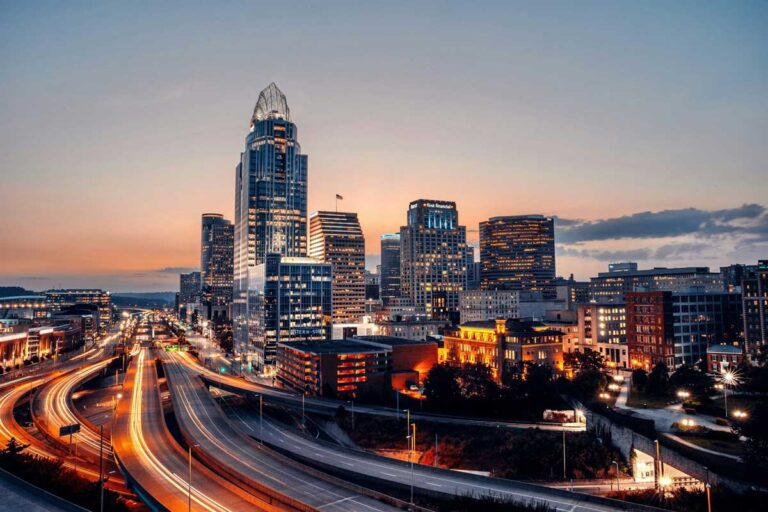
Cincinnati sits on the north bank of the Ohio River at the point where Ohio, Kentucky and Indiana converge — a position that shaped its identity as a Civil War-era freedom gateway for enslaved people crossing from the South, and as the birthplace of a US President and the country’s oldest professional baseball team. The city’s Over-the-Rhine neighbourhood is the largest intact historic urban district in the United States; the National Underground Railroad Freedom Center is one of the most important civil rights museums in the country; and the American Sign Museum is one of the most genuinely surprising specialist museums anywhere in America. These guides cover Cincinnati’s key attractions with practical information on ticket prices, opening hours and what to expect on arrival, alongside road trip guides for the most popular routes to and from the city.
History, civil rights and presidential heritage
Cincinnati’s position on the Ohio River — the boundary between the free states of the North and the slave states of the South — made it a critical node in the Underground Railroad network and the setting in which Harriet Beecher Stowe absorbed the experiences that would shape Uncle Tom’s Cabin. The city is also the birthplace of William Howard Taft, the only man to serve as both US President and Chief Justice of the Supreme Court. These three sites between them cover some of the most significant threads in 19th-century American history.
- National Underground Railroad Freedom Center, Cincinnati: ticket prices, hours and visitor tips — a civil rights museum on the Ohio River waterfront telling the story of the Underground Railroad and the broader struggle for human freedom, with a restored slave pen from a Kentucky farm among the most powerful original artefacts, alongside exhibitions covering modern slavery and human trafficking that extend the story to the present day.
- Harriet Beecher Stowe House, Cincinnati: ticket prices, hours and visitor tips — the Federal-style house in the Walnut Hills neighbourhood where Harriet Beecher Stowe lived when she witnessed the conditions of enslaved people across the river in Kentucky and began forming the experiences that led to Uncle Tom’s Cabin — the novel that Abraham Lincoln is said to have credited with starting the Civil War.
- William Howard Taft National Historic Site, Cincinnati: ticket prices, hours and visitor tips — the restored Greek Revival birthplace of William Howard Taft, the 27th President of the United States and the only person in American history to serve as both President and Chief Justice of the Supreme Court, managed by the National Park Service with free admission and guided tours.
Art, sport, culture and a Kentucky day trip
Beyond its historical significance, Cincinnati has a strong cultural offer — a free art museum in the Eden Park hilltop gardens, a specialist museum dedicated to the history of American signage that is far more compelling than it sounds, and the hall of fame of the oldest professional baseball team in the United States. Just across the Ohio River in northern Kentucky, a state historic site preserves the ground where Ice Age megafauna came to lick the salt and left one of the most significant Pleistocene fossil deposits in North America.
- Cincinnati Art Museum: visitor guide with ticket prices, hours and tips — a free encyclopaedic art museum in Eden Park overlooking the Ohio River, with a permanent collection of over 67,000 works spanning 6,000 years, from ancient Egyptian artefacts and European old masters to a particularly strong collection of decorative arts and fashion.
- American Sign Museum, Cincinnati: ticket prices, hours and visitor tips — the only museum in the United States dedicated to the history and art of American commercial signage, tracing the evolution of signs from 19th-century hand-painted trade boards through neon, plastic and LED to the present day, in a warehouse in Camp Washington that consistently surprises visitors who arrive with low expectations.
- Cincinnati Reds Hall of Fame and Museum: complete guide with prices, hours and tips — the museum at Great American Ball Park celebrating the history of the Cincinnati Reds — the oldest professional baseball team in the United States, founded in 1881 — with memorabilia, interactive exhibits and the stories of the Big Red Machine era that produced some of the finest teams in Major League Baseball history.
- Big Bone Lick State Historic Park, Kentucky: hours, admission and visitor tips — a state historic site in northern Kentucky, less than 30 miles from Cincinnati, where a saltwater spring attracted mastodons, woolly mammoths and giant ground sloths during the Pleistocene epoch, leaving one of the most significant Ice Age fossil deposits in North America, now a park with a museum, live bison and accessible walking trails.
- Guides to state parks near Cincinnati: Stone Lick State Park and East Fork State Park.
Road trips to and from Cincinnati
Cincinnati’s position at the junction of Ohio, Kentucky and Indiana — and its location midway between the Midwest’s major cities and the mid-South — makes it a natural road trip hub. Columbus, Louisville and Indianapolis are all within two hours; Nashville, Pittsburgh and Philadelphia are a comfortable day’s drive. These guides cover eight of the most popular routes, with best stops, distances and realistic drive times.
- Columbus to Cincinnati drive: best stops, distance and drive time — the drive southwest along the I-71 corridor through the Ohio heartland, with Chillicothe and the Hopewell Culture National Historical Park as natural stops on a route connecting two of Ohio’s most historically significant cities.
- Louisville to Cincinnati drive: best stops, distance and drive time — the drive northeast along the I-71 corridor through northern Kentucky, with the Big Bone Lick State Historic Park as the most rewarding detour on a short route connecting two Ohio River cities.
- Nashville to Cincinnati drive: best stops, distance and drive time — the drive north from Music City through Kentucky, with options to detour through Mammoth Cave National Park, the Bourbon Trail and the Shaker Village of Pleasant Hill before crossing the Ohio River.
- Pittsburgh to Cincinnati road trip: best stops, distance and drive time — the drive southwest from western Pennsylvania through West Virginia or across Ohio, connecting two of the Ohio River valley’s most historically significant industrial cities.
- Philadelphia to Cincinnati drive: best stops, distance and drive time — the drive west through the Pennsylvania Appalachians, Pittsburgh and into Ohio, connecting the birthplace of American democracy with the Queen City of the West across a varied landscape of mountains, river valleys and Midwest farmland.
- Cincinnati to Cleveland road trip: best stops, distance and drive time — the drive north along I-71 the full length of Ohio, through Columbus and the Cuyahoga Valley National Park, connecting the state’s two most distinctive cities at opposite ends of the Lake Erie corridor.
- Cincinnati to Chicago road trip: best stops, drive time and distance — the drive northwest through Indiana toward the Lake Michigan shoreline, with options to slow down through Indianapolis, the Indiana Dunes National Park and the South Shore before the Chicago skyline appears.
- Cincinnati to Detroit drive: best stops, distance and drive time — the drive north through Ohio or northwest through Indiana toward the Motor City, connecting the Ohio River to the Great Lakes with stops that span Toledo‘s Art Museum, the Lake Erie islands and the approach to Michigan.
- The best stops on the New York City to Cincinnati drive.
Planning your Cincinnati visit
Cincinnati’s compact city centre and the Eden Park hilltop district are easily navigable on foot or by rideshare; a car is useful for reaching the American Sign Museum in Camp Washington and essential for Big Bone Lick across the river in Kentucky. The Cincinnati Art Museum is free to enter, making it one of the best-value half-days in any Ohio itinerary. The city’s most distinctive neighbourhood, Over-the-Rhine — a 19th-century German immigrant district with the largest concentration of Italianate architecture in the United States — is worth an evening for its restaurants and bars regardless of which attractions you visit. Spring and autumn are the most comfortable visiting seasons; summers are humid and winters can be cold with occasional significant snow.
How many days do you need in Cincinnati?
Two days covers Cincinnati’s main attractions comfortably. A first day works well for the National Underground Railroad Freedom Center and the Harriet Beecher Stowe House, with an evening in the Over-the-Rhine neighbourhood. A second day suits the Cincinnati Art Museum in the morning, the American Sign Museum in the afternoon and the Cincinnati Reds Hall of Fame if there’s a game on. A third day opens up a day trip to Big Bone Lick in Kentucky or a drive to Louisville.
What is Cincinnati best known for?
Cincinnati is best known for Cincinnati chilli — a distinctly spiced meat sauce served over spaghetti or hot dogs in a style unique to the city — the Cincinnati Reds, the Ohio River waterfront and the Over-the-Rhine neighbourhood’s 19th-century German heritage. Among historically minded visitors it is known for its Underground Railroad significance and as the birthplace of William Howard Taft. The American Sign Museum has developed a strong reputation as one of the most unusual and rewarding specialist museums in the Midwest.